6.13 - The Immune System
Physical and chemical barriers
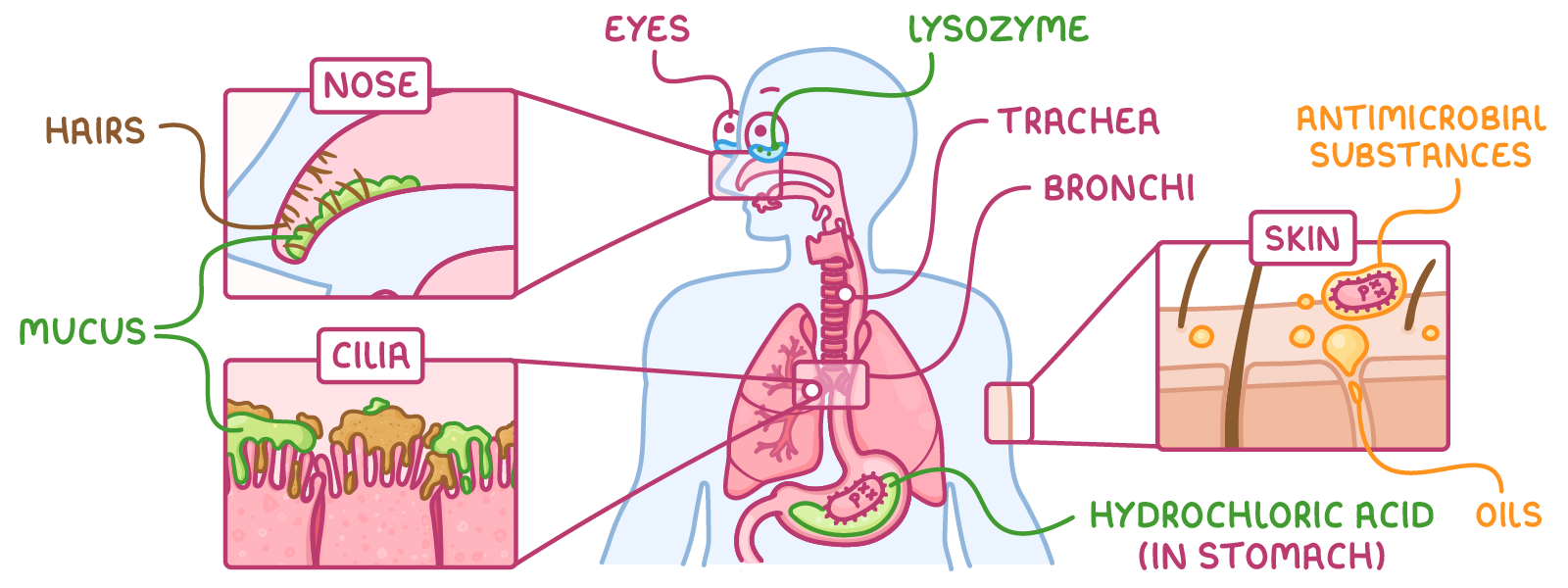
- The body's first line of defence is a set of barriers that stop pathogens getting inside in the first place.
- These work against many different pathogens rather than one in particular, so they're described as non-specific.
Physical barriers
- Skin - Covers most of the body and acts as a physical barrier that pathogens can't pass through. It also secretes oils and antimicrobial substances that kill pathogens on its surface.
- If the skin is cut, the blood clots quickly to seal the wound - keeping microorganisms out as well as stopping blood loss.
- Nose - Contains hairs and a layer of mucus that trap particles in the air before they can travel further.
- Trachea and bronchi - The airways down to the lungs are lined with mucus that traps pathogens, and with cilia (tiny hair-like structures on the cells).
- The cilia beat in a rhythm that wafts the trapped mucus up to the back of the throat, where it's swallowed and carried down to the stomach.
Chemical barriers
- Stomach - Produces hydrochloric acid, making the stomach contents strongly acidic. This kills most swallowed pathogens, whether they came in with food or in mucus from the airways.
- Eyes - Tears contain lysozyme, an enzyme that kills bacteria on the surface of the eye.
Phagocytosis
- When pathogens get past the body's barriers and into the body, the white blood cells of the immune system destroy them.
- White blood cells travel in the blood and move into the tissues, constantly patrolling for pathogens.
- One of their main defences is phagocytosis - carried out by white blood cells called phagocytes.
How a phagocyte destroys a pathogen
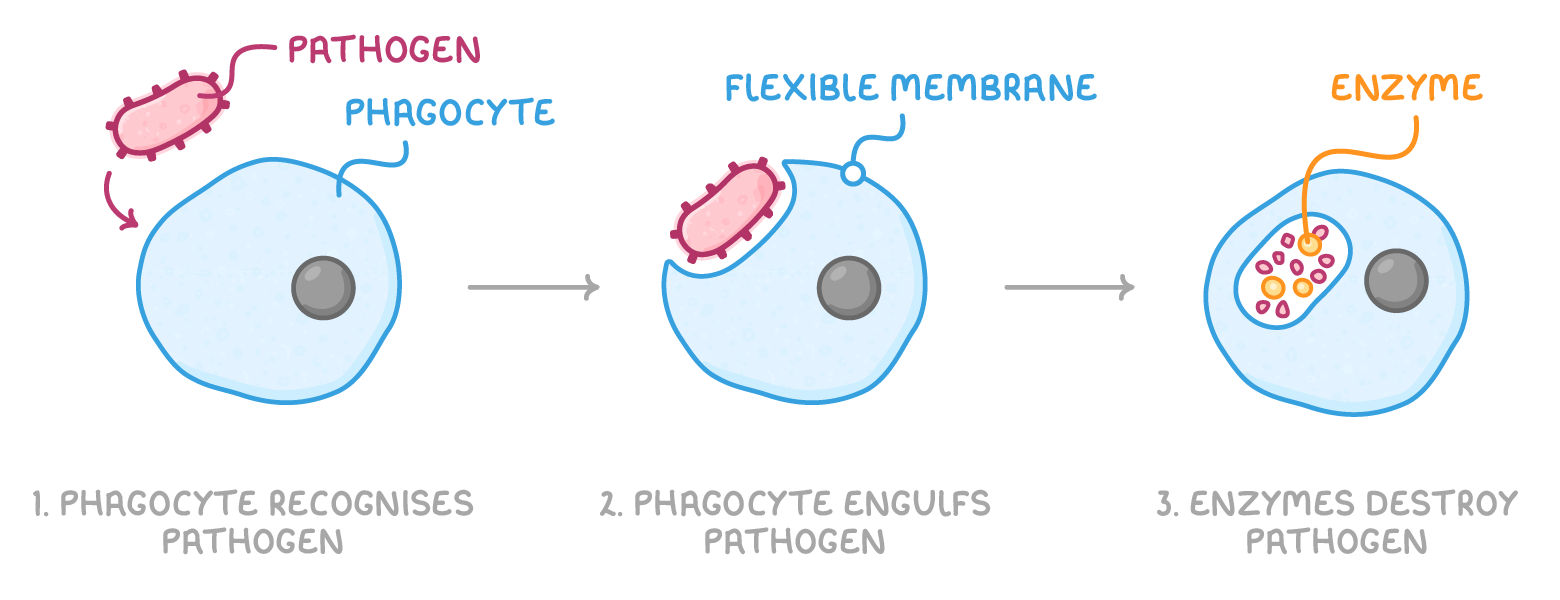
- The phagocyte tracks down a pathogen and binds to it.
- Its flexible membrane changes shape and wraps right around the pathogen, engulfing (surrounding) it and taking it inside the cell.
- Enzymes inside the phagocyte break the pathogen down and destroy it.
Key features of phagocytosis
- Non-specific - The same phagocyte can engulf many different kinds of pathogen, rather than acting against one in particular.
- Works alongside antibodies - Phagocytes more easily find and engulf pathogens that have been clumped together or marked by antibodies.
Antibodies and specificity
- As well as phagocytosis, white blood cells defend the body by producing antibodies, which deal with pathogens specifically.
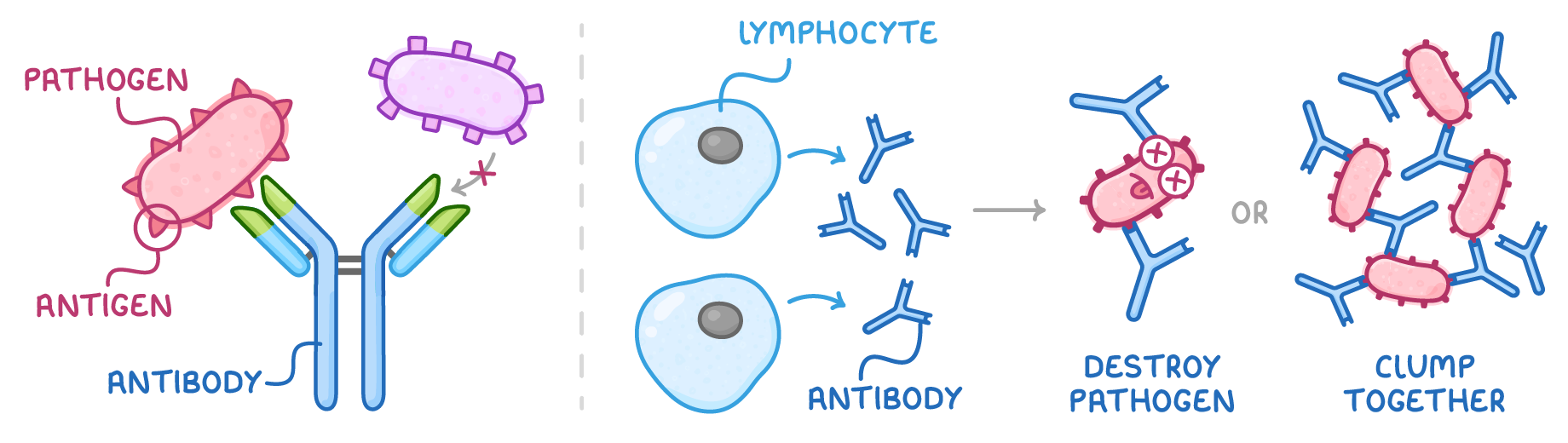
- Every pathogen has unique molecules on its surface called antigens, and each antigen has a particular shape.
Self vs non-self
White blood cells can tell the difference between the body's own cells and invaders:
- Antigens on the body's own cells are recognised as "self".
- Antigens on a pathogen are recognised as foreign, or "non-self".
How antibodies are made and how they work
- When white blood cells called lymphocytes meet a foreign antigen, they start to produce proteins called antibodies.
- An antibody has a shape that is complementary to a particular antigen, fitting it like a key in a lock - so each antibody binds to only one type of antigen and won't lock onto any others.
- The lymphocyte that recognises the pathogen then divides many times to make clones of itself, all producing the same antibody. This means antibodies are made rapidly and in large numbers and are carried all round the body.
- The antibodies bind to the antigens on the pathogens. This can:
- Destroy a pathogen directly, or
- Clump pathogens together and mark them out so that phagocytes find them more easily and engulf them.
Memory cells and the secondary response
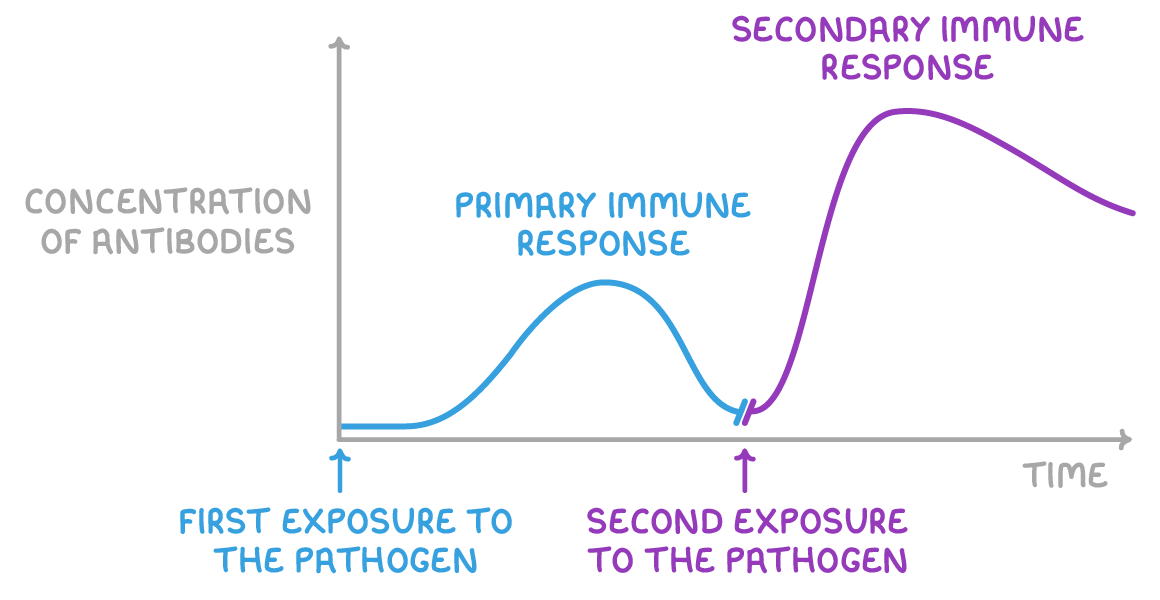
- The primary response is the immune response the first time a pathogen enters the body.
- It's slow because there are very few lymphocytes able to make the antibody that matches that pathogen's antigen, so it takes time to build up enough of the right antibody to clear the infection.
- During this delay, the person shows the symptoms of the disease.
Memory cells persist after infection
- As well as producing antibodies, the body makes memory cells (also called memory lymphocytes) in response to the antigen.
- They stay in the body for a very long time - often many years - after the infection has been cleared.
- They "remember" the specific antigen they were made against.
The secondary response
- If the same pathogen enters the body again, the memory cells recognise its antigen straight away.
- This triggers the rapid production of large amounts of the matching antibody.
- This secondary response is much faster and stronger than the primary response, so the pathogen is usually destroyed before it can multiply enough to cause symptoms.
- The person is then immune to that pathogen - their immune system can respond quickly enough to stop them becoming ill.
TermDefinition
PhagocytosisThe process by which a white blood cell engulfs and digests a pathogen.
PhagocyteA type of white blood cell that carries out phagocytosis.
AntigenA unique molecule on the surface of a cell or pathogen that the immune system can recognise.
AntibodyA protein produced by lymphocytes that binds to a specific antigen.
LymphocyteA type of white blood cell that produces antibodies.
Memory cellA white blood cell that remains in the body after an infection and responds rapidly if the same pathogen enters again.
Key points to remember
How were these notes?