7.13 - Investigating the Products of Respiration (Carbon Dioxide & Heat)
The experiment
Aim
To show that living, respiring organisms (here, germinating seeds) release carbon dioxide and give out heat, and that it's the respiration of the living seeds that does this, by comparing them with dead seeds.
Background
- Respiration releases energy from glucose inside living cells.
- In aerobic respiration, glucose reacts with oxygen to produce carbon dioxide and water. Some of the energy transferred is lost as heat.
- You can't see respiration happening, but you can measure the temperature rise it causes and test for the carbon dioxide it gives off.
- So in this practical you set up living germinating seeds and boiled, dead seeds in exactly the same way, and see which ones warm up and give off carbon dioxide.
Method
- Prepare two batches of seeds - Soak two batches of seeds, such as peas, so they start to germinate. Boil one batch to kill it and let it cool, then rinse both batches in disinfectant.
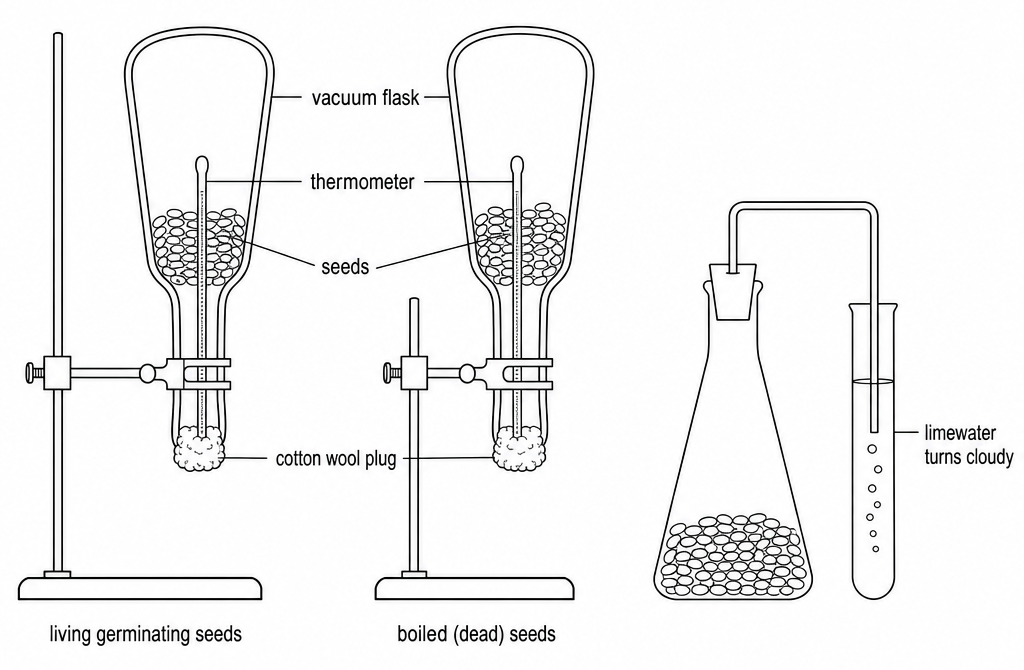
- Fill the vacuum flasks - Put the living seeds in one vacuum flask and the boiled seeds in another, each with a thermometer pushed in among the seeds.
- Plug and turn the flasks - Plug the neck of each flask with cotton wool and turn it upside down. Warm air rises, so this keeps the warmth from the seeds inside the flask, around the thermometer, and stops it escaping through the cotton wool.
- Record the temperatures - Record the temperature in each flask at the start and again after one to two days. The living seeds warm up, and the dead seeds don't.
- Set up the carbon dioxide test - Set up a flask of living seeds so that air is slowly drawn through it and then through limewater. Set up a matching flask of boiled seeds in the same way.
- Check the limewater - Leave both, then check the limewater. It turns cloudy if carbon dioxide has been produced. Hydrogencarbonate indicator can be used instead, which turns from orange-red to yellow when there's plenty of carbon dioxide.
Safety
- Hot water - Take care with the near-boiling water used to kill the seeds.
- Wash your hands - After handling the seeds and the disinfectant.
Common exam questions
Question 1
Why are boiled (dead) seeds used in the second flask?
They're a control. Dead seeds don't respire, so they should give off no heat and no carbon dioxide. This shows that the heat and carbon dioxide in the other flask come from the living seeds respiring.
Question 2
Why are both batches of seeds rinsed in disinfectant?
To kill any microbes on them. Microbes left on the seeds could respire themselves, warming the flask or giving off carbon dioxide, which would spoil the comparison.
Question 3
Why is a vacuum flask, rather than an open beaker, used to show the heat?
A vacuum flask insulates the seeds, so the small amount of heat released by respiration isn't lost to the surroundings, and the temperature rise is big enough to measure.
Question 4
Why is each flask plugged with cotton wool rather than a rubber bung?
Cotton wool lets gases pass through it, so oxygen can get into the flask for the seeds to respire, and the carbon dioxide they give off can get out. A rubber bung would seal the flask, so the seeds would run out of oxygen and carbon dioxide would build up inside.