6.6 - Benefits & Risks of GM
Benefits of GM crops
- Genetic engineering puts useful genes into crop plants so farming can produce more food, grow it in places it otherwise couldn't, and make it more nourishing.
- The main benefit is a higher yield - more food from the same area of land.
Higher yield
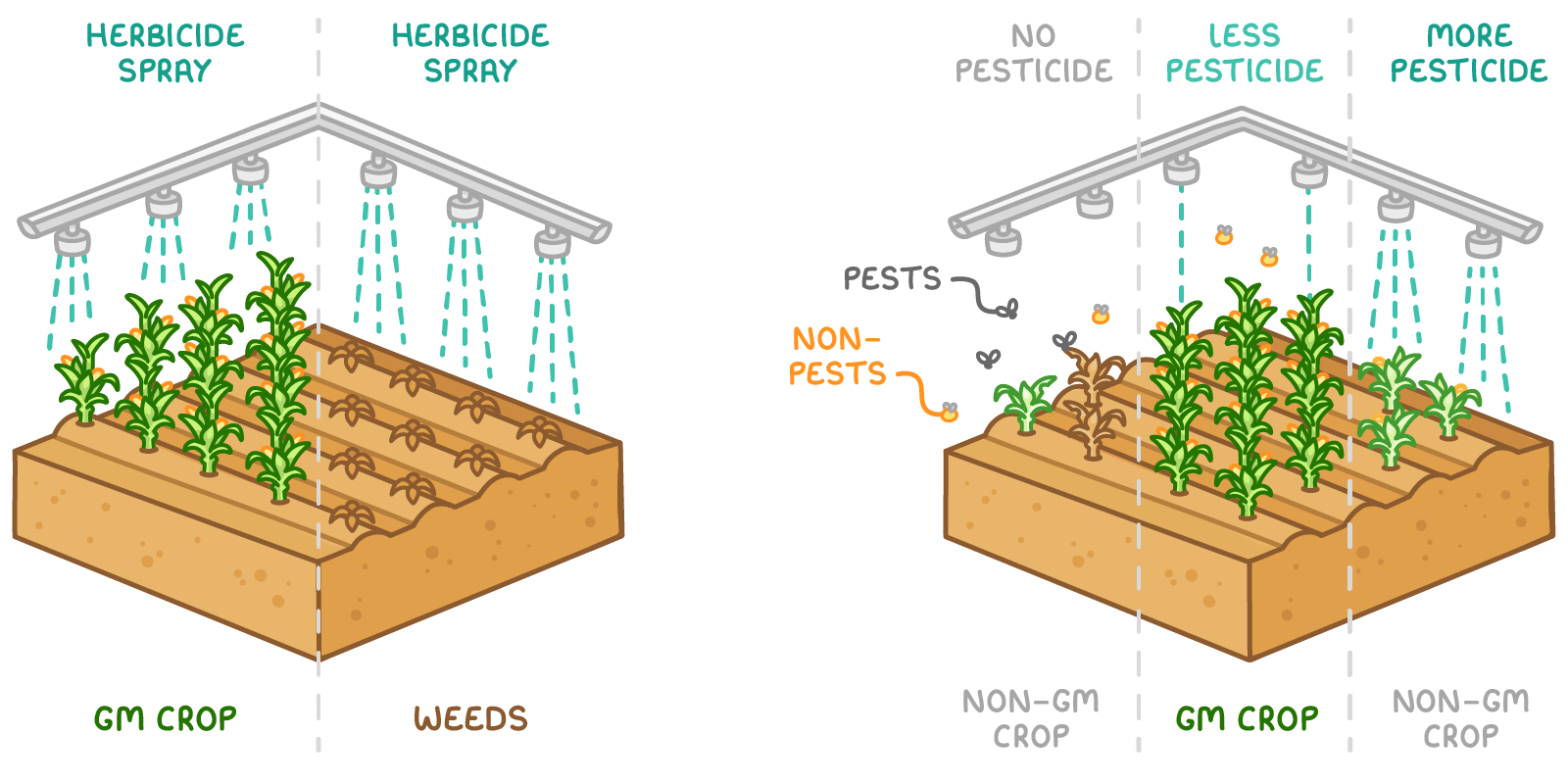
- Insect resistance - Crops modified to resist insect pests are damaged less, so more of the crop survives. Because the crop protects itself, farmers spray far less pesticide, avoiding harm to non-pest wildlife.
- Herbicide tolerance - Crops made tolerant of a particular weedkiller (herbicide) let a field be sprayed to kill competing weeds without harming the crop, again raising the yield.
Growing in difficult conditions
- Crops can be modified to grow well in difficult conditions - for example to tolerate drought.
- This means food can be produced on land that would otherwise give a poor harvest.
Improved nutrition
- Where people's diets lack a particular nutrient, a crop can be engineered to supply it - for example by adding a vitamin that is otherwise missing.
- This helps prevent the deficiency disease the shortage would cause.
Risks and concerns of GM crops
- There are real concerns about growing genetically modified (GM) crops that people weigh against the benefits.
- The main worries are the escape of transplanted genes, effects on biodiversity and food chains, human health, and long-term uncertainty.
Transplanted genes escaping into the wild
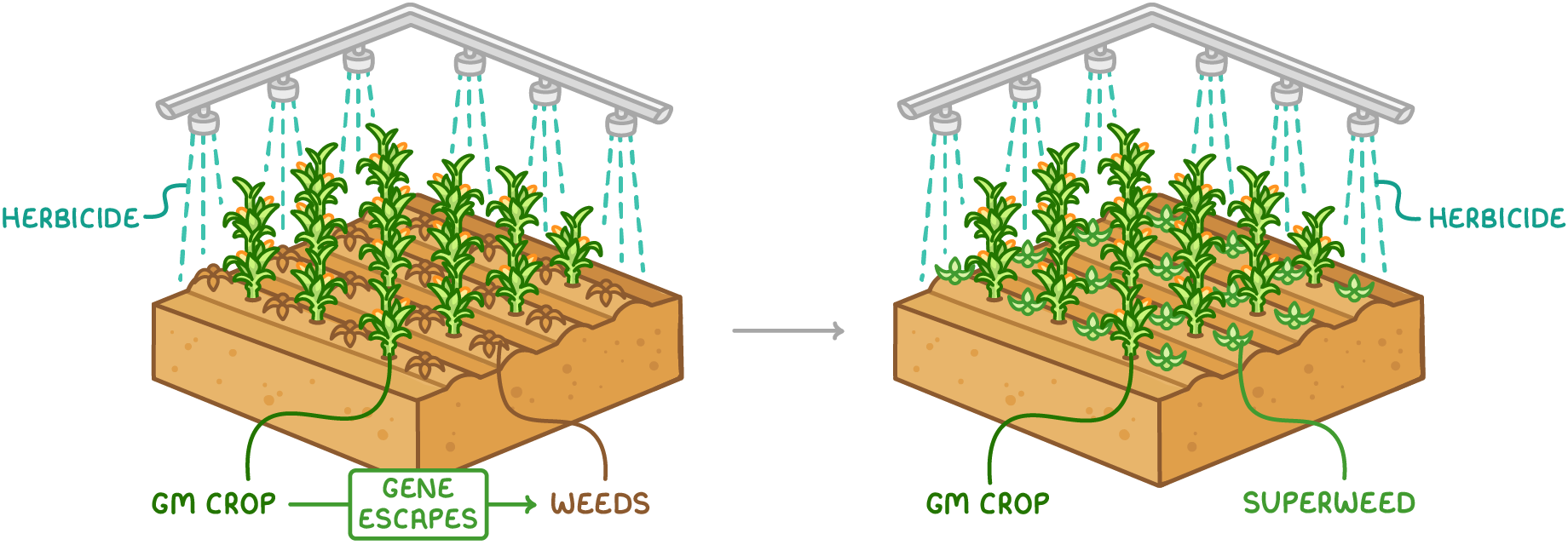
- The most discussed risk is a transplanted gene escaping into the wild.
- If a herbicide-tolerance gene spread from a crop to nearby weeds, it could produce a "superweed" that the weedkiller no longer kills.
- This would make weeds much harder to control.
Effects on biodiversity and food chains
- Growing GM crops may reduce farmland biodiversity.
- If farmers spray weedkiller on a herbicide-tolerant crop, fewer weeds and wild flowers survive, so the insects and other wildlife that depend on those plants decline too.
- This has knock-on effects along food chains.
Human health
- People cannot yet be certain that eating GM food is completely safe.
- Some worry about developing allergies, although there is no clear evidence this is any more likely than with ordinary food.
- The long-term effects on human health are not fully known.
Long-term uncertainty
- Altering an organism's genes might create unforeseen problems that only show up later.
- Because genetic changes are inherited, they could be passed on to future generations.
- For this reason some people argue that more long-term studies are needed before the full risks are known.
Ethics of genetic engineering
- Genetic engineering doesn't just raise practical questions of benefits and risks - it also raises ethical questions about whether it's right to do, not just whether it works.
- People hold a range of views on these questions.
Is it right to modify organisms for human benefit?
- One question is whether it's acceptable to modify living organisms purely for human benefit.
- This concern is sharpest for the genetic engineering of animals, because the modification can cause the animal to suffer.
- Some people argue that causing that suffering for our own ends is wrong.
Worries about the future
- Some people fear genetic engineering won't stop at plants and animals, and might eventually be used to choose the characteristics of human children.
- If only wealthy families could afford this, society might split into those who'd been genetically "improved" and a "genetic underclass" who hadn't - deepening inequality.
- A broader version of the worry is that genetic engineering is irresponsible while so much about its long-term consequences is uncertain - that we shouldn't make permanent, inheritable changes when we can't be sure of the results.
TermDefinition
YieldThe amount of food or other useful product obtained, for example from a given area of land in a given time.
HerbicideA weedkiller used to kill competing plants.
Deficiency diseaseA disease caused by a shortage of a particular nutrient in a person's diet.
SuperweedA weed that has gained a resistance gene and can no longer be killed by weedkiller.
Key points to remember
How were these notes?