1.9 - Food Tests
Testing for starch with iodine solution
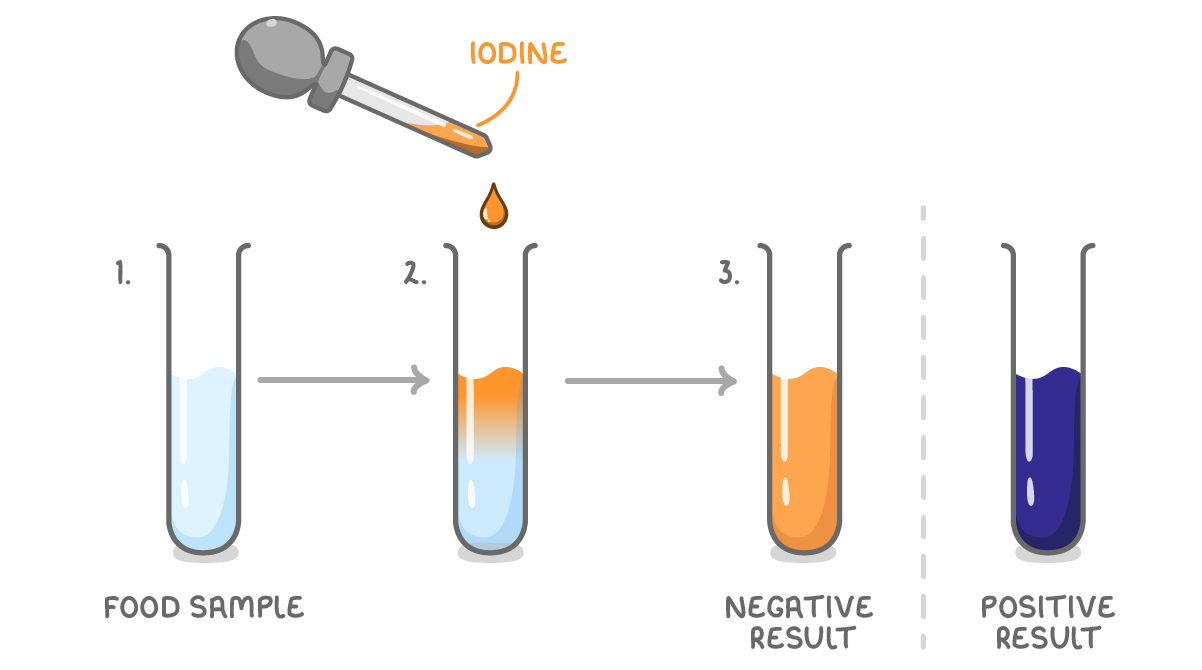
- Iodine solution is used to test a sample for starch.
- Add a few drops of iodine solution to the sample.
Reading the result
- Starch present - The iodine solution changes colour from yellow-brown to dark blue-black.
- No starch present - The solution stays yellow-brown.
The result is shown by the change in colour, so a positive starch test is described as a change from yellow-brown to blue-black - not simply as "blue-black".
Testing for reducing sugars with Benedict's solution
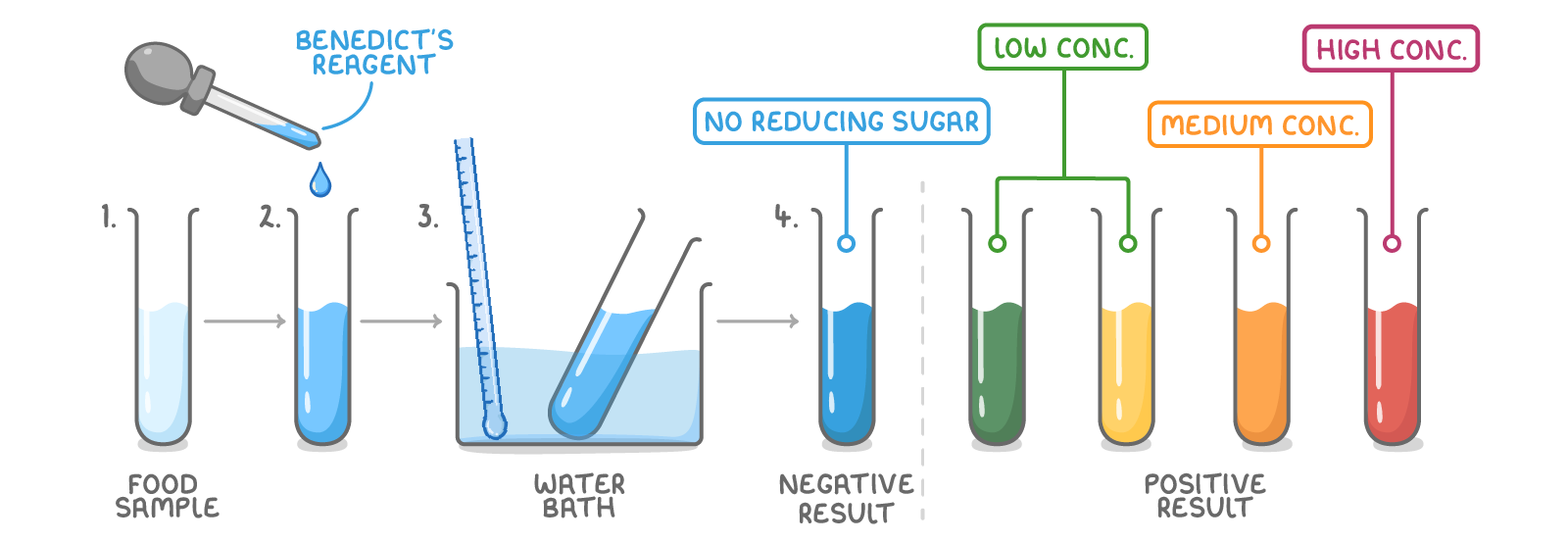
- Benedict's solution, also called Benedict's reagent, tests a sample for reducing sugars - the commonest of which is glucose.
- Benedict's solution starts off blue.
Carrying out the test
- Add Benedict's solution to the sample.
- Heat the sample in a hot water bath.
- If a reducing sugar is present, a coloured precipitate forms (solid particles suspended in the solution) and the colour changes from the original blue.
Reading the result
- The colour runs through a sequence: blue → green → yellow → orange → brick-red.
- The more reducing sugar there is, the further along the sequence the colour goes, so the test is partially quantitative:
- Brick-red - A high concentration of reducing sugar.
- Green or yellow - A lower concentration.
- If no reducing sugar is present, the solution stays blue.
- This is the only one of the common food tests that needs heating.
Testing for protein with biuret reagent
- The biuret test is used to test a sample for protein.
- The biuret reagent is blue.
Carrying out the test
The test can be done in one of two forms:
- Two-solution form - Add a few drops of an alkali (such as potassium hydroxide or sodium hydroxide) to make the sample alkaline, then add a little copper(II) sulfate solution (bright blue).
- Ready-mixed form - Add a single ready-mixed biuret solution to the sample.
Either way, the mixture is then gently shaken.
Reading the result
- Protein present - The solution changes from blue to purple (also described as lilac or violet).
- No protein present - The solution stays blue.
The colours can be pale, so the result is read carefully against the original blue.
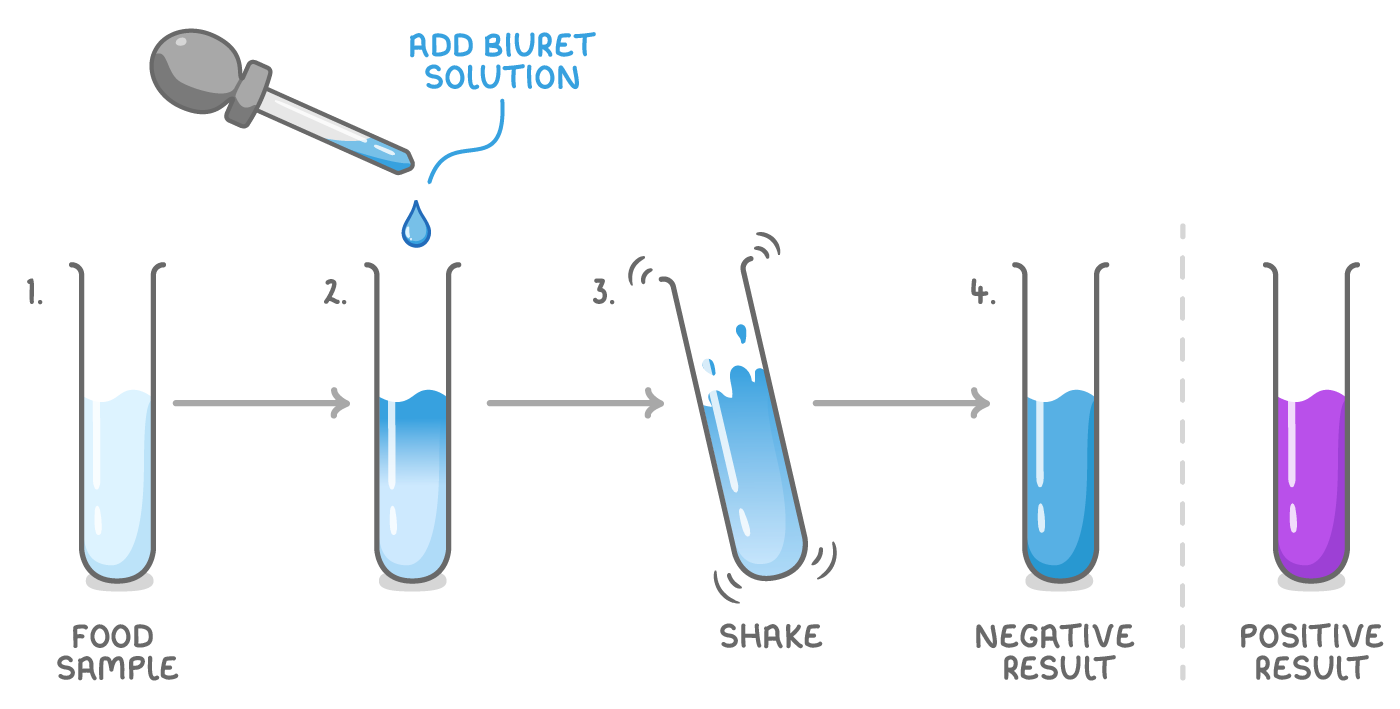
The ready-mixed form of the biuret test, from food sample to result.
Testing for lipids (ethanol emulsion test)
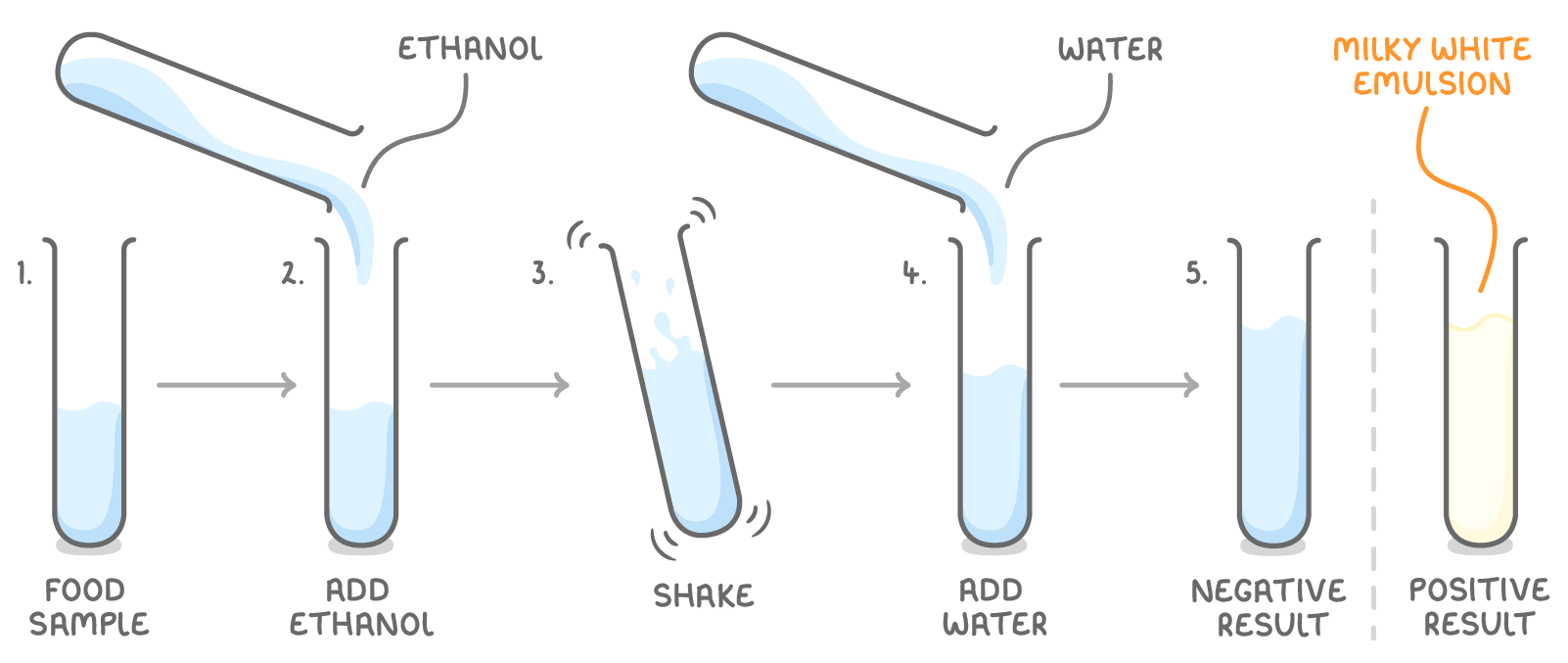
- The ethanol emulsion test checks a sample for lipids (fats and oils).
- An emulsion is tiny droplets of one liquid suspended in another.
Method
- Shake the test substance with ethanol for about a minute, so any lipid dissolves into the ethanol. Ethanol is colourless.
- Add water to the ethanol solution.
Result
- Lipids present - The lipids come out of solution in the water, showing up as a cloudy white emulsion. The more lipid there is, the more obvious the milky cloudiness.
- No lipid present - The mixture stays colourless.
Food tests summary
Each food test uses a specific reagent that changes colour when the food substance is present. The four common tests are summarised below.
| Food substance | Reagent | Positive result (colour change) |
|---|---|---|
| Starch | Iodine solution | Yellow-brown to blue-black |
| Reducing sugar | Benedict's solution (heated in a water bath) | Blue to a brick-red precipitate (through green, yellow and orange) |
| Protein | Biuret reagent | Blue to purple (lilac) |
| Lipid (fat or oil) | Ethanol then water (emulsion test), or Sudan III stain | Cloudy white emulsion, or a bright red top layer |
TermDefinition
Iodine solutionA reagent that changes colour from yellow-brown to blue-black when starch is present.
Benedict's solutionA blue reagent that changes colour to green, yellow, orange, or brick-red when heated with a reducing sugar.
Biuret reagentA blue solution that turns purple or lilac when protein is present.
EmulsionA mixture formed of tiny droplets of one liquid suspended in another.
Key points to remember
How were these notes?