6.9 - Preventing the Spread of Disease
Reducing disease spread through hygiene, food and water
- Communicable (infectious) diseases are caused by pathogens that pass from one person to another.
- They can be reduced - and sometimes stopped altogether - by breaking the routes along which they spread.
- One group of measures works by keeping people, their food, and their water free of pathogens.
Key measures
- Good hygiene - Simple measures stop pathogens passing between people, e.g. washing hands thoroughly before preparing food and after sneezing or using the toilet. Cleaning a wound kills microorganisms near it and stops them entering the blood.
- Hygienic food preparation - Preparing food in clean conditions stops pathogens spreading from work surfaces, chopping boards, and hands onto food. Cooking food thoroughly kills bacteria such as those that cause food poisoning.
- A clean water supply - Access to clean, fresh water for drinking and cooking reduces the spread of water-borne pathogens, otherwise picked up by drinking or bathing in dirty water.
- Safe waste disposal and sewage treatment - Not letting rubbish build up, safely disposing of items such as soiled bandages and used needles, and treating sewage so it can't contaminate drinking water all cut the spread of pathogens carried in human waste.
Reduce disease spread - Vectors, isolation, vaccination
These measures reduce the spread of disease by attacking what carries a pathogen and by keeping infected individuals apart from others.
Destroying vectors
- Getting rid of the organisms that carry a pathogen prevents it being passed on.
- Insect vectors can be killed with insecticides, or their breeding habitats removed so they can no longer multiply.
- For a disease spread by mosquitoes, nets and insect repellent also stop people being bitten.
Isolating infected individuals
- Keeping a person (or, on a farm, an infected animal) away from others prevents them passing the disease on.
- In some cases, restricting travel stops it spreading further afield.
- Detecting and treating a disease early also limits how far it spreads.
Vaccination
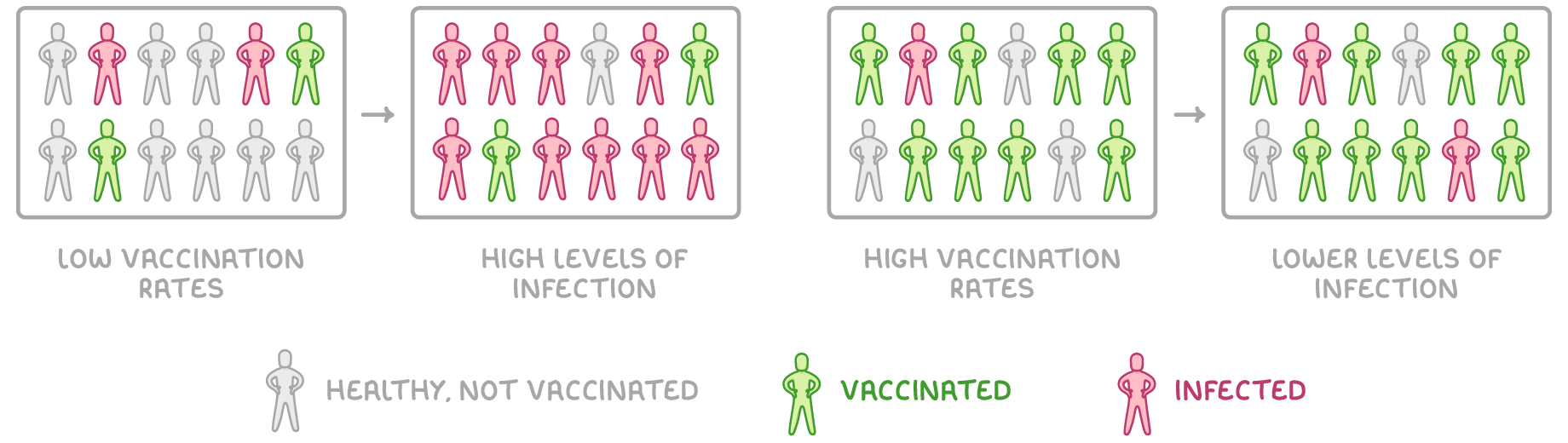
- Vaccinating people and animals against a communicable disease means they are less likely to develop the infection and then pass it on.
- This reduces how far the disease spreads through a population, as shown below.
Reducing the spread of disease in plants
- Plant diseases matter because they reduce crop yields and harm the wider ecosystem.
- The pathogens differ from those in humans, but the principle is the same: break the route by which the disease spreads.
Methods of control
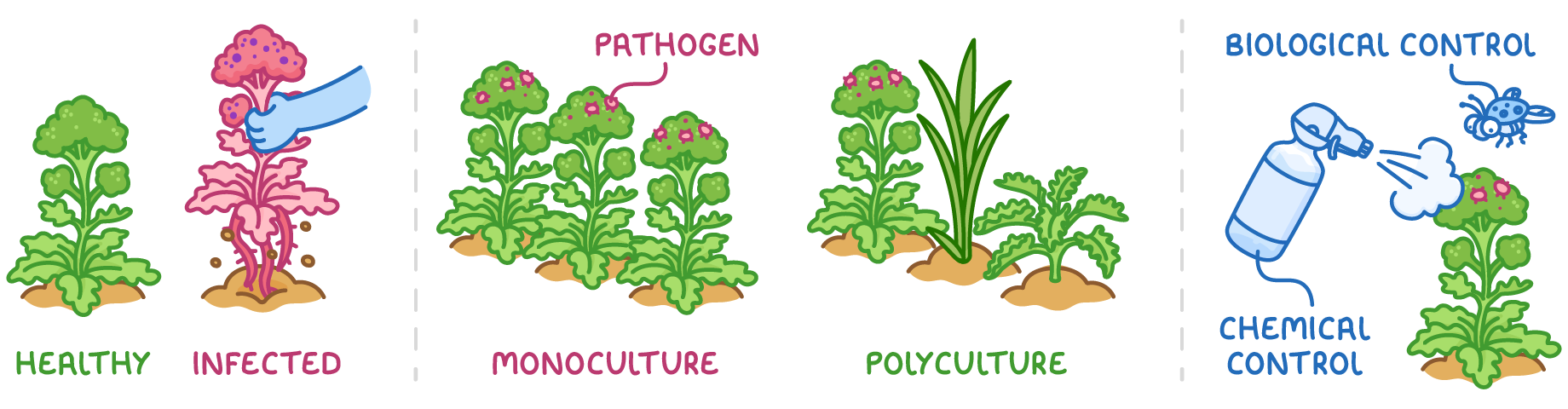
- Regulating the movement of plant material - Keeps infected plants away from healthy ones (e.g. not selling or transporting diseased stock), and uses only healthy seeds and plants so the disease isn't introduced in the first place.
- Destroying infected plants - Removes them as a source of further infection.
- Crop rotation and polyculture - Many pathogens are specific to one type of plant, so a field growing a single crop (monoculture) lets them spread easily. Changing the crop grown in a field each year (rotation), or growing different species together (polyculture), stops a pathogen becoming established and limits its spread.
- Chemical control - Spraying fungicides to kill fungal pathogens, or coating seeds and bulbs before planting.
- Biological control - Using another organism to keep a pest or pathogen in check, e.g. releasing ladybirds, which eat the aphids that damage and spread disease between crops.
TermDefinition
Communicable diseaseA disease caused by a pathogen that can be passed from one organism to another.
Vector (disease)An organism that carries a pathogen and passes it from one host to another.
MonocultureThe growing of a single crop species over a large area of land.
Crop rotationGrowing a different crop in a field each year, which stops pathogens building up. Including peas or beans also puts nitrates back into the soil.
PolycultureGrowing different plant species together to limit the spread of pathogens.
Biological controlUsing a living organism, such as a predator or parasite, to reduce the numbers of a pest or pathogen.
Key points to remember
How were these notes?