6.17 - Non-Communicable Disease
Non-communicable disease and risk factors
- A non-communicable disease is one that cannot be passed from person to person - it is not caused by a pathogen, so it is not infectious.
- These diseases generally last a long time and get worse slowly.
- Examples include:
- Cardiovascular disease
- Many cancers
- Some lung and liver diseases
- Type 2 diabetes
Risk factors
- Rather than being caught from someone else, non-communicable diseases are linked to risk factors.
- A risk factor is anything that increases the likelihood that a person will develop a particular disease during their lifetime.
- A risk factor does not guarantee the disease - someone with a risk factor is simply more likely to develop it than someone without it.
Types of risk factor
- Lifestyle - Aspects of how a person lives, such as how much exercise they do, or whether they smoke
- Substances in the environment - Such as air pollution around them
- Substances in the body - Substances found inside the body
- Inherited genes - The genes a person has inherited, which can make them more susceptible to some diseases
Many non-communicable diseases are caused by several of these risk factors interacting, rather than by any single factor on its own.
Correlation and cause
- Scientists identify risk factors by looking at data and searching for correlations - links where two things tend to change together (e.g. more of a certain behaviour found alongside more cases of a disease).
- A correlation on its own does not prove that one thing causes the other.
- For some risk factors a causal mechanism has been proven, so the factor really does cause the disease.
- For others, the risk factor is only correlated with the disease and the true cause lies elsewhere.
- To decide whether a risk factor is a cause, scientists look for a plausible mechanism that explains how it could bring the disease about, not just a statistical link.
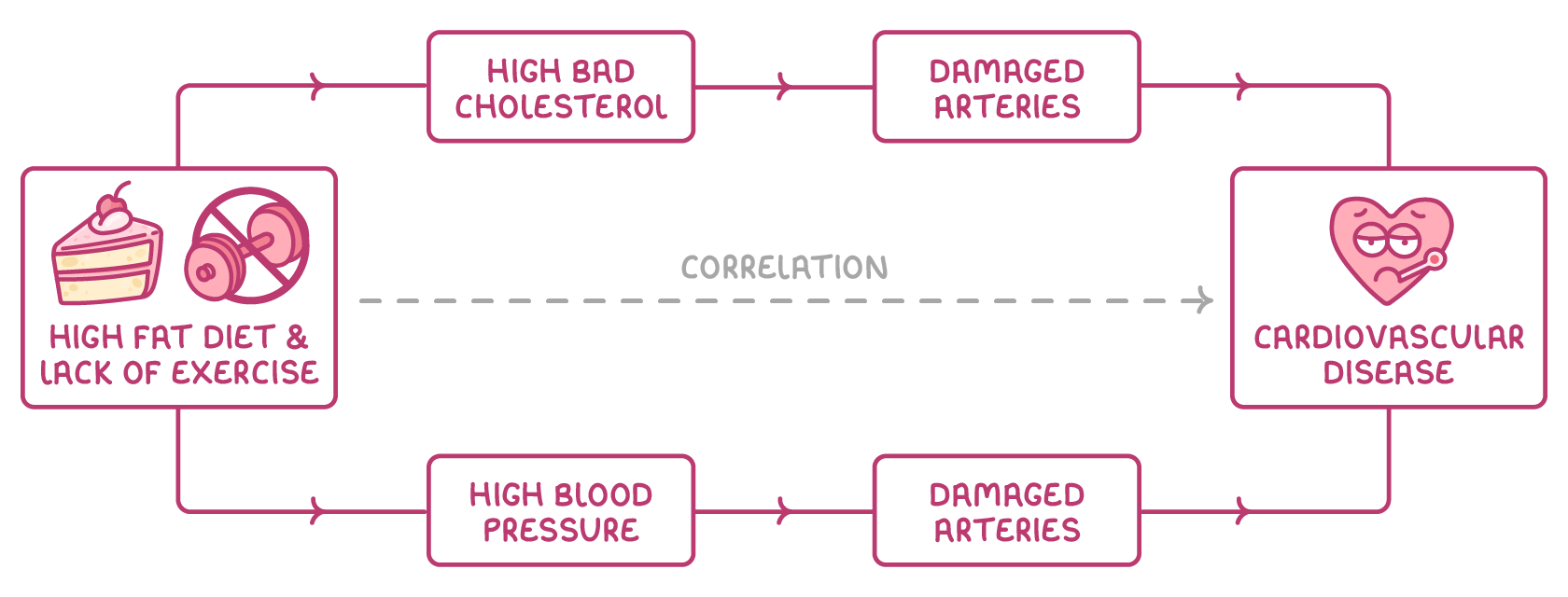
Example - Lifestyle and cardiovascular disease
- A lack of exercise and a high-fat diet are strongly linked to cardiovascular disease, but they do not cause it directly.
- It is the high blood pressure and high level of "bad" cholesterol they lead to that actually damage the arteries.
The cost of non-communicable disease
- The incidence of a non-communicable disease means the number of new cases.
- Incidence varies between different parts of the world, between regions of one country, and from person to person - because different groups tend to have different risk factors.
Why incidence varies
- Wealthier, developed countries - Higher incomes make it easier to buy energy-rich food and live without much physical activity, so obesity and the diseases it raises are common.
- More deprived areas within a country - People here are more likely to smoke, eat poorly, and exercise less, so cardiovascular disease, obesity, and Type 2 diabetes are more common.
- Individual choices - A person's own choices then affect their personal risk.
Lifestyle risk factors
- A risk factor is an aspect of a person's life or environment linked to an increased chance of developing a disease.
- The four main lifestyle risk factors for non-communicable diseases are diet, exercise, alcohol, and smoking.
- Each is linked to particular diseases, and because these diseases overlap, someone with several risk factors is at much greater risk than someone with one.
Diet
- Eating too much - especially fatty and sugary food - takes in more energy than the body uses, and the excess is stored as fat.
- A poor diet is a risk factor for obesity, and through it for Type 2 diabetes and cardiovascular disease.
- A diet high in saturated fat raises the level of "bad" cholesterol in the blood, which contributes to fatty deposits forming inside arteries - raising cardiovascular risk.
- Too few nutrients causes the opposite problem: malnutrition.
Exercise
- Being active increases the energy the body uses and reduces the fat stored.
- It builds muscle, which raises the metabolic rate so energy from food is used up more quickly.
- People who exercise regularly are less likely to become obese or develop cardiovascular disease.
- A lack of exercise has the reverse effect and raises blood pressure, increasing cardiovascular risk.
Alcohol
- Drinking too much alcohol is a risk factor for liver disease - alcohol is broken down by the liver and some of the products are toxic.
- Drinking heavily over a long period can permanently damage the liver.
- Alcohol is also linked to cardiovascular disease and to some cancers.
Smoking
- Smoking is a major risk factor for cardiovascular disease. The chemicals in cigarette smoke:
- Raise the heart rate and blood pressure
- Damage the walls of the arteries, encouraging fatty deposits and blood clots to build up
- This makes a heart attack or stroke more likely.
- Smoking is also a well-established risk factor for lung disease and lung cancer.
TermDefinition
Non-communicable diseaseA disease that cannot be passed from one person to another.
Risk factorAnything that increases the likelihood that a person will develop a particular disease during their lifetime.
CorrelationA relationship between two variables where a change in one is linked to a change in the other.
IncidenceThe number of new cases of a disease.
Key points to remember
How were these notes?