6.8 - Communicable Disease & Pathogens
Pathogens and the four types
- A pathogen is a microorganism that causes disease.
- The diseases pathogens cause can be passed from one host to another, so they're called communicable diseases (also called infectious or transmissible diseases).
- Both animals and plants can be infected.
- There are four types of pathogen: bacteria, viruses, protists, and fungi. Viruses aren't living organisms, but they still count as pathogens.
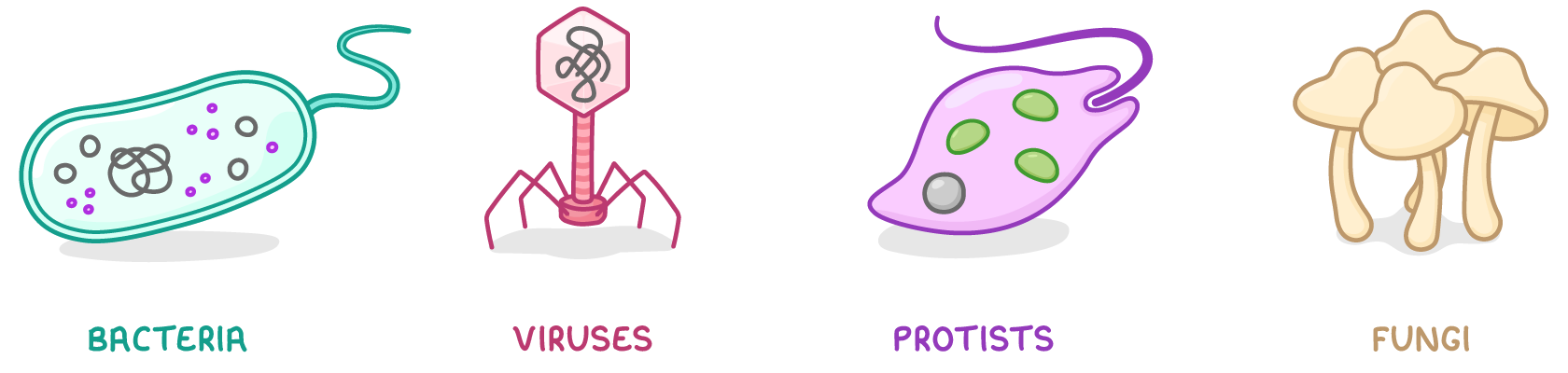
The four types of pathogen
- Bacteria - Very small living cells, roughly a hundredth of the size of a body cell. Once inside the body they reproduce rapidly and make the host feel ill mainly by producing poisons called toxins, which damage cells and tissues.
- Viruses - Not cells at all, and much smaller than bacteria (about a hundredth the size of a bacterium). A virus gets inside a living cell and uses it to make many copies of itself; the cell then usually bursts, releasing the new viruses to infect more cells. This damage to the host's cells makes the host feel ill.
- Protists - Usually single-celled, and vary widely in size. Disease-causing protists are often parasites, living on or inside another organism and harming it. Many are carried to a new host by a vector - an organism, such as an insect, that transfers the pathogen from one host to another without catching the disease itself.
- Fungi - Can be single-celled, or have a body made of thread-like structures called hyphae. The hyphae can grow into and penetrate human skin or the surface of a plant, causing disease. Fungi can also produce spores, which spread the infection to other animals and plants.
How pathogens spread
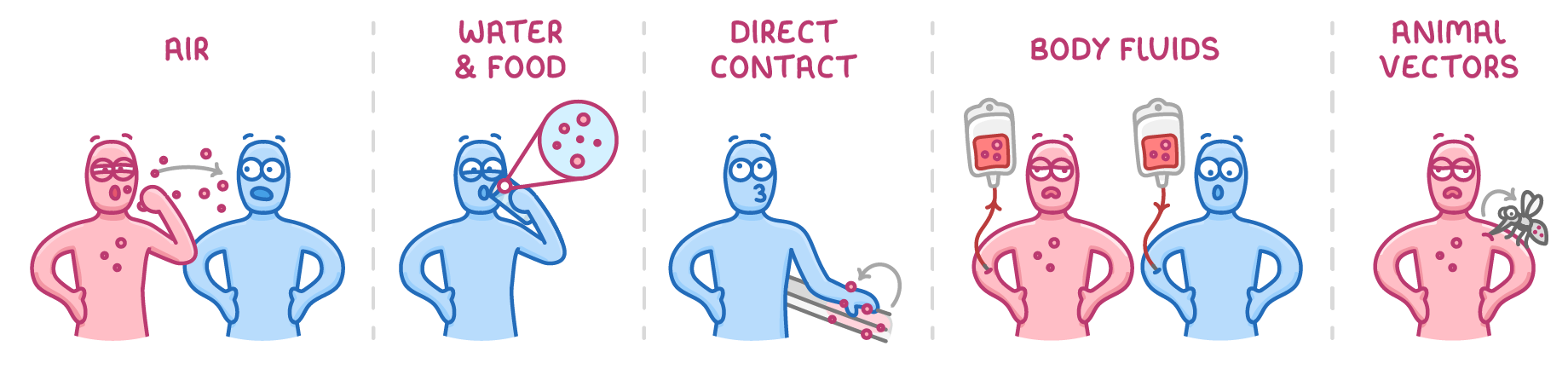
- Pathogens spread from host to host in several general ways.
- The same routes apply to both animals and plants.
Routes of spread
- Air - Carried through the air, often in the tiny droplets released when an infected person coughs or sneezes
- Water and food - Picked up from contaminated water or food
- Direct contact - Passed by touching an infected organism
- Contaminated surfaces - Picked up indirectly by touching a surface or object that carries the pathogen
- Body fluids - Passed through contact with blood and other body fluids
- Animal vectors - Carried from host to host by animals such as insects, which transfer the pathogen without catching the disease themselves
TermDefinition
PathogenA microorganism that causes disease.
Communicable diseaseA disease caused by a pathogen that can be passed from one organism to another.
ToxinA poison produced by a pathogen that damages cells and tissues.
ParasiteAn organism that lives on or inside another organism and harms it.
Vector (disease)An organism that carries a pathogen and passes it from one host to another.
HyphaeThread-like structures that make up the body (mycelium) of many fungi.
Key points to remember
How were these notes?