6.4 - Selective Breeding
What selective breeding is
- Selective breeding (also called artificial selection) is when humans choose which plants or animals get to breed, so the genes for a chosen characteristic are kept and made more common in the population.
- People have done it for thousands of years - it's how edible crops were developed from wild plants and how animals such as cattle and dogs were domesticated.
Organisms are selectively bred for characteristics that are useful or attractive, for example:
- Crops that resist disease, or that give a higher yield of grain, fruit or other food
- Animals that produce more meat or milk
- Animals with other useful qualities, such as a gentle temperament in dogs
- Decorative plants with large or unusual flowers
Combining two characteristics
- Two characteristics can be combined in one variety by crossing, then selecting the best offspring over generations.
- Example - wheat:
- Tall wheat gives a good grain yield but is easily flattened by wind and rain
- Dwarf wheat resists the weather but yields less
- Crossing the two and selecting over generations produces a dwarf, weather-resistant wheat with a high yield
Selective breeding process and drawbacks
- Selective breeding is choosing which organisms breed together so that a desired characteristic gets stronger over many generations.
- The process is the same whatever the characteristic you're selecting for.
The process step by step
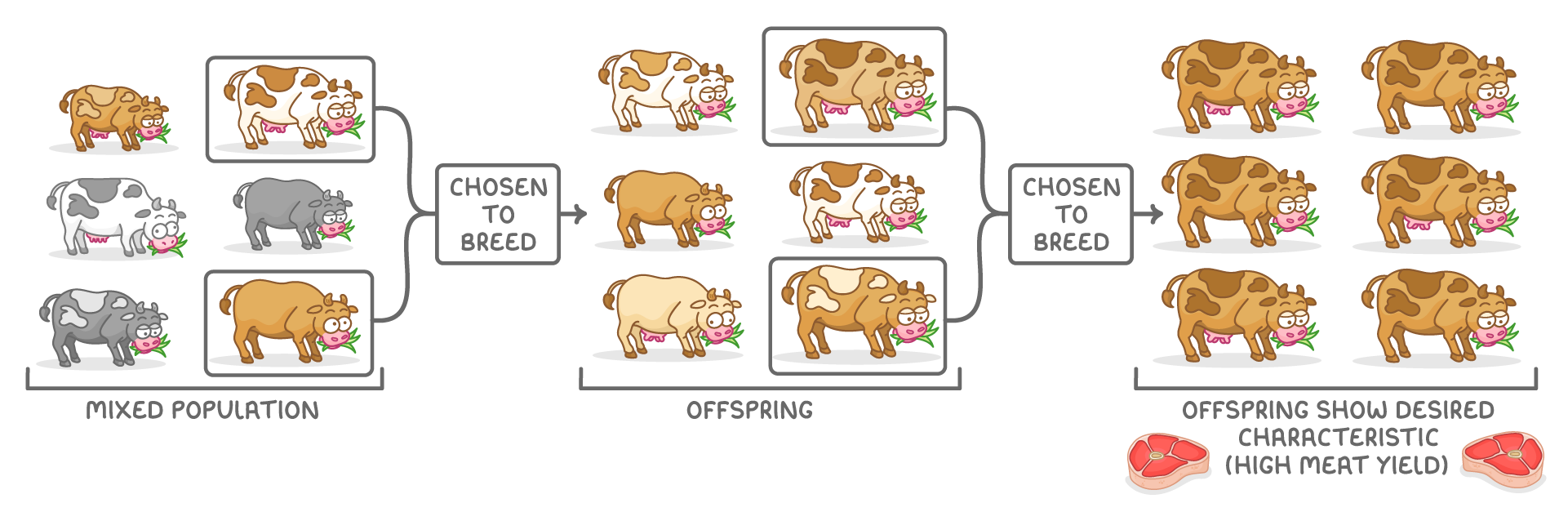
- From a mixed population, choose the individuals showing the desired characteristic most strongly (e.g. the cows and bulls best for meat production).
- Breed these chosen individuals together.
- From their offspring, again choose the ones showing the characteristic best, and breed those together.
- Repeat over several generations. The characteristic becomes stronger and more common each time, until eventually the whole stock shows it - e.g. a herd with a very high meat yield.
The main drawback - A reduced gene pool
- Selective breeding reduces the gene pool - the number of different alleles (versions of a gene) in the population.
- Breeders keep using only the "best" individuals, which tend to be closely related, so repeated breeding from close relatives is a form of inbreeding.
- Inbreeding makes it more likely that offspring inherit harmful genetic defects - which is why some dog breeds are especially prone to particular health problems.
- A small gene pool also means little variation. If a new disease appears, there's little chance any individual carries a resistance allele, so a single disease could wipe out the whole stock at once.
Natural and artificial selection compared
- Both change a population over many generations by deciding which individuals reproduce.
- They differ in who or what does the choosing and in their effects on variation.
Who does the selecting
- Natural selection - The environment does the selecting. The individuals that survive and reproduce are those whose characteristics happen to suit their surroundings, so it affects all wild organisms.
- Artificial selection (selective breeding) - Humans do the selecting. The individuals that reproduce are those with characteristics people find useful or desirable, so it happens only to the organisms humans choose to breed.
Speed and effect on variation
| Natural selection | Artificial selection | |
|---|---|---|
| Speed | Slow - takes a great many generations | Fast - each generation is chosen on purpose |
| Variation | A good deal of variation is kept, because no one is deliberately narrowing the population down | Breeding from a few closely related "best" individuals causes inbreeding, reducing variation |
| Coping with change | Better chance of surviving a new disease or change in conditions; less risk of inbreeding | Less likely to cope with a new disease or change; offspring more likely to inherit genetic disorders |
TermDefinition
Selective breedingThe process of humans choosing which plants or animals breed together to pass on desired characteristics.
Gene poolAll the different genes and alleles present in a population.
InbreedingRepeatedly breeding from closely related individuals, which can lead to harmful genetic defects.
Key points to remember
How were these notes?