5.12 - Antibiotic Resistance
How antibiotic resistance arises
- Bacteria reproduce very quickly, so they can evolve in a short time.
- Like all organisms, a bacterium can develop a random mutation in its DNA. Very occasionally this makes the bacterium less affected by a particular antibiotic - a drug that kills bacteria or stops them reproducing.
- The mutation produces a new allele (sometimes called a new variant) for antibiotic resistance.
- The mutation happens by chance - the antibiotic does not cause it. So some bacteria in a population are already resistant before any antibiotic is used.
Natural selection builds up a resistant strain
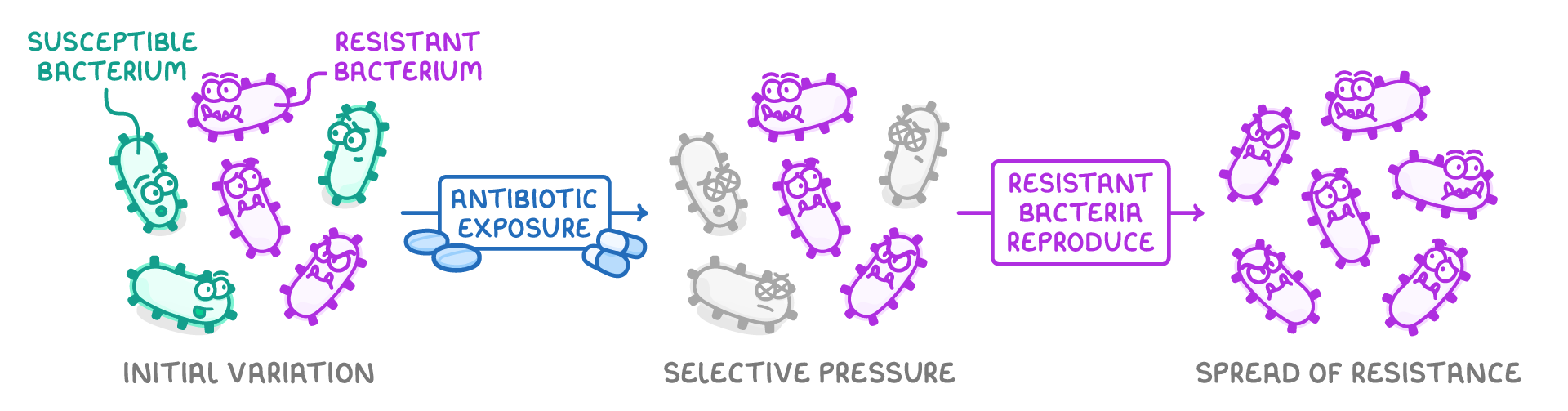
This is natural selection acting on bacteria, with the antibiotic as the selection pressure. Because bacteria reproduce so fast, it can be watched happening within a few generations:
- The antibiotic kills the bacteria that are not resistant, known as susceptible bacteria, but a resistant bacterium survives.
- Resistance is a large survival advantage - the resistant bacterium lives longer and reproduces many more times, even inside a host being treated for the infection.
- It passes the resistance allele on to all of its offspring.
- Because bacteria reproduce so rapidly, the proportion of resistant bacteria rises quickly until a whole new antibiotic-resistant strain has built up.
Why a resistant strain is a serious problem
- People have no immunity to it and the usual antibiotic no longer works, so the infection is hard to treat and spreads easily from person to person.
- Bacteria that have become resistant to many different antibiotics are called superbugs.
- An example is MRSA, and such superbugs are becoming more common.
TermDefinition
AntibioticA substance that kills bacteria or stops them from growing and dividing, used as a medicine to cure bacterial diseases.
SuperbugA strain of bacteria that has become resistant to many different antibiotics.
Key points to remember
How were these notes?