2.7 - Surface Area to Volume Ratio
Surface area to volume ratio
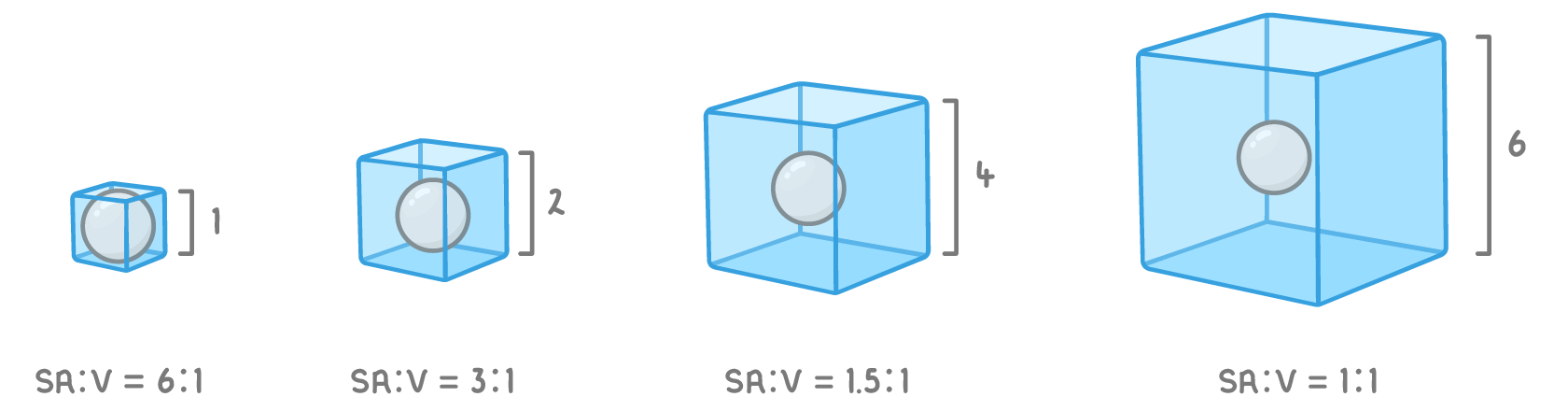
- The surface area to volume ratio (written SA : V) compares the size of an object's outer surface with the amount of space inside it.
- A ratio shows how big one value is compared with another - so a ratio of 6 : 1 means there are six units of surface area for every one unit of volume.
- It can be written three ways: as a ratio (e.g. 6 : 1), as a fraction, or as a single number (surface area ÷ volume, e.g. 6).
Why bigger organisms have a smaller ratio
- As an object gets bigger, its surface area and its volume don't grow at the same rate:
- Surface area depends on the sides multiplied two at a time (length × width)
- Volume depends on all three dimensions multiplied together (length × width × height)
- Volume grows faster than surface area, so a large object has a smaller surface area compared with its volume than a small object does.
- In short: the bigger an organism is, the smaller its surface area to volume ratio.
Why the ratio matters in biology
- Substances enter and leave an organism across its surface, by diffusion, while the whole volume has to be supplied.
- The surface is where exchange happens; the volume is what needs supplying.
- As an organism gets bigger, the distance a substance must diffuse from the surface to reach the middle also grows.
- A large surface area compared with the volume, and a short diffusion distance, both make exchange easy.
Worked example - Surface area to volume ratios
An elephant is modelled as a block 8 cm by 8 cm by 4 cm, and a shrew as a 2 cm cube. Work out the surface area to volume ratio of each, giving both in the form n : 1, and say which is larger.
Step 1 - Elephant surface area
Add the area of all six faces:
- Top and bottom: 8 × 8 = 64 cm2 each
- Four sides: 8 × 4 = 32 cm2 each
(64 × 2) + (32 × 4) = 256 cm2
Step 2 - Elephant volume
8 × 8 × 4 = 256 cm3
Step 3 - Elephant ratio
Surface area : volume = 256 : 256
Divide both sides by 256:
256 : 256 = 1 : 1
Step 4 - Shrew surface area
Add the area of its six faces:
(2 × 2) × 6 = 24 cm2
Step 5 - Shrew volume
2 × 2 × 2 = 8 cm3
Step 6 - Shrew ratio
Surface area : volume = 24 : 8
Divide both sides by 8:
24 : 8 = 3 : 1
Step 7 - Interpretation
The shrew's surface area is three times its volume, while the elephant's is only equal to its volume. The smaller animal has the larger surface area to volume ratio - much more surface, relative to its size, across which to exchange substances with its surroundings.
Why large organisms need exchange surfaces and transport
- Substances like oxygen and dissolved food must get into an organism, and wastes like carbon dioxide must get out.
- How an organism does this depends on its surface area to volume ratio (SA : V) - how much outer surface it has compared with its volume.
Single-celled organisms rely on diffusion
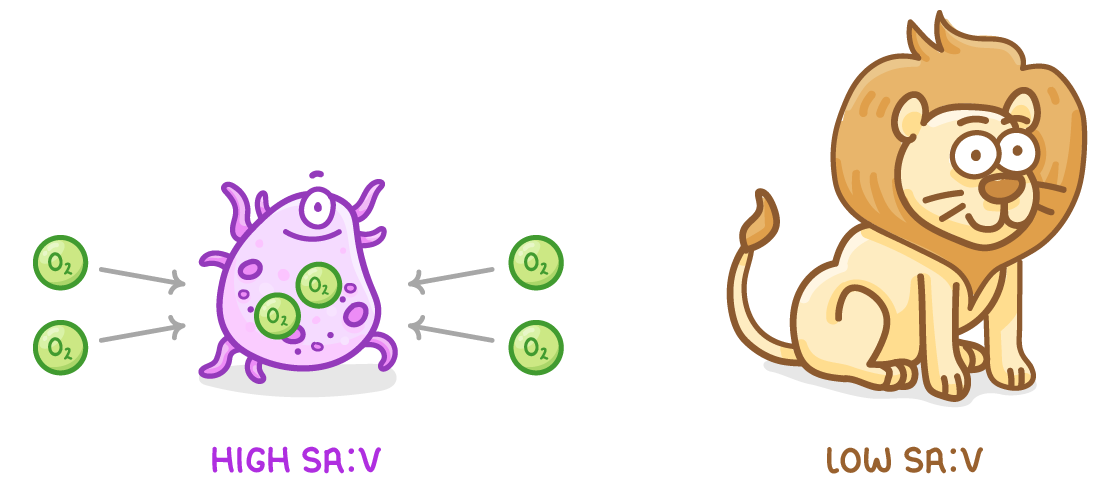
- A single-celled organism has a large surface area compared with its volume.
- Substances can diffuse in and out across its cell membrane fast enough to supply its whole small volume.
- The distance from the membrane to any part of the cell is tiny.
- So it can rely on simple diffusion across its outer surface and needs no special exchange structures.
Large multicellular organisms cannot rely on diffusion alone
- Their surface area is small compared with their much greater volume.
- Substances would have to diffuse a long way from the outer surface to reach cells deep inside.
- So diffusion across the outside surface alone cannot supply the whole volume quickly enough - there isn't enough surface, and the diffusion distances are too great.
Two things solve the problem
To get around this, large multicellular organisms have:
- Specialised exchange surfaces - Parts of the body adapted to exchange substances efficiently, such as the lungs in mammals or the gills in fish.
- A transport system - For example a circulatory system, which carries substances between the exchange surfaces and the rest of the body, so every cell can be supplied even though it is far from the surface.
A few small multicellular organisms, such as earthworms, still have a large enough surface area to volume ratio to manage with diffusion across the body surface and don't need specialised exchange surfaces.