1.11 - Rate of Photosynthesis
Limiting factors in photosynthesis
- The rate of photosynthesis isn't fixed - it rises and falls with the conditions around the plant.
- A limiting factor is the factor in shortest supply at that moment, so it's the one holding the rate back.
- Increasing the limiting factor raises the rate; increasing any other factor makes no difference until the limiting one is raised.
- Which factor is limiting depends on the surroundings:
- At night - Light is limiting
- A cold winter day - Temperature is often limiting
- Warm and bright - Carbon dioxide is usually limiting
The three environmental factors
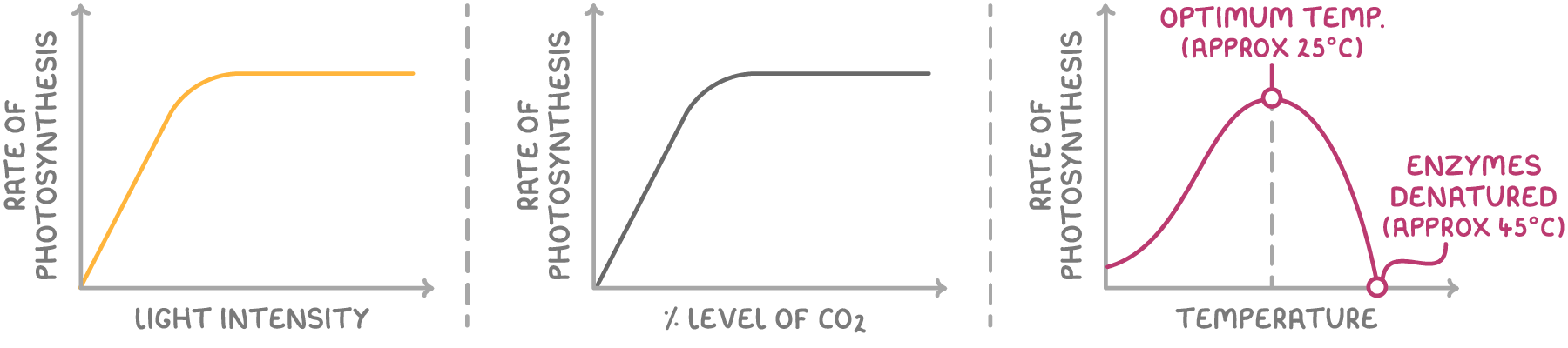
- Light intensity - Provides the energy for photosynthesis. Raising it from low increases the rate steadily, but only up to a point. Beyond that, more light makes no difference because temperature or carbon dioxide has become limiting instead. The rate-against-light-intensity graph climbs, then levels off at a plateau.
- Carbon dioxide concentration - A raw material of photosynthesis. Increasing it raises the rate up to a point, then the graph flattens - showing light or temperature is now limiting. Same rise-then-plateau shape as the light graph.
- Temperature - Affects the enzymes that control photosynthesis:
- In the cold, enzymes work slowly, so the rate is slow - this is usually why temperature is limiting.
- As temperature rises, the rate increases up to an optimum at around 25°C.
- Above the optimum the rate falls sharply, and by around 45°C the enzymes are denatured (their shape is destroyed) and the rate drops to zero.
- The rate-against-temperature graph therefore rises to a peak then drops steeply - unlike the light and carbon dioxide graphs, which plateau.
The amount of chlorophyll can also limit the rate
- Chlorophyll is the pigment that absorbs the light, so less chlorophyll means a reduced rate.
- Things that can damage chloroplasts or stop the plant making enough chlorophyll include:
- Disease - e.g. infection with tobacco mosaic virus
- Environmental stress - e.g. a shortage of nutrients
- With less chlorophyll, the plant can't absorb as much light, slowing photosynthesis.
Interpreting graphs with more than one limiting factor
- A single graph can show more than one factor limiting photosynthesis at once.
- Reading it tells you which factor is holding the rate back in each region of the graph.
Reading one line
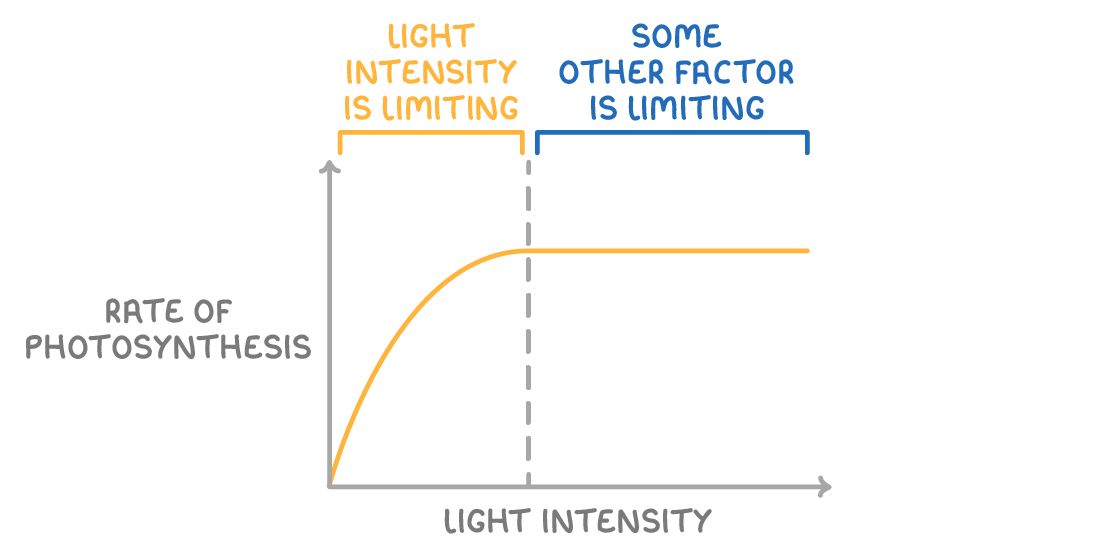
- Where a line is still rising, the factor on the horizontal axis is the limiting factor there.
- Where a line has levelled off (plateaued), some other factor has become limiting instead.
Comparing two lines - Temperature
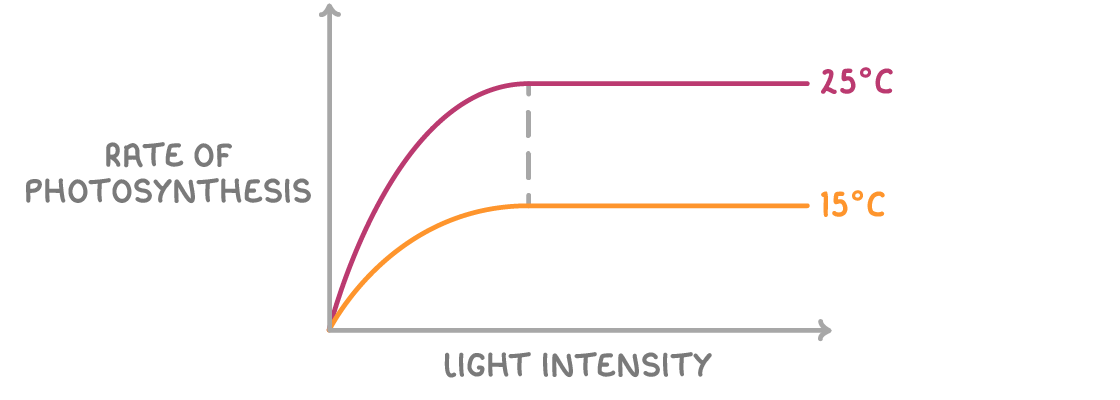
- Plot rate of photosynthesis against light intensity as two lines at two different temperatures, 15°C and 25°C.
- At low light intensity both lines rise together as light is increased - light is the limiting factor for both.
- Each line then levels off when light stops being limiting.
- The 25°C line levels off at a higher rate than the 15°C line.
- This shows temperature was the limiting factor for the cooler line: once light was plentiful, the 15°C plant couldn't go as fast because its lower temperature held it back.
Comparing two lines - Carbon dioxide
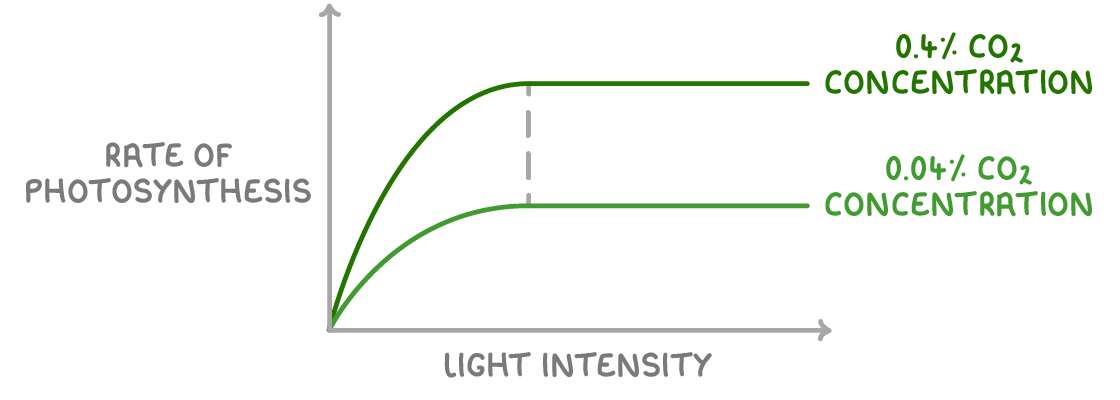
- Plot rate against light intensity as two lines at the same temperature but two different carbon dioxide concentrations, 0.4% and 0.04%.
- Both lines rise, then level off when light is no longer limiting.
- The line at the higher CO2 concentration (0.4%) levels off higher, so carbon dioxide was the limiting factor for the 0.04% line.
- Here the limiting factor can't be temperature, because both lines were at the same temperature.
The general method
- Find where a line is still rising - the factor on the horizontal axis is limiting there.
- Find where it has levelled off - another factor has become limiting.
- Compare the heights of the plateaus to spot which factor differs between the lines - that is the one limiting the lower line.
TermDefinition
Limiting factorThe factor in shortest supply that holds back the rate of a process.
Optimum temperatureThe temperature at which an enzyme works fastest.
DenaturedDescribes an enzyme whose active site has permanently changed shape, so the substrate no longer fits and the enzyme no longer works.
ChlorophyllThe green pigment in chloroplasts that absorbs light energy for photosynthesis.
Key points to remember
How were these notes?