7.7 - Breathing & the Effect of Exercise
The experiment
Aim
To find out how exercise affects breathing rate and pulse (heart) rate, and how long each takes to return to its resting value once the exercise stops (the recovery time).
Background
- When you exercise, your muscles respire faster to release the energy they need to contract. They use more oxygen and glucose, and make more carbon dioxide.
- To keep up, your heart beats faster, giving a higher pulse rate, and you breathe faster and more deeply, giving a higher breathing rate.
- Once you stop, both rates fall back to their resting values. The time this takes is the recovery time.
- You can't see how fast your muscles are respiring, but you can count your pulse and your breaths.
- So in this practical you measure your pulse rate and breathing rate at rest, straight after exercise, and then every minute until they're back to resting.
Variables
- Independent variable - The amount of exercise, such as resting and then a set time of exercise, or the time since the exercise stopped.
- Dependent variable - The breathing rate in breaths per minute, and the pulse rate in beats per minute.
- Control variables - The type and intensity of the exercise, how long it lasts, and the person doing it.
Method
- Measure your resting pulse rate - Sit still for a few minutes, then count the beats at your wrist or neck for one minute (or for 15 seconds, and multiply by 4).
- Measure your resting breathing rate - Count the breaths you take in one minute.
- Exercise - Exercise at a steady pace for a set time, for example stepping up and down on a low step for 3 minutes.
- Measure straight after - As soon as you stop, measure your pulse rate and breathing rate again in the same way.
- Measure every minute - Keep measuring every minute until the rates return to their resting values.
- Repeat - Rest fully, then repeat and find a mean. You can also compare different people, or different amounts of exercise.
Safety
- Healthy volunteers only - Anyone with asthma, a heart condition, or an injury should take the readings instead. Everyone must be free to refuse to take part, or to stop at any time.
- Space and footwear - Exercise in a clear space in suitable footwear, and rest fully before any harder or repeated exercise.
Worked example - Pulse rate after exercise
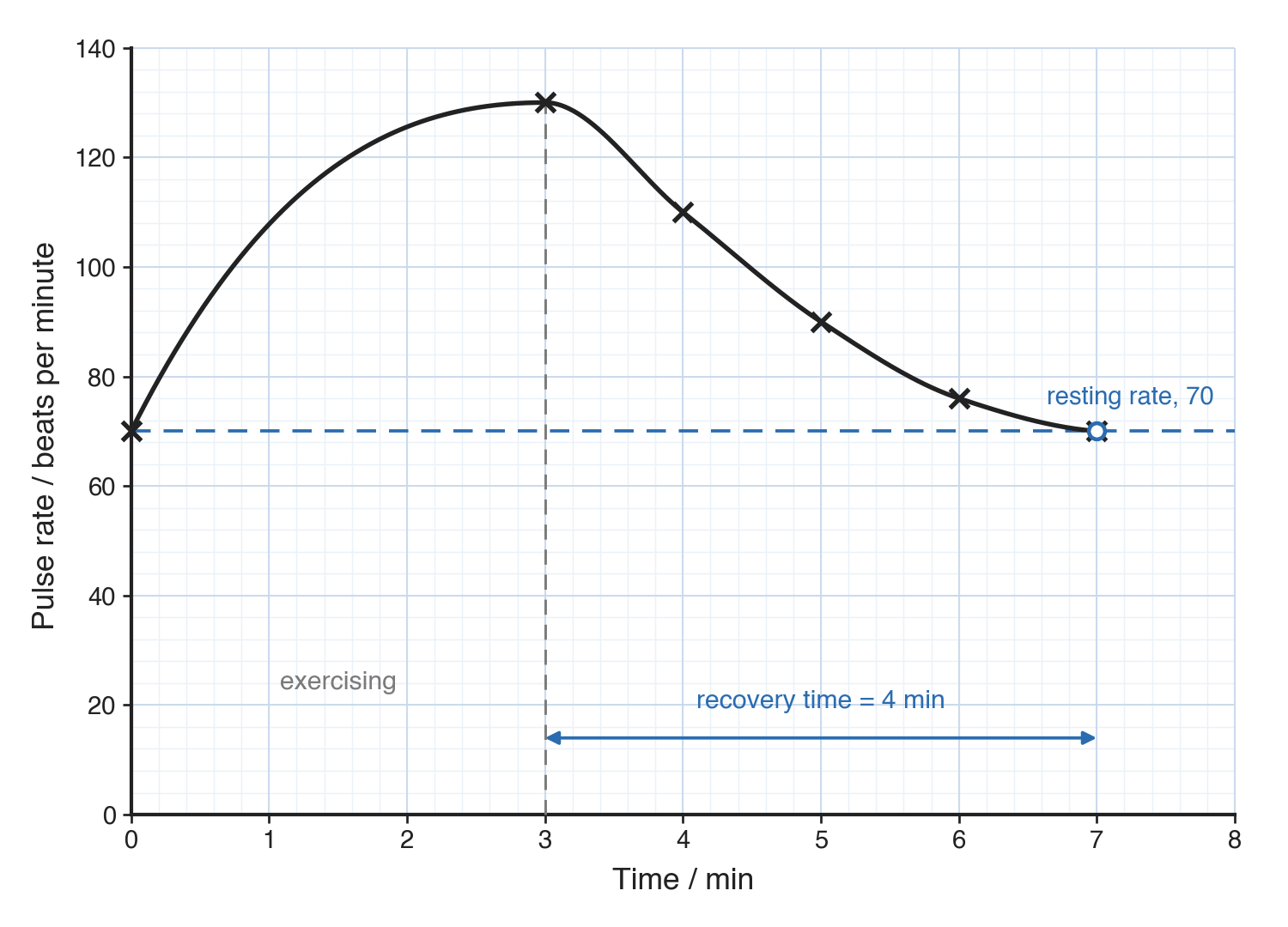
A student measured her pulse rate at rest, straight after 3 minutes of exercise, and then every minute afterwards.
| Time | Pulse rate (beats per minute) |
|---|---|
| At rest | 70 |
| Just after exercise | 130 |
| 1 minute after | 110 |
| 2 minutes after | 90 |
| 3 minutes after | 76 |
| 4 minutes after | 70 |
Calculate the increase in her pulse rate and the percentage increase. Then find the recovery time, and describe the trend.
Step 1 - Work out the increase in pulse rate
Take the resting rate away from the rate just after exercise.
Increase = 130 - 70 = 60 beats per minute
Step 2 - Work out the percentage increase
A percentage increase lets you compare people who start at different resting rates.
Step 3 - Plot the graph and read off the recovery time
Plot pulse rate on the y-axis against time on the x-axis, and draw a smooth curve. The recovery time is when the curve gets back to the resting value of 70 beats per minute. Here that's 4 minutes after she stopped.
Step 4 - Describe the trend
Her pulse rate rose during the exercise, from 70 to 130 beats per minute, because her muscles were respiring faster and needed more oxygen. Once she stopped, it fell back down, quickly at first and then more slowly, reaching her resting rate after 4 minutes.
Common exam questions
Question 1
Why does the pulse rate increase during exercise?
The heart beats faster to pump blood round more quickly. That supplies the muscles with more oxygen and glucose, and carries away the extra carbon dioxide.
Question 2
Why does the breathing rate increase during exercise?
To take oxygen into the blood faster and remove carbon dioxide from it faster, to keep up with the muscles respiring more quickly.
Question 3
Two people did the same exercise. Person A's pulse returned to rest in 2 minutes, and Person B's in 5 minutes. Who is fitter, and why?
Person A. A shorter recovery time shows a fitter person, whose heart and lungs deliver oxygen and clear carbon dioxide more efficiently, so the body returns to normal sooner.
Question 4
Why is a resting reading taken first?
To give a baseline to compare the reading after exercise against, so you can see how much the exercise changed the rate.
Question 5
Why does breathing stay faster than normal for a while after the exercise stops?
To repay the oxygen debt. During hard exercise the muscles also respired anaerobically and built up lactic acid, and extra oxygen is needed afterwards to break it down.