Homeostasis - exam practice
Homeostasis
Question 1 of 6
The endocrine system coordinates many internal functions of the body.
Give three ways in which the endocrine system differs from the nervous system.
The response of the skin to cold weather is an involuntary action.
How is an involuntary action different from a voluntary action?
Give the name of the process by which the internal conditions of the body are maintained.
A diabetic woman needs to calculate the number of grams of carbohydrate in her meals.
She then uses the mass of carbohydrate to calculate the number of units of insulin she will need to inject to lower her blood glucose concentration. She takes no other medications.
Does the woman suffer from type 1 or type 2 diabetes?
Explain your answer.
The woman eats a jam doughnut and drinks a hot chocolate before going to bed.
The doughnut contains 38 g of carbohydrate. The hot chocolate contains 12 g of carbohydrate.
The woman needs to inject 1 unit of insulin for every 10 grams of carbohydrate she consumes.
How many units of insulin will she need to inject to control a rise in her blood glucose levels?
Apart from injecting insulin, give one other way the woman could help to control the concentration of glucose in her blood.
The body cells of a person with untreated diabetes lose more water than the cells of a person without diabetes.
Explain how diabetes can cause the cells to lose more water.
A scientist studied two populations in very different environments.
One of the populations lives in a hot desert. The other population lives in a rainforest.
The scientist recorded the air temperature, mean humidity levels and mean wind speed, in the desert and in the rainforest.
The scientist also recorded the core body temperature of members of both populations.
The data was recorded in the table below.
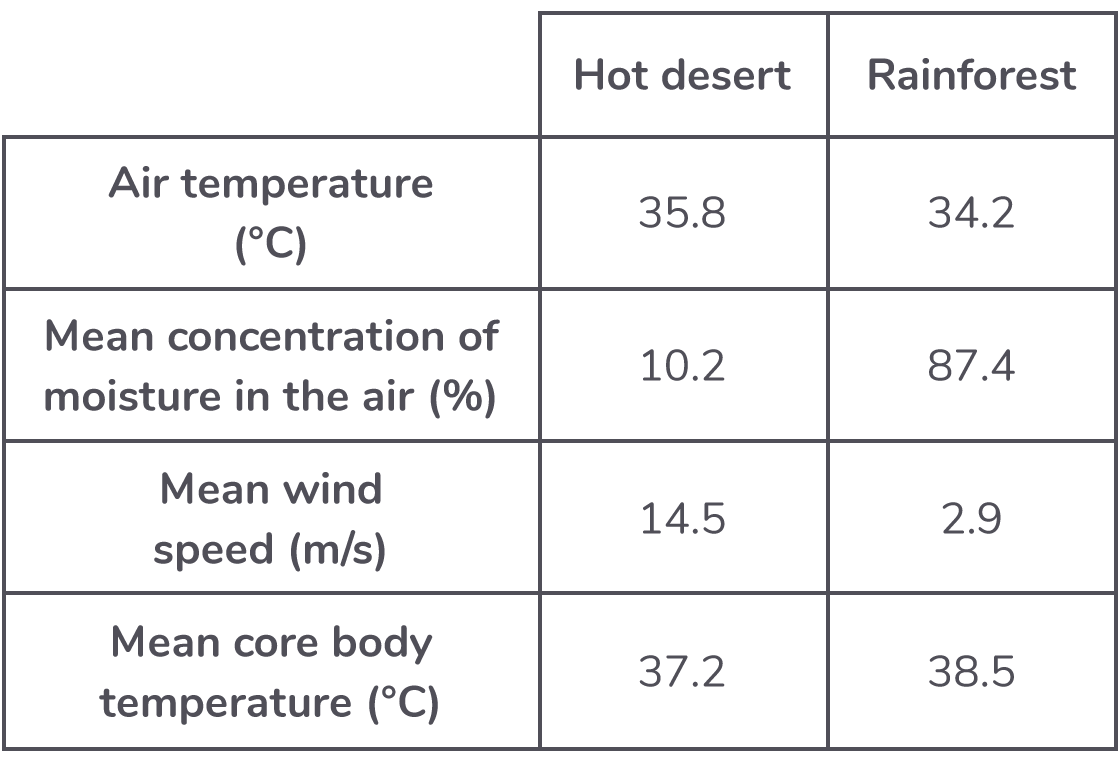
Why is it important to maintain a constant body temperature?
Use information from the table and your prior knowledge to explain the difference in the mean core body temperature of the members of the two tribes.
What happens to blood vessels if a persons core body temperature is too high?
Homeostasis keeps conditions in the body relatively constant.
Body temperature and the amount of water in the body are both controlled by homeostasis.
The human body maintains a constant core body temperature of around 37°C.
Describe what happens in the body to keep the body temperature constant.
Some people suffer from diabetes.
People with type 1 diabetes do not produce enough insulin to maintain an appropriate level of blood glucose.
Which organ in the body monitors blood glucose concentration?
Insulin causes its target organs to take in glucose from the blood.
Which of the following is a target organ for insulin?
Explain how blood glucose levels are controlled in the body of a person who does not suffer from diabetes.
The control of blood sugar is an example of a negative feedback mechanism.
State what is meant by negative feedback and explain how negative feedback works.
Insulin is a protein.
Insulin must be injected as it cannot be taken as a tablet.
Suggest what would happen to an insulin tablet if it reached the stomach.
Compare the causes of type 1 and type 2 diabetes, and explain how each type of diabetes can be treated.
The diagram below shows a cross section of human skin.
Name structures A, B and C.
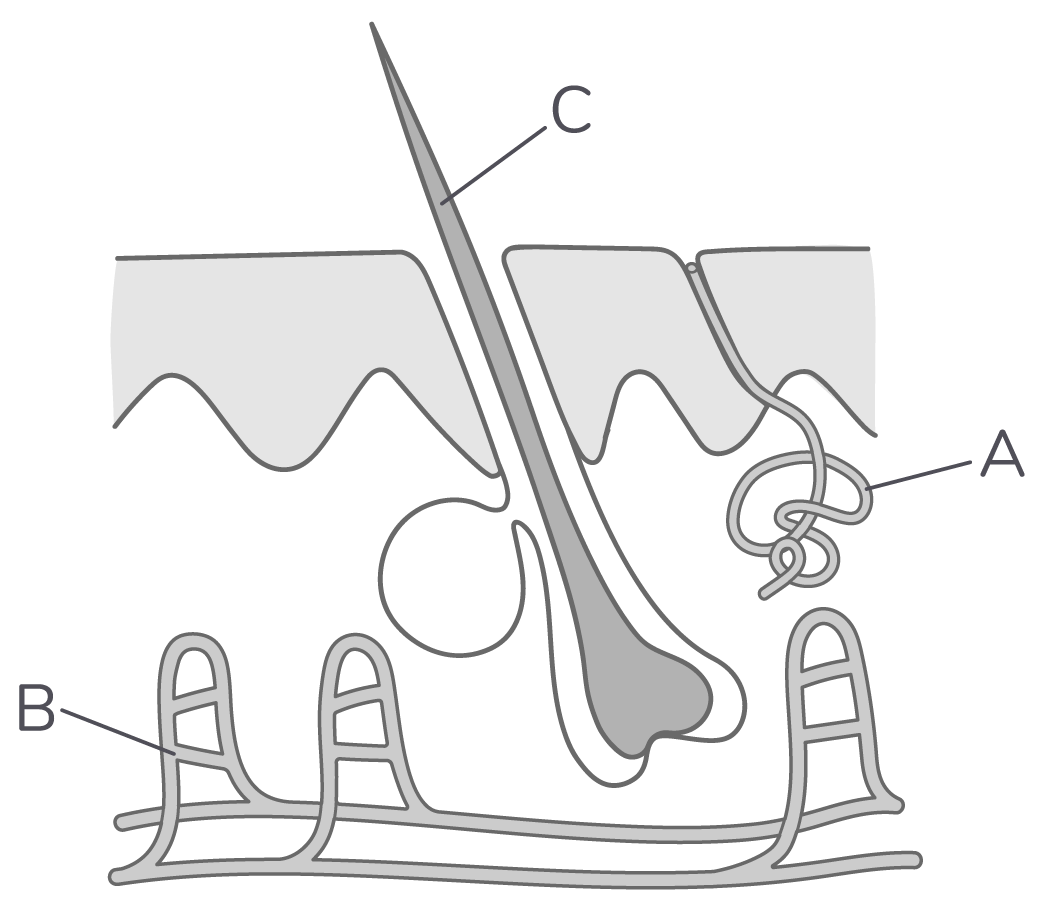
Describe the appearance of human skin when the temperature drops.
Use information from the diagram and your own knowledge to explain the change in appearance of human skin following exposure to a cold environment.