4.3 - Ventilation
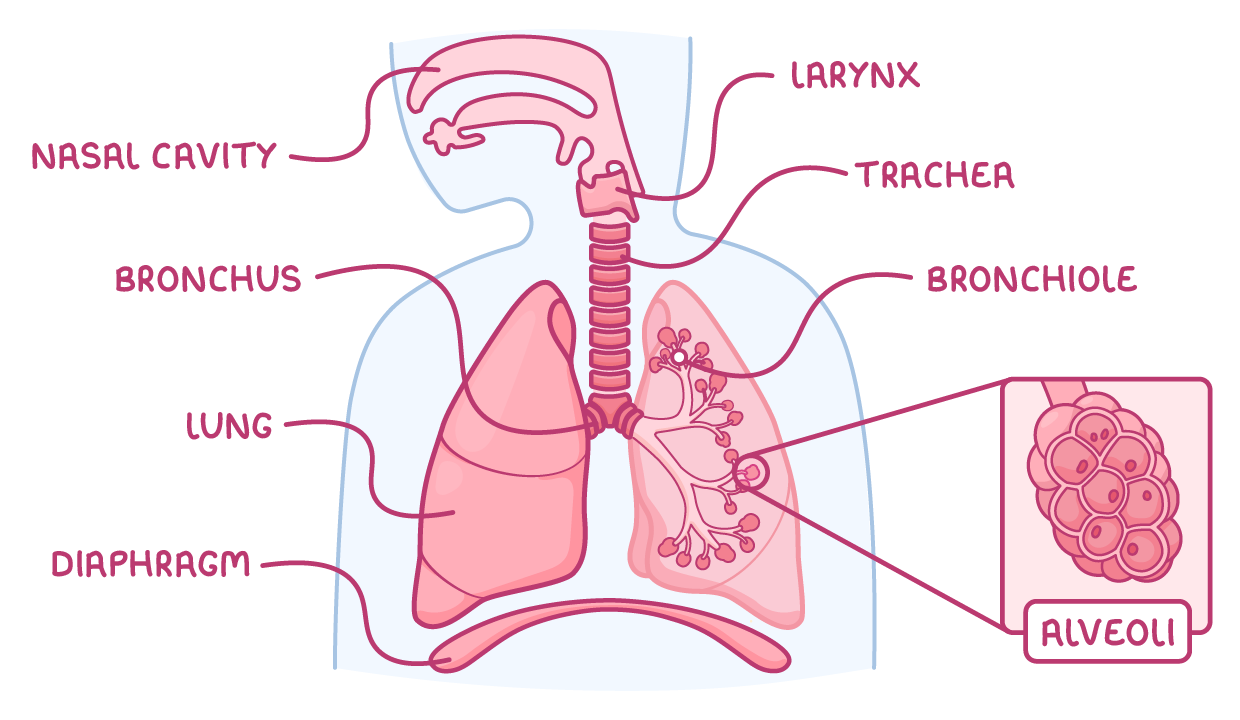
The breathing-system structures
- The lungs are the organs where air is taken in and let out.
- They sit inside the thorax - the chest cavity between the neck and the diaphragm.
- The lungs are protected by the ribcage, with intercostal muscles running between the ribs.
- Below the lungs, a sheet of muscle called the diaphragm separates the thorax from the lower part of the body.
- Thin pleural membranes surround the lungs themselves.
The path of air into the lungs
Air breathed in travels through a series of structures before reaching the sites of gas exchange:
- Nasal cavity - Air enters here first.
- Larynx - Air passes through next.
- Trachea (windpipe) - A hollow tube held open by C-shaped rings of cartilage, so it stays strong but can still move.
- Bronchi - The trachea divides into two of these tubes, one bronchus to each lung.
- Bronchioles - Each bronchus branches into progressively smaller tubes.
- Alveoli - The bronchioles end in these tiny air sacs, where gas exchange takes place.
The mechanism of breathing
- Breathing in (inspiration) and breathing out (expiration) move air into and out of the lungs.
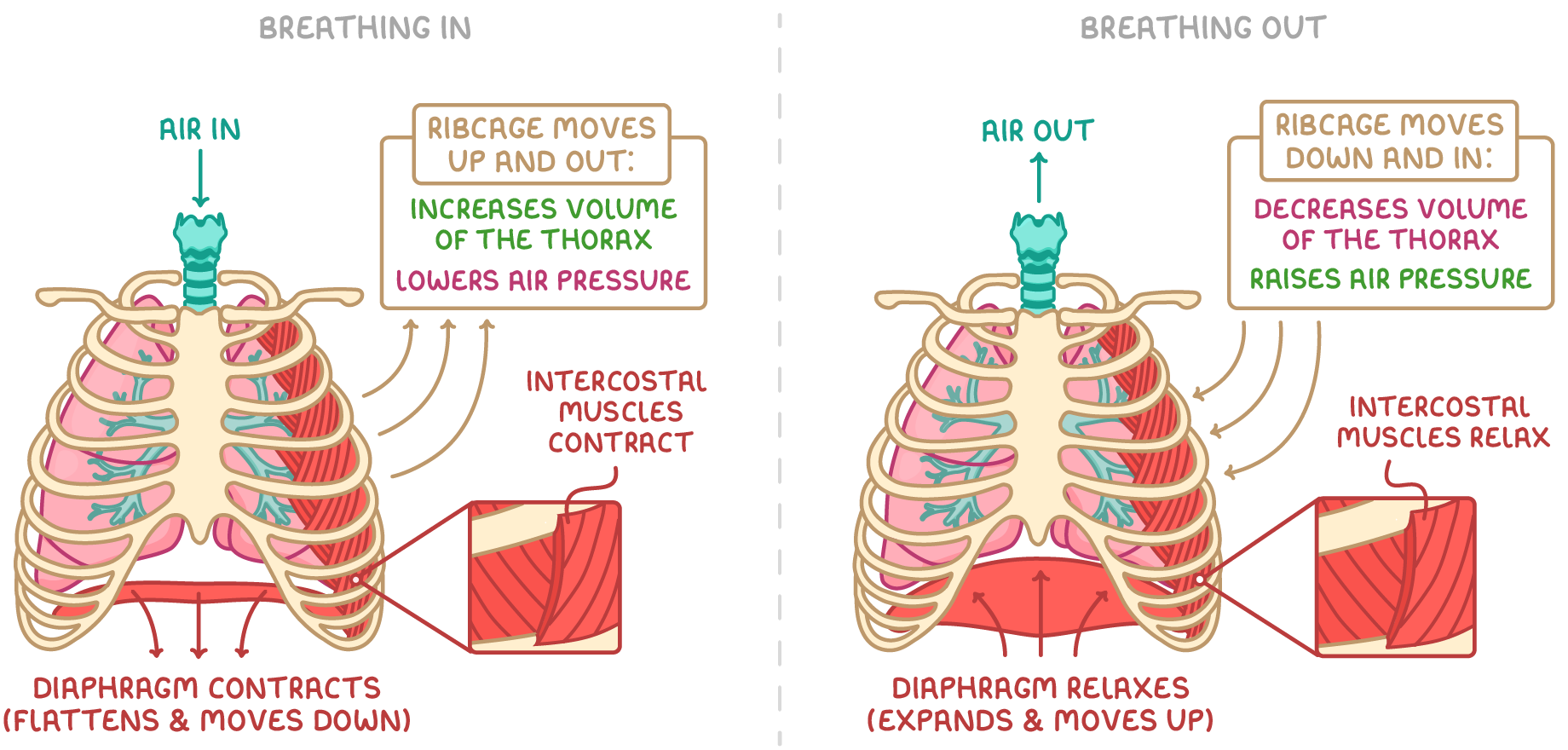
- This works by changing the volume of the thorax (chest), which changes the air pressure inside the lungs.
- Air always moves down the pressure difference - from where pressure is higher to where it is lower.
Breathing in (inspiration)
- The intercostal muscles and the diaphragm muscle contract.
- The intercostal muscles pull the ribcage upwards and outwards; the diaphragm flattens and moves down.
- Together these movements increase the volume of the thorax.
- The larger volume lowers the air pressure inside the lungs until it is below atmospheric pressure outside the body.
- Air flows in through the trachea to fill the lungs.
Breathing out (expiration)
- The intercostal muscles and the diaphragm relax.
- The ribcage moves downwards and inwards; the diaphragm returns to its domed shape.
- These movements decrease the volume of the thorax.
- The smaller volume raises the air pressure inside the lungs until it is above atmospheric pressure.
- Air is forced out of the lungs.
TermDefinition
ThoraxThe chest cavity between the neck and the diaphragm.
DiaphragmA sheet of muscle below the lungs that separates the thorax from the lower part of the body.
TracheaThe tube, held open by rings of cartilage, that carries air from the mouth and nose to the lungs.
BronchiThe two tubes that the trachea divides into, leading to each lung.
AlveoliThe tiny air sacs in the lungs where gas exchange takes place.
InspirationThe process of breathing air into the lungs.
ExpirationThe process of breathing air out of the lungs.