4.2 - Evidence for Evolution
Evidence for evolution
- The theory of evolution by natural selection says species have changed over time and share common ancestors.
- When first proposed there was little to confirm it, but a great deal of evidence has built up since, so the theory is now widely accepted.
- Three independent lines of evidence support it: inheritance genetics, the fossil record, and present-day change.
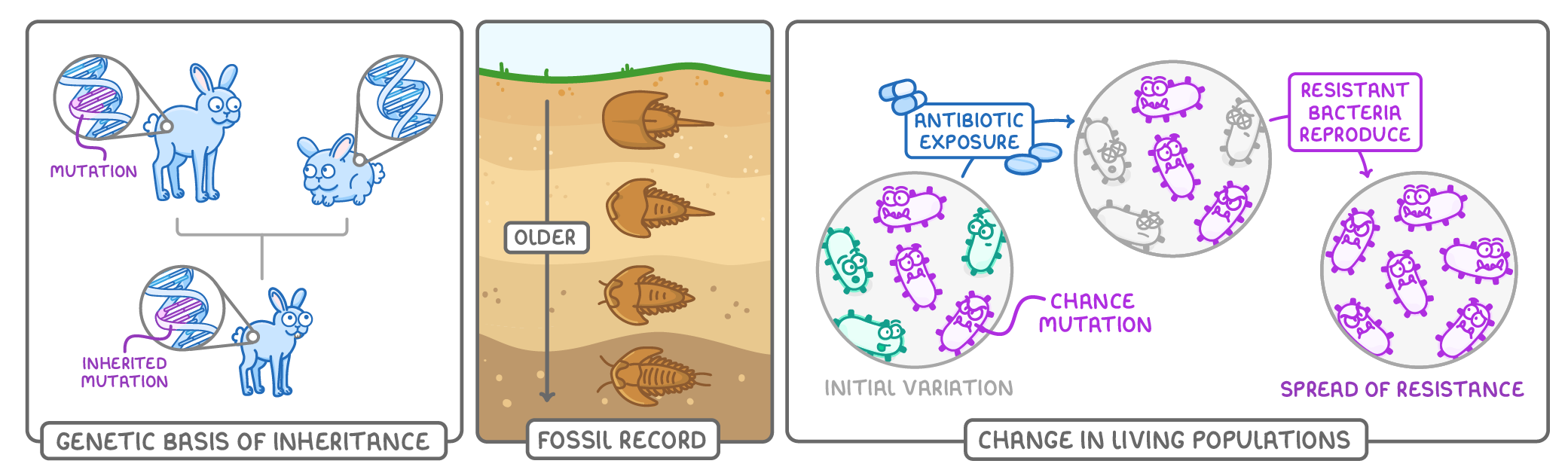
Genetic basis of inheritance
- When the theory was first proposed, there was no explanation for where new characteristics came from or how they were passed on.
- It's now known that:
- Characteristics are controlled by genes.
- New variations arise from mutations changing the genetic material.
- These variations are passed from parents to offspring in their genes.
- This supplied the mechanism the original theory was missing, showing how beneficial characteristics can be inherited and become more common over generations.
The fossil record
- Fossils are the preserved traces or remains of organisms that lived long ago, most commonly found in rocks.
- Deeper rock layers generally hold the older fossils.
- Arranging fossils of different ages in order shows how organisms gradually changed over very long periods, and which forms appeared and disappeared.
- This gives direct evidence that life has not stayed the same but has evolved.
Change observed in the present day
- Bacteria evolve quickly because they reproduce rapidly, and populations have been seen to develop resistance to antibiotics:
- A chance mutation gives some bacteria an advantage when antibiotics are present.
- Those bacteria survive and reproduce.
- The resistant form spreads through the population.
- The same present-day change is seen in other organisms - rats becoming resistant to the poison warfarin, and insects becoming resistant to pesticides.
- These are examples of natural selection happening now, in observable time, not only in the distant past.
Together, the genetic basis of inheritance, the fossil record, and change in living populations all support the conclusion that organisms have evolved and that present-day species are descended from common ancestors.
Human evolution - Fossils, tools and dating
- Fossil evidence shows humans evolved, alongside chimpanzees, from a shared common ancestor that lived around six million years ago.
- Humans and their extinct ancestors are called hominids, and several hominid species are known from fossils.
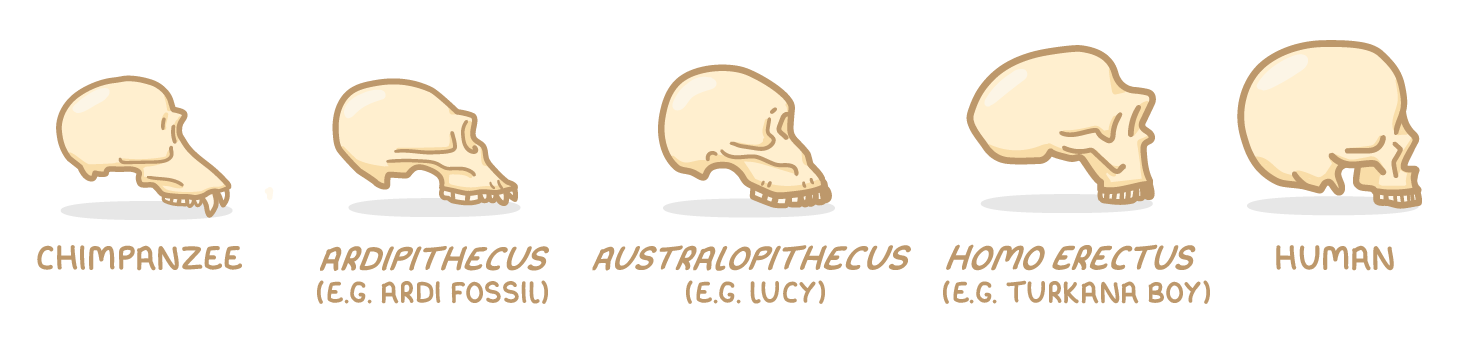
- These fossils have features falling between those of apes and modern humans. Arranging them by age traces how humans became more human-like over time.
Key hominid fossils in order of age
- Ardi - Ardipithecus ramidus, found in Ethiopia, dated to 4.4 million years ago:
- Ape-like grasping big toe, suggesting she climbed trees
- Long arms, short legs, and a brain about the size of a chimpanzee's
- Structure of her legs and hands suggests she could walk upright
- Lucy - Australopithecus afarensis, from Ethiopia, 3.2 million years old and more human-like than Ardi:
- Arched feet adapted to walking rather than climbing, with no grasping big toe
- Limb proportions between those of apes and humans
- Brain only slightly larger than Ardi's
- Leg and foot bones show she walked upright more efficiently
- Turkana Boy - Homo erectus, a 1.6-million-year-old skeleton found by Richard Leakey's team in Kenya in 1984:
- Short arms and long legs, much like a modern human
- Brain close to human size
- Legs and feet show he was better adapted to upright walking than Lucy
Placed on a timeline, these fossils show a clear progression from ape-like ancestors towards modern humans.
Stone tools as evidence
Tools became steadily more complex over time, which suggests the hominids' brains were getting larger.
| Hominid | Tools | When |
|---|---|---|
| Homo habilis | Simple pebble tools - rocks struck together to make sharp flakes for scraping meat from bones | About 2.5-1.5 million years ago |
| Homo erectus | More complex tools, such as simple hand-axes for hunting, digging, and chopping | - |
| Homo neanderthalensis | More sophisticated flint and pointed tools and wooden spears | - |
| Homo sapiens | Flint tools used widely, with pointed tools such as arrowheads, fish hooks, and needles | Around 50,000 years ago |
Dating fossils and tools
- Tool structure - Gives a rough guide, since simpler tools are usually older than more complex ones.
- Stratigraphy - The study of rock layers, and more reliable. Older layers normally lie below younger ones, so a fossil or tool found in a deeper layer is usually older.
- Carbon-14 dating - Where a stone tool is found with carbon-containing material (such as a wooden handle), this can date that material directly.
TermDefinition
FossilThe remains or traces of organisms that lived millions of years ago, most often preserved in rocks.
MutationA random change in an organism's genetic material (DNA).
HominidA human or an extinct human ancestor.
StratigraphyThe study of rock layers, used to date fossils and tools based on how deep they are found.
Key points to remember
How were these notes?