9.7 - Maintaining Biodiversity
Conservation programmes
- When humans damage an ecosystem, biodiversity falls - but the trend can be reversed by reducing harmful practices or by protecting species and habitats so they recover.
- Conservation programmes are set up by scientists, governments, and concerned citizens to do this.
Breeding programmes
- Often set up for endangered species - those at high risk of extinction.
- Animals are bred in captivity (e.g. in zoos), where numbers can be built up safely with less infant mortality than in the wild.
- Individuals can later be reintroduced to the wild to boost an existing population or start a new one.
- This only works long term if the natural habitat is also safe.
Protecting and regenerating habitats
- Rare habitats worth protecting include mangroves, heathland, coral reefs, and wetlands.
- Protected areas - Creating national parks, nature reserves, and Sites of Special Scientific Interest, where building and farming are restricted.
- Managing habitats - For example, controlling water levels to conserve wetlands, and coppicing to conserve woodland.
Other conservation methods
- Seed banks - Store the seeds of rare and endangered plants, preserving their genetic diversity for the future.
- Controlling non-native species - The introduction of harmful non-native species can be controlled to protect native wildlife.
- Educating people - Teaching people about the value of biodiversity and how their choices affect it; public understanding and support make the other measures possible.
Reforestation and sustainable use
- Human activity doesn't only damage biodiversity - it can also have positive effects.
- Conserving species and habitats is one of the main ways to protect biodiversity.
Reforestation
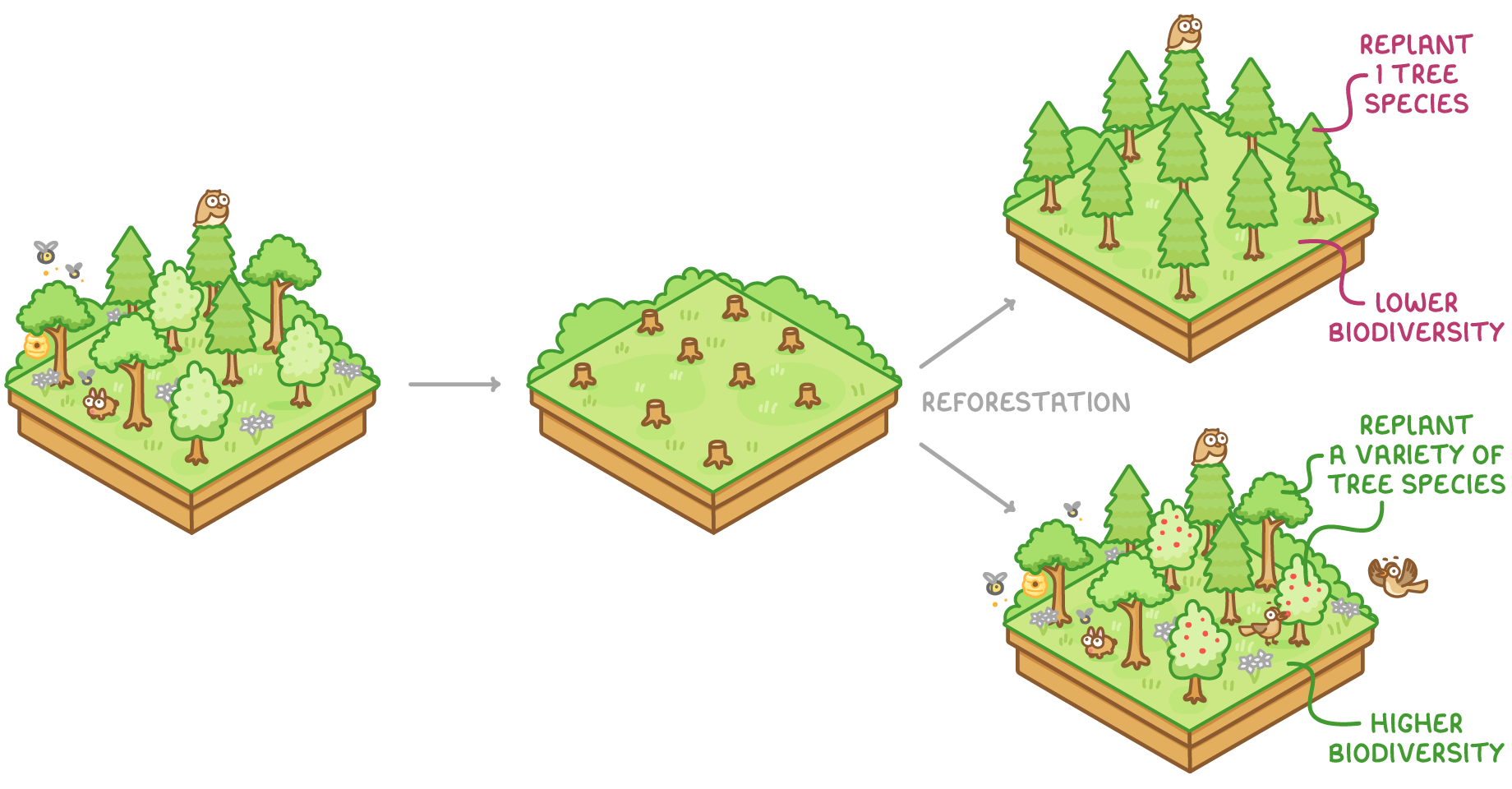
- Reforestation is replanting a forest in an area where one previously stood.
- Forests have high biodiversity because they contain a wide variety of trees and plants that provide food and shelter for many animal species.
- Deforestation reduces biodiversity by removing the trees, so reforestation helps to restore it.
- Schemes need careful planning: replanting with a variety of tree species gives higher biodiversity than replanting with a single type.
- Protecting the habitats animal species depend on helps stop them dying out - this matters because the loss of one species affects every organism in the food chain that depends on it.
Sustainable woodlands
- Sustainable woodland is planted to meet commercial needs (for example timber and paper) at the same rate it is harvested.
- This means the resource is not used up and the habitat is maintained.
International treaties
On a larger scale, treaties between governments aim to reduce global carbon dioxide levels and so limit the warming that threatens habitats:
- Kyoto Protocol (1997) - Had limited success because many countries did not sign up.
- Paris Agreement (2015) - Legally binding, has far more signatories, and aims to limit global warming to well below 2 degrees Celsius compared with pre-industrial levels.
TermDefinition
Endangered speciesA species that is at a high risk of extinction.
ReforestationThe replanting of a forest in an area where one previously stood.
Key points to remember
How were these notes?