5.11 - Developing New Medicines
Discovering new medicines
- Many medicines used today were first discovered by studying the natural world.
- Plants and microorganisms have evolved over millions of years to make chemicals that protect them. Some of these chemicals turn out to be useful drugs for treating disease or relieving symptoms.
Medicines discovered from natural sources
- Digitalis - A heart drug developed from a chemical found in foxgloves
- Aspirin - A painkiller developed from a chemical found in the bark of willow
- Penicillin - An antibiotic discovered by Alexander Fleming
How penicillin was discovered
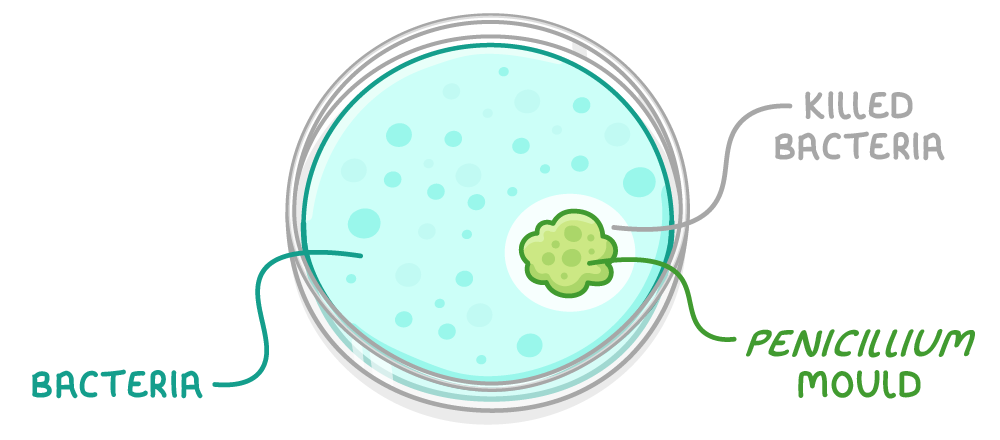
- Fleming noticed that a Penicillium mould, growing by accident on one of his bacterial plates, had killed the bacteria around it.
- He found the mould was producing a substance - penicillin - that killed the bacteria.
- Later, two other scientists, Florey and Chain, isolated this substance so it could be produced commercially as the first antibiotic.
- The discovery shows how important careful observation and the scientific process are in developing new medicines.
How new medicines are made today
- Most new drugs are now synthesised by chemists in the pharmaceutical industry, though the starting point may still be a chemical extracted from a plant.
- Another modern approach begins from the disease itself:
- Scientists identify a target - usually a gene or protein involved in causing the disease.
- They screen large numbers of chemicals to find ones that act on that target.
- They modify the most promising ones into a possible drug.
Preclinical testing
- Any possible new drug must be tested thoroughly before being given to people, to check it is both safe and effective.
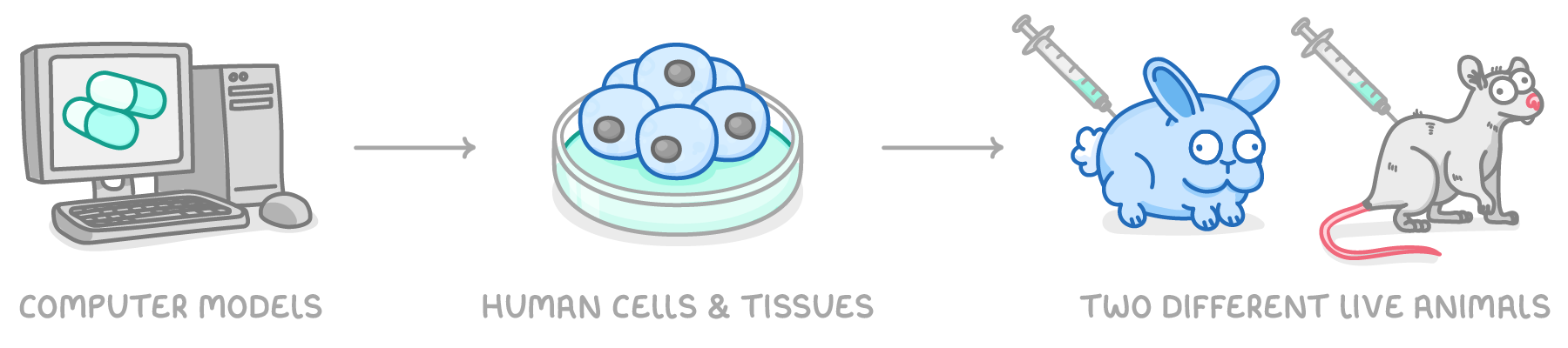
- Preclinical testing is the first stage. It is carried out in the laboratory, not on people, and works through three steps in order.
Stages of preclinical testing
- Computer models and simulations - Used first to identify the most promising drugs before any living material is involved
- Human cells and tissues - Grown in the lab; a cheap way to screen many substances
- Live animals - In Britain the law requires any new drug to be tested on two different live mammals
Why cells and tissues aren't enough
- Testing on cells and tissues cannot show how the drug would affect a whole body, because cells and tissues are not joined into working organs and systems.
- For example, a drug for blood pressure has to be tried on a whole animal with an intact circulatory system.
What animal testing checks
- Efficacy - Whether the drug actually produces the effect wanted
- Toxicity - How harmful it is and whether it causes side effects
- Best dose - What amount should be given
The ethical debate
- Animal testing is a subject of ethical debate.
- Some people object to it, while others argue it is the safest way to be sure a drug is not dangerous before any human takes it.
- Computer models are increasingly used and may one day replace some of it.
Clinical trials
- A clinical trial is when a candidate drug is tested on people - it happens once the drug has passed all its preclinical tests.
- Trials are extensive, large-scale, and rigorous, because any drug given to the public must be shown to be both safe and effective - and even a drug that passes can still have side effects.
- Trials take a long time and cost a great deal, but they're the only way to be confident about how a new drug behaves in real patients before it's approved for general use.
The two stages of a clinical trial
- Healthy volunteers first - The drug is given to a small number of healthy people, starting with a very low dose that is increased gradually. This checks it has no harmful side effects when the body is working normally.
- Patients with the illness next - If results from the healthy volunteers are good, the drug is given to patients who actually have the illness it's meant to treat.
Finding the optimum dose
- With patients, the aim is to find the optimum dose.
- This is the dose that gives:
- The most benefit - the greatest efficacy
- The fewest side effects - the least toxicity
Reducing bias in clinical trials
- To find out how well a drug really works, patients in a trial are divided at random into two groups:
- One group is given the new drug.
- The other is given a placebo - a substance made to look exactly like the drug but containing no active medicine (e.g. a sugar pill).
- Comparing the two groups shows the real difference the drug makes.
- This controls for the placebo effect - the tendency of a patient who expects to get better to feel better even when their treatment does nothing.
Blind and double-blind trials
To stop people's expectations affecting the results, clinical trials are usually blind or double-blind:
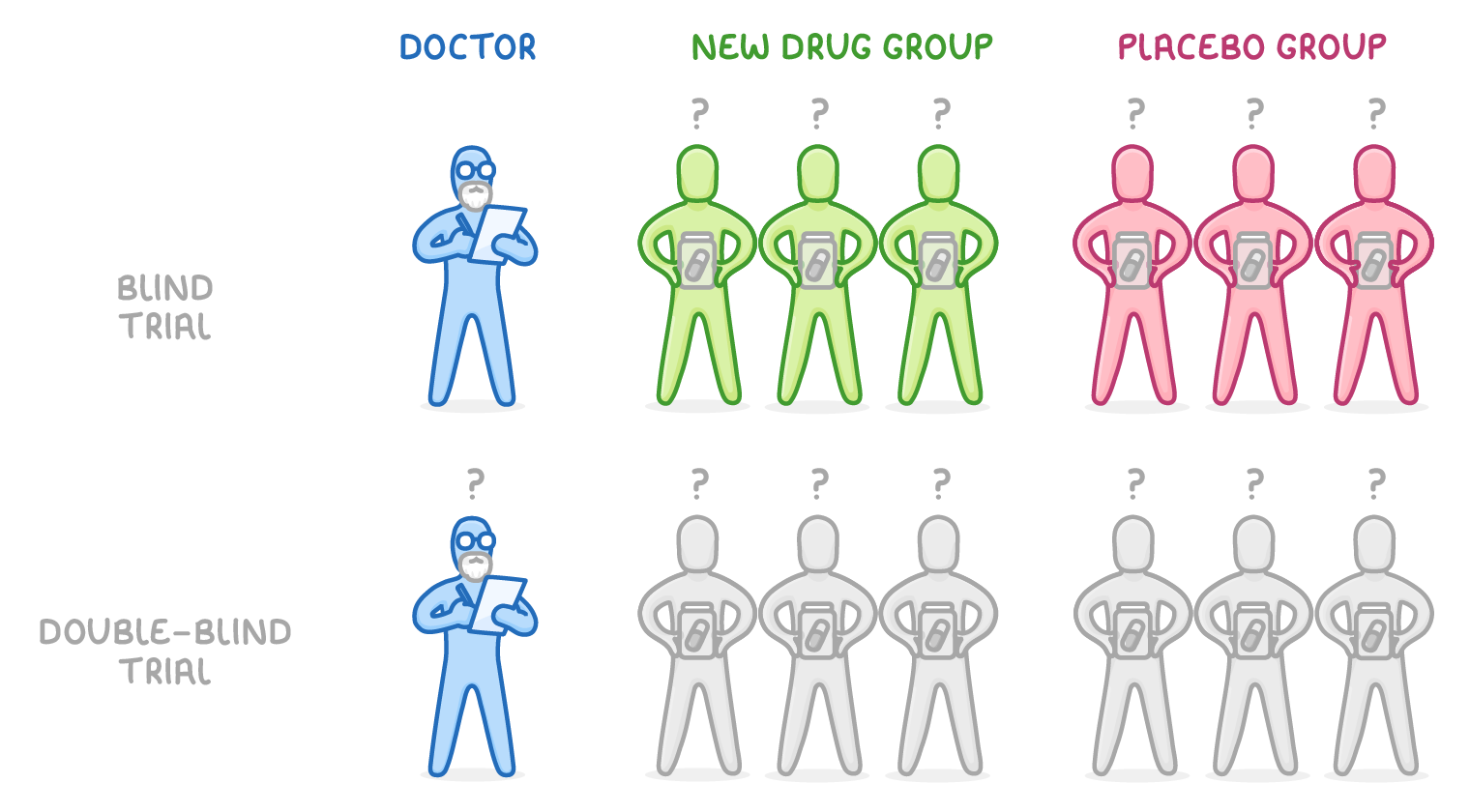
- Blind - The patient does not know whether they are receiving the drug or the placebo.
- Double-blind - Neither the patient nor the doctor knows who is getting which until all the results have been collected and analysed.
Most trials are double-blind. This prevents the doctors who monitor the patients and judge the results from being unconsciously influenced by what they expect to see.
Peer review
- Once all the testing and trials are complete, the results are written up and go through peer review before they are published.
- In peer review, the work is scrutinised by other scientists of at least the same standing, who check that the methods and conclusions are sound.
- This independent checking helps prevent false claims or unreliable results from being accepted.
- It is a central part of how science is validated.
TermDefinition
Preclinical testingThe first stage of drug testing, carried out in a laboratory on computer models, human cells, tissues and live animals.
EfficacyWhether a drug actually produces the effect wanted.
ToxicityHow poisonous or harmful a substance is (for a new drug, whether it has harmful side effects).
Clinical trialThe stage of drug testing where a candidate drug is tested on healthy human volunteers and patients.
Optimum doseThe amount of a drug that gives the most benefit with the fewest side effects.
PlaceboA substance made to look exactly like a real drug but containing no active medicine.
Double-blind trialA clinical trial where neither the patient nor the doctor knows who is getting the drug or the placebo until all results have been collected.
Peer reviewThe checking of scientific work by other scientists who are experts in the same field before it is published. They make sure the methods and conclusions are sound.
Key points to remember
How were these notes?