10.3 - Effect of pH, Temperature & Concentration on Enzyme Activity
The experiment
Aim
To find out how the pH of a solution affects the rate at which the enzyme amylase breaks down starch.
Background
- An enzyme such as amylase has an active site, with the exact shape needed to hold its substrate and break it down. Amylase's substrate is starch.
- Every enzyme works fastest at its optimum pH. Away from that pH, the active site changes shape, so the substrate fits less well and the reaction slows.
- If the pH is too far from the optimum, the shape changes permanently. The enzyme is denatured and stops working.
- You can't see the starch being broken down, but you can test samples with iodine solution, which stays orange-brown once all the starch has gone.
- So in this practical you time how long amylase takes to break down all the starch at different pH values. The shorter the time, the faster the rate.
Variables
- Independent variable - The pH of the solution, set using a buffer.
- Dependent variable - The time taken for the starch to be fully broken down, turned into a rate.
- Control variables - The temperature, the volume and concentration of the amylase and of the starch, and the sampling routine (the same volume of iodine and the same time between samples).
Method
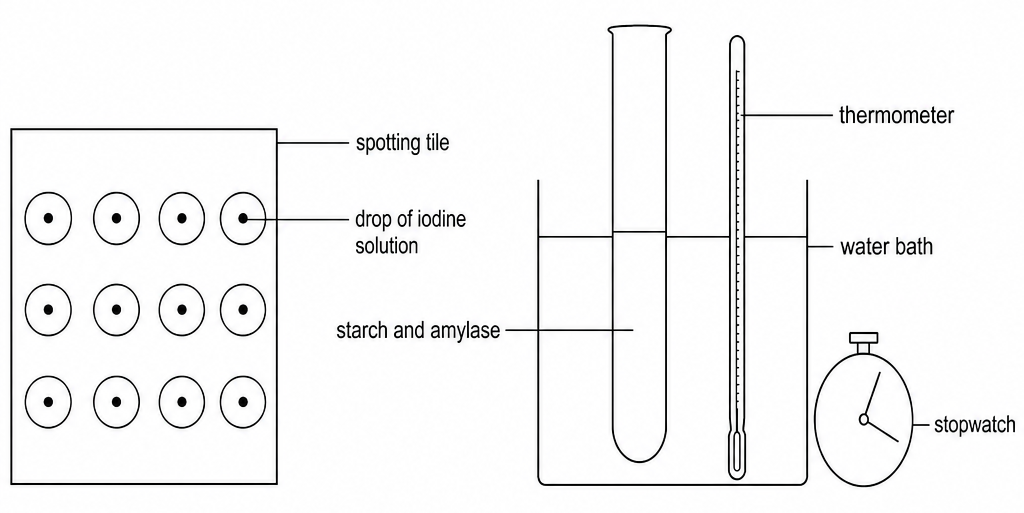
- Set out the iodine - Put a drop of iodine solution into each well of a spotting tile.
- Measure the buffer - Use a syringe to measure a set volume of buffer at your first pH into a test tube.
- Warm everything to the same temperature - Stand the buffer, starch, and amylase in a water bath until they all reach the temperature of the bath.
- Start the reaction - Add the starch to the buffer, then add the amylase, mix, and start the stopwatch.
- Take a sample every 10 seconds - Use a glass rod to put a drop of the mixture into the next iodine well, rinsing the rod between samples.
- Stop the clock - When a sample leaves the iodine orange-brown, and record the time.
- Repeat at other pH values - For example pH 4, 5, 6, 7, and 8, then repeat the whole experiment and find a mean time at each pH.
Safety
- Iodine solution - It's an irritant, so wear eye protection and wash any off your skin at once.
- Buffer solutions - The acidic and alkaline ones are irritants, so measure them with a syringe rather than pouring, and mop up spills straight away.
- Amylase - It can cause an allergic reaction, so keep it off your skin and wash your hands afterwards.
Worked example - Amylase rate from digestion times
A student timed how long amylase took to break down starch at five pH values.
| pH | 4 | 5 | 6 | 7 | 8 |
|---|---|---|---|---|---|
| Time to digest starch (s) | 200 | 100 | 50 | 40 | 80 |
Turn each time into a rate, then use a graph to find and describe the optimum pH.
Step 1 - Choose the formula for the rate
A shorter time means a faster reaction, so the rate is found by dividing by the time.
The 1,000 just keeps the numbers tidy, and the rate has no unit. It's a relative rate, so the values only mean something when you compare one pH with another. Some guides use rate = 1 ÷ time instead. Every value then comes out 1,000 times smaller, but the graph has the same shape and the same optimum pH, so use whichever form you've been taught.
Step 2 - Turn each time into a rate
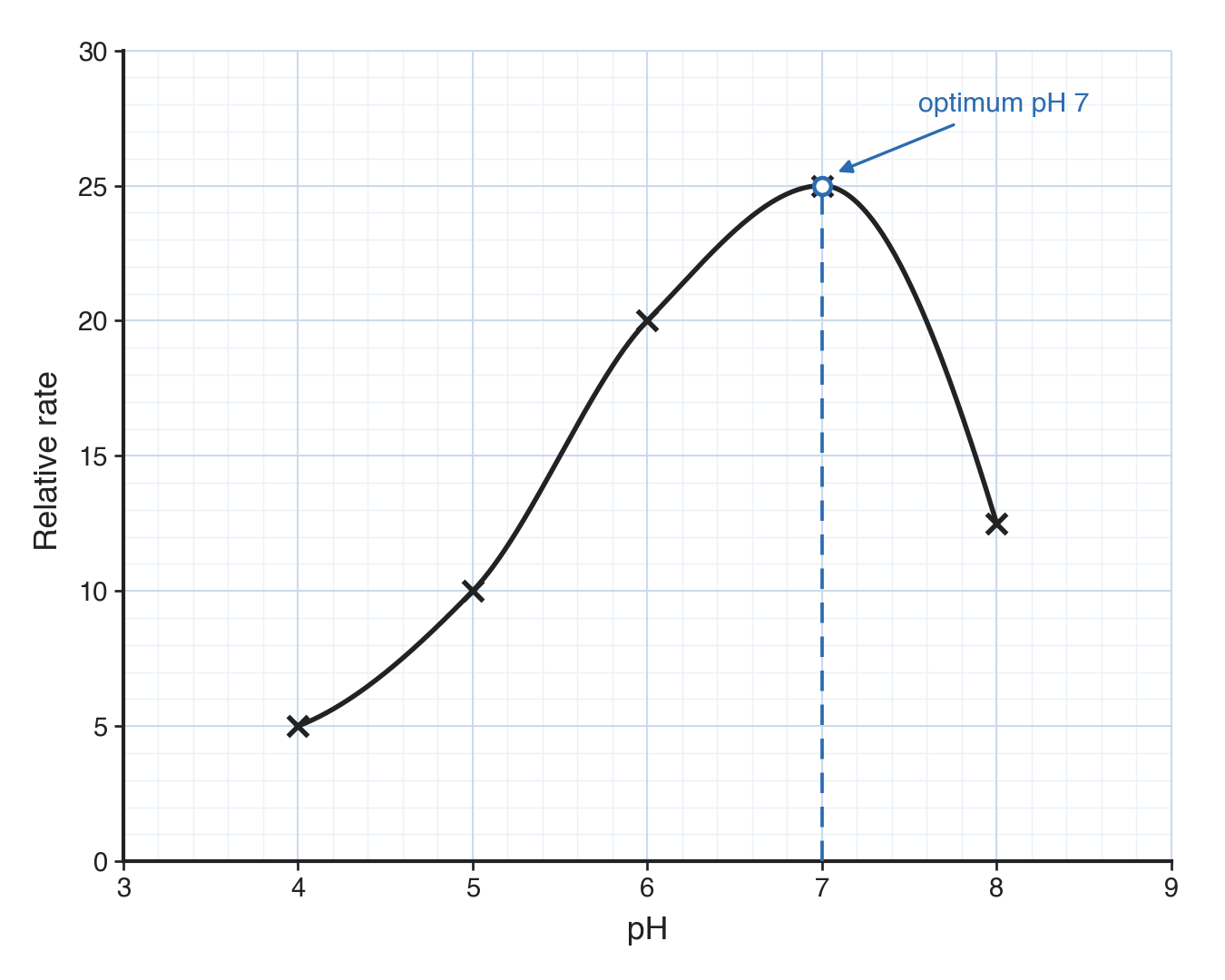
- At pH 4, the rate is 1,000 ÷ 200 = 5.0.
- At pH 5, the rate is 1,000 ÷ 100 = 10.0.
- At pH 6, the rate is 1,000 ÷ 50 = 20.0.
- At pH 7, the rate is 1,000 ÷ 40 = 25.0.
- At pH 8, the rate is 1,000 ÷ 80 = 12.5.
Using rate = 1 ÷ time, pH 7 would give 1 ÷ 40 = 0.025 instead.
Step 3 - Plot the graph and find the optimum pH
Plot the rate on the y-axis against pH on the x-axis, and draw a smooth curve. It rises to a peak at about pH 7, then falls. That peak is the optimum pH, where the active site is exactly the right shape and the reaction is fastest.
Step 4 - Explain the shape of the curve
As the pH rises towards 7, the rate increases, because the active site fits the starch better and better. Above pH 7, the rate drops, because the active site is being distorted, so the starch fits less well. The further the pH is from the optimum, the slower the reaction.
Common exam questions
Question 1
Why is a buffer used?
To hold the pH constant, so that any change in rate is caused only by the pH being tested, not by the pH drifting during the run.
Question 2
Why are the tubes placed in a water bath?
To keep the temperature constant. Temperature also affects the rate, so controlling it makes sure only the pH is changing the result.
Question 3
Amylase in saliva works best at about pH 7. Explain what happens to it in the stomach, where the pH is about 2.
The strong acid changes the shape of the active site, so starch no longer fits. The amylase is denatured and can no longer break down starch.
Question 4
Why is it wrong to say the enzyme was "killed"?
An enzyme isn't alive, so it can't be killed. The correct word is "denatured", which means its shape has been changed.