2.1 - Mitosis
What mitosis is and why the body needs it
- Most body cells have a nucleus holding genetic material as chromosomes - coiled-up lengths of DNA.
- Each chromosome carries many genes, and different genes control the development of different characteristics.
- Body cells normally carry two copies of each chromosome, one from each parent, which makes them diploid.
What mitosis produces
- Mitosis is a type of cell division in which one cell divides to produce two new cells (daughter cells).
- The daughter cells are genetically identical to each other and to the original parent cell - each has exactly the same chromosomes, and so the same genes.
- The chromosome number is kept constant: because the body cell is diploid, each daughter cell is also diploid, with the full set, and no genetic information is lost.
- The full number of chromosomes, counting both copies, is the diploid chromosome complement.
Why the body needs mitosis
- Mitosis is the stage of a repeating sequence called the cell cycle at which the cell actually divides.
- Multicellular organisms use it to:
- Grow - By increasing the number of body cells
- Replace cells that have worn out or been damaged, repairing the tissue
- Mitosis is also how some organisms reproduce asexually, producing offspring genetically identical to the single parent.
The cell cycle
- The cell cycle is the repeating sequence a cell goes through: grow, copy its DNA, divide, and round again.
- A cell that isn't dividing has its DNA spread out in long strings.
- Before a cell can divide, it must prepare so there's enough of everything to share between the two new cells.
Preparing to divide
- The cell grows and increases the number of its sub-cellular structures, such as mitochondria and ribosomes, so there's enough for both new cells.
- It then duplicates its DNA, making one full copy for each new cell.
- The copied DNA forms X-shaped chromosomes, where each half is an exact copy of the other.
- Once its contents and DNA have been copied, the cell is ready for mitosis.
Interphase takes up most of the cycle
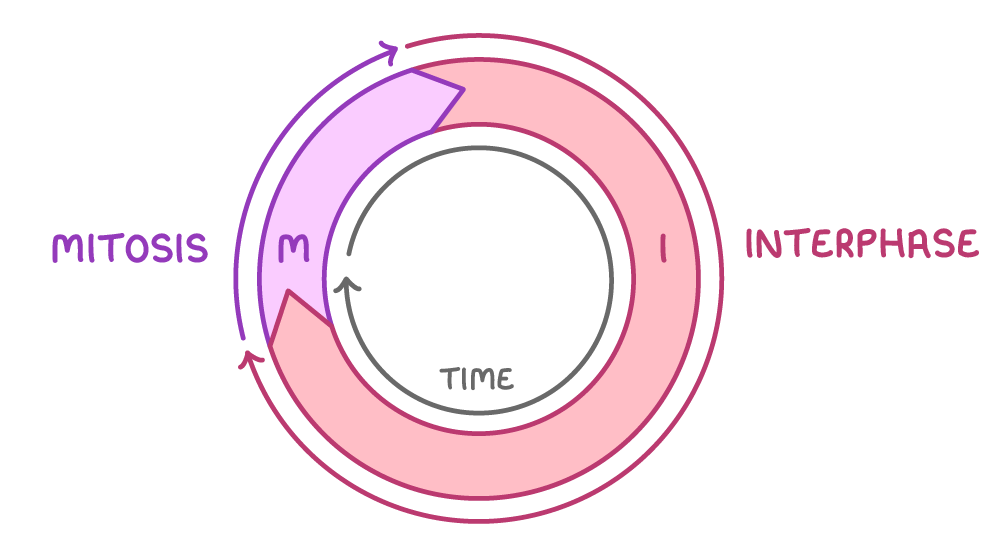
- The long growth-and-preparation period is called interphase.
- A cell spends most of its time in interphase, with mitosis only a small part of the cycle.
The stages of mitosis
- Once the cell's contents and DNA have been copied, it is ready for mitosis.
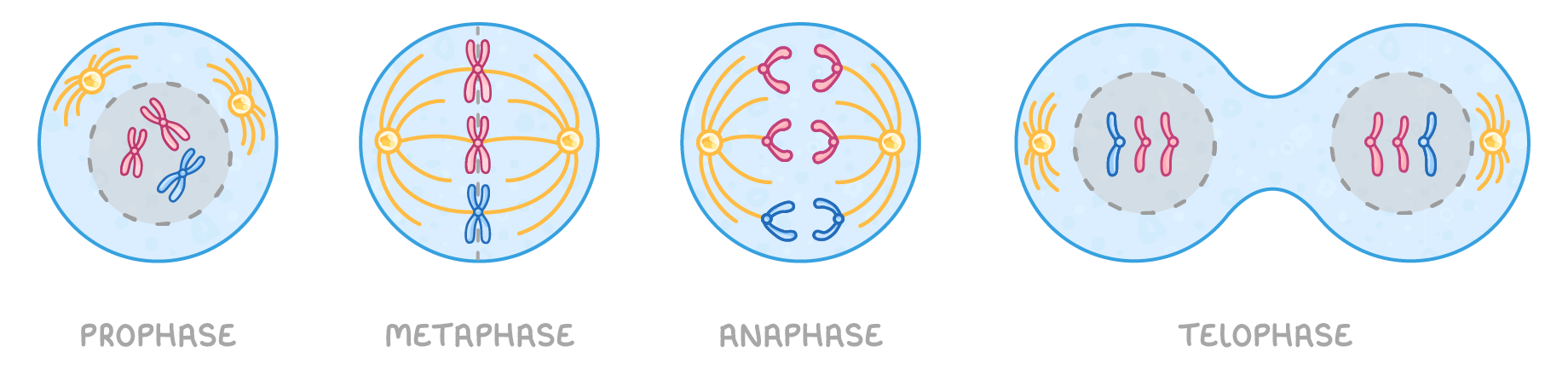
- Mitosis is divided into four named stages that run one after another, ending with telophase.
The four stages
- Prophase - The chromosomes condense (get shorter and fatter), the membrane around the nucleus breaks down, and the chromosomes lie free in the cytoplasm.
- Metaphase - The chromosomes line up across the centre of the cell.
- Anaphase - Spindle fibres pull the chromosomes apart, dragging the two chromatids (the two identical copies that make up each chromosome) to opposite ends of the cell.
- Telophase - A membrane forms around each set of chromosomes, creating the two new nuclei - the nucleus has divided.
Cytokinesis and the result
- Before telophase fully ends, the cytoplasm and cell membrane divide to form two separate cells. This division of the cytoplasm is called cytokinesis.
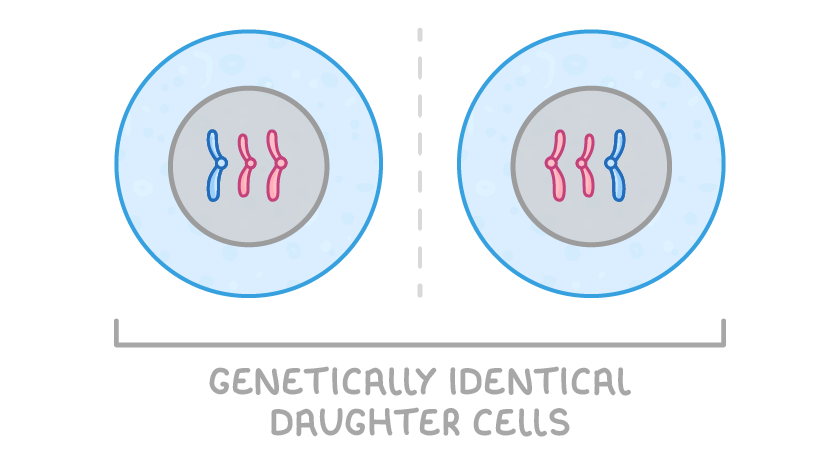
- The result is two daughter cells, each with an identical set of chromosomes.
- The daughter cells are genetically identical diploid cells - identical to each other and to the parent cell.
Cancer - Uncontrolled mitosis
- The rate at which cells divide by mitosis is normally controlled by the genes (chemical instructions) in the cell's DNA - so the body only makes new cells when it needs them.
- If one of the genes that controls cell division changes, the cell may start dividing uncontrollably, far faster than the body needs.
- This produces a mass of abnormal cells called a tumour.
- If the tumour invades and destroys the surrounding tissue, it is called cancer.
Key points about the change
- A random change in a gene like this is called a mutation.
- Cancer is a non-communicable disease - it cannot be passed from one person to another.
TermDefinition
MitosisA type of cell division in which one cell divides to produce two genetically identical daughter cells.
DiploidDescribes a cell or nucleus that has two sets of chromosomes, one set from each parent.
InterphaseThe long stage of the cell cycle in which a cell grows and copies its DNA, ready to divide.
ProphaseThe first stage of mitosis, when the chromosomes condense and the membrane around the nucleus breaks down.
MetaphaseThe stage of mitosis when the chromosomes line up across the centre of the cell.
AnaphaseThe stage of mitosis when spindle fibres pull the chromatids of each chromosome to opposite ends of the cell.
TelophaseThe last stage of mitosis, when a membrane forms around each set of chromosomes to make two new nuclei.
ChromatidOne of the two identical copies of a chromosome that form when the DNA is copied before a cell divides. The two chromatids are joined together.
CytokinesisThe division of the cytoplasm and cell membrane to form two separate cells.
TumourA mass of abnormal cells produced when cells divide uncontrollably.
CancerA disease caused by changes in cells that lead to abnormal and uncontrolled growth and division.
MutationA random change in an organism's genetic material (DNA).
Key points to remember
How were these notes?