2.4 - The Nervous System & Reflexes
The nervous system and how it coordinates a response
- The nervous system lets the body react to its surroundings and coordinate its response.
- It's built from nerve cells called neurones, which run to all parts of the body.
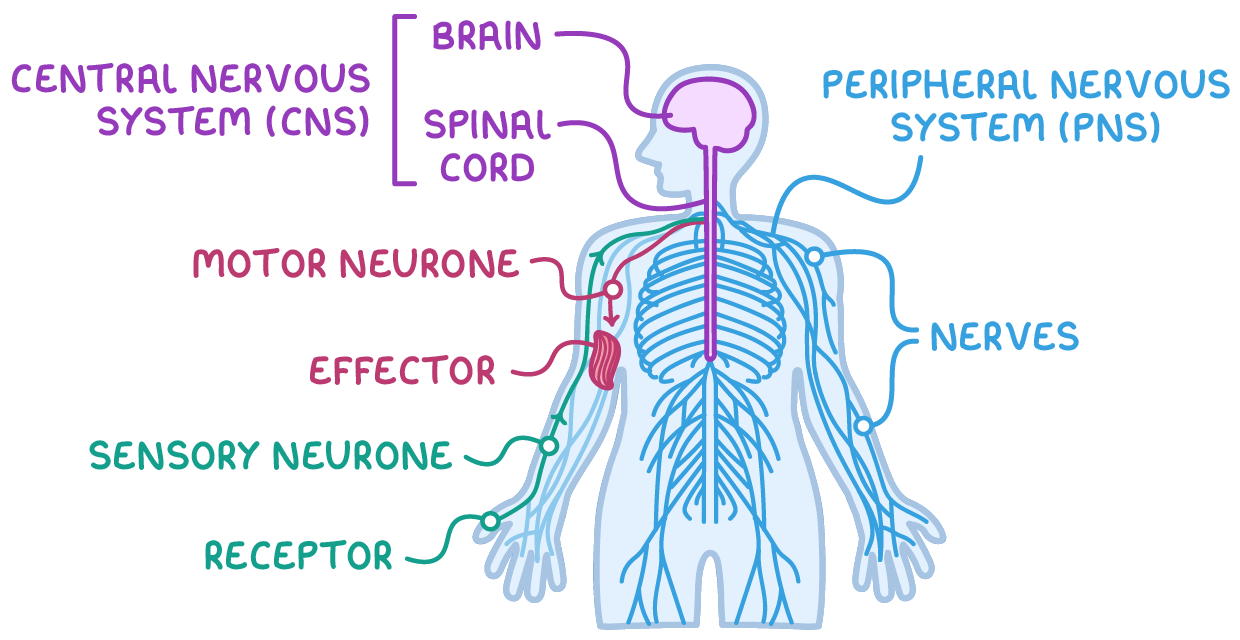
- The central nervous system (CNS) is made up of the brain and the spinal cord.
- The peripheral nervous system (PNS) is the nerves outside the brain and spinal cord, connecting the CNS to the rest of the body.
Stimuli, receptors and effectors
- Stimulus - A change in the environment inside or outside the body.
- Receptors - Cells that detect a particular kind of change. Different receptors detect different stimuli, and many are grouped together in sense organs:
- Light receptors in the eyes
- Sound receptors in the ears
- Touch and temperature receptors in the skin
- Chemical receptors in the tongue and nose
- Effectors - The parts that carry out the response. They are either:
- Muscles - Respond by contracting
- Glands - Respond by secreting a substance such as a hormone
- When a receptor detects a stimulus, the information is carried as an electrical impulse.
The coordination pathway
- Information passes from the receptor along a sensory neurone to the CNS.
- The CNS is the coordinator - it receives the information, decides the response, and links the right receptor to the right effector.
- It sends an electrical impulse out along a motor neurone to an effector.
- The effector produces the response.
The whole pathway runs: stimulus → receptor → sensory neurone → CNS → motor neurone → effector → response.
The neurones and the nerve impulse
- The nervous system is made of nerve cells called neurones.
- A nerve impulse is a small electrical charge that passes along the neurone.
The three types of neurone
- Sensory neurones - Carry impulses from the receptors to the central nervous system
- Relay neurones (also called interneurones, connector neurones, or association neurones) - Carry impulses through the central nervous system, linking sensory neurones to motor neurones
- Motor neurones - Carry impulses from the central nervous system out to the effectors
The structure of a neurone
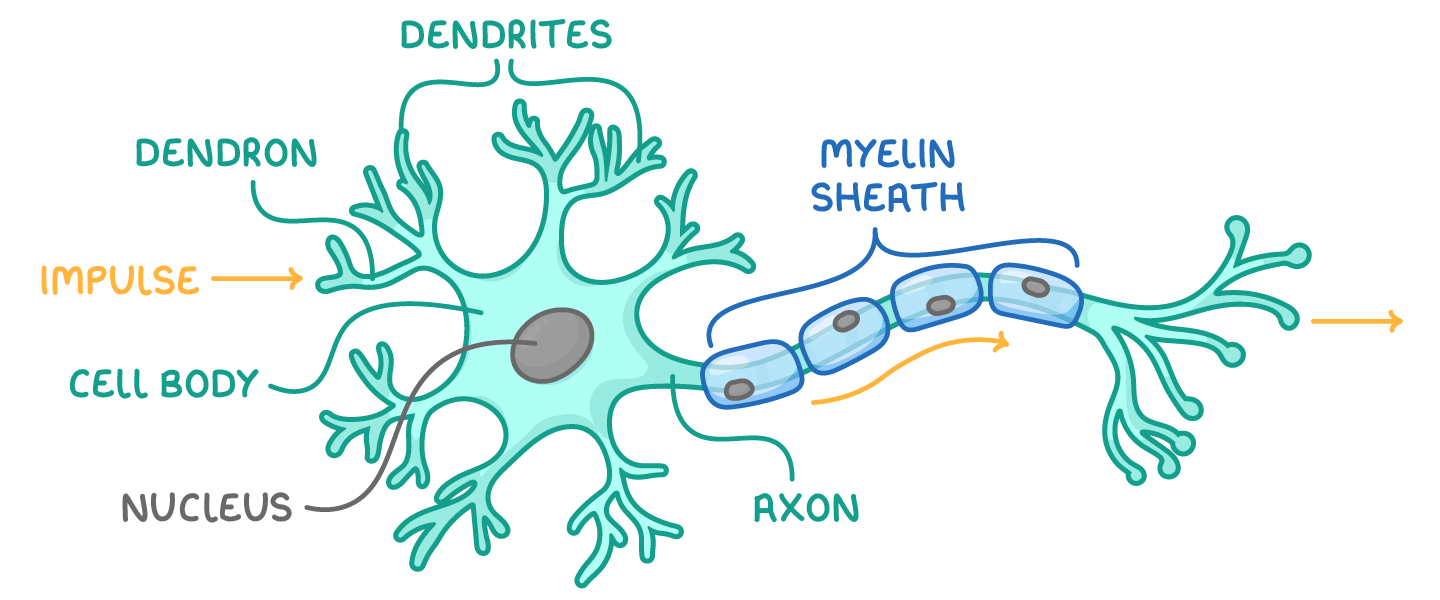
- A neurone has a cell body containing the nucleus, with thin processes extending from it.
- Dendrites - Short branched processes that carry impulses towards the cell body
- Dendron - A single long process in a sensory neurone that carries impulses towards the cell body
- Axon - A long process that carries the impulse away from the cell body
- The branched endings let one neurone connect to many others.
Two features make the impulse travel quickly
- Myelin sheath - A fatty layer wrapping many axons; it acts as an electrical insulator and speeds the impulse up.
- Length - A neurone is very long, and one long neurone carries an impulse faster than a row of short ones joined end to end, because passing the impulse from one neurone to the next slows it down.
Together these adaptations let the nervous system carry information rapidly, so the body can respond quickly.
The synapse
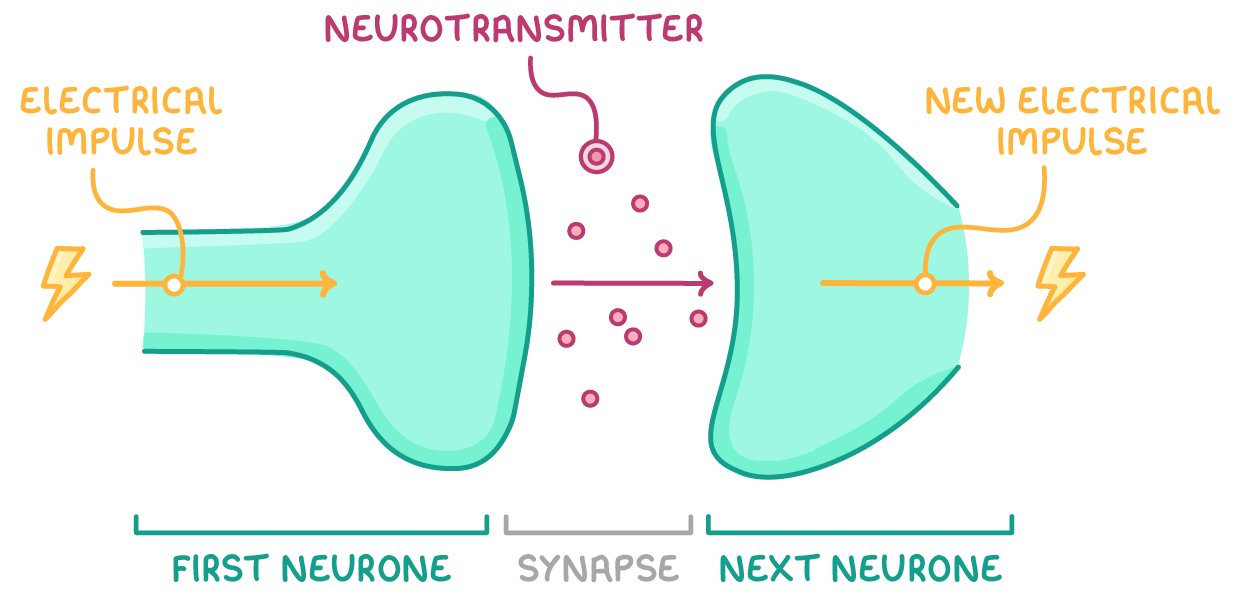
- Where the end of one neurone meets the next, the two do not actually touch - there's a tiny gap between them.
- This junction is called a synapse.
- The impulse travelling along a neurone is electrical and can't jump the gap on its own, so the signal is carried across the synapse by a chemical.
How the signal crosses the gap
- An electrical impulse arrives at the end of the first neurone.
- This causes a chemical, called a neurotransmitter, to be released into the gap.
- The neurotransmitter diffuses across the gap to the next neurone.
- When it arrives, it sets off a new electrical impulse in that neurone, so the signal continues on its way.
Passing the signal across a synapse takes a little longer than carrying it along a neurone, because the diffusion of the chemical across the gap takes time.
The reflex arc and reflex action
- A reflex action is an automatic, rapid response to a stimulus that happens without any conscious thought.
- Because the body doesn't spend time deciding what to do, a reflex is faster than an ordinary, considered response.
- Reflexes are often protective - they help prevent injury. Examples:
- Pulling your hand away from a hot object before you've thought about it
- The pupil of the eye getting smaller in bright light to protect the eye
The reflex arc
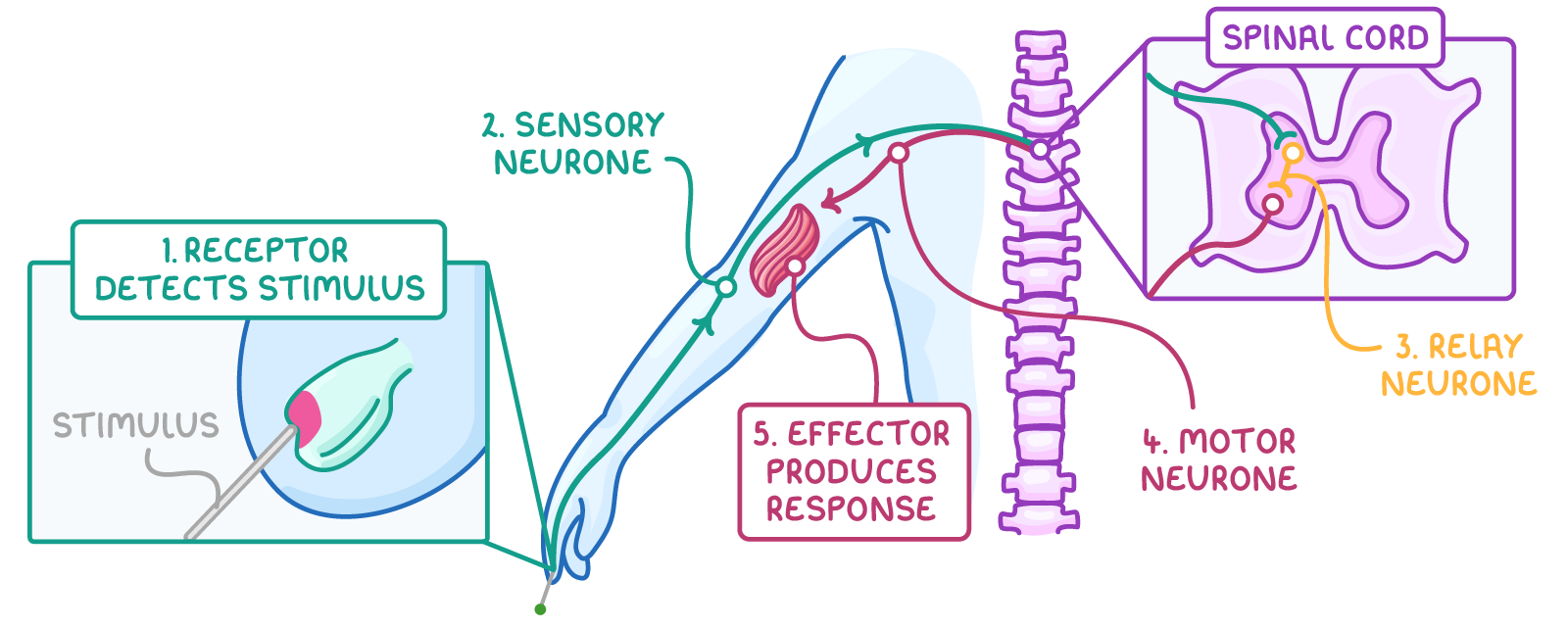
- A reflex arc is the pathway the information follows in a reflex, from the receptor that detects the stimulus to the effector that responds.
- The neurones pass through the spinal cord or an unconscious part of the brain, rather than the conscious part - which is why the response is so quick.
The pathway of a reflex arc
- A receptor detects the stimulus.
- The receptor sends an impulse along a sensory neurone to the central nervous system.
- The sensory neurone passes the impulse across a synapse to a relay neurone.
- The relay neurone passes it across another synapse to a motor neurone.
- The motor neurone carries the impulse out to the effector - a muscle or a gland - which produces the response.
Example - Touching something sharp
- A receptor in the skin detects the stimulus.
- The impulse travels in along the sensory neurone to a relay neurone in the spinal cord.
- The impulse passes out along the motor neurone.
- The muscle contracts to pull the hand away.
TermDefinition
NeuroneA nerve cell that carries an electrical impulse.
Central nervous system (CNS)The brain and the spinal cord, which coordinate the body's responses.
StimulusA change in the internal or external environment that an organism detects and responds to.
ReceptorA cell or group of cells that detects a change in the internal or external environment.
EffectorA muscle or gland that carries out a response to a stimulus.
Sensory neuroneA neurone that carries impulses from the receptors to the central nervous system.
Relay neuroneA neurone that carries impulses through the central nervous system, linking sensory neurones to motor neurones.
Motor neuroneA neurone that carries impulses from the central nervous system out to the effectors.
SynapseThe junction between two neurones, where the end of one neurone is separated from the next by a tiny gap.
NeurotransmitterA chemical that carries a nerve signal across a synapse.
Reflex actionAn automatic, rapid response to a stimulus that happens without any conscious thought.
Reflex arcThe pathway the information follows in a reflex, from the receptor that detects the stimulus to the effector that responds.
Key points to remember
How were these notes?