8.3 - Lungs & Gas Exchange
Gas exchange in the lungs and the alveoli
- The lungs are the body's gas-exchange organs. Their job is to transfer oxygen into the blood and remove waste carbon dioxide from it.
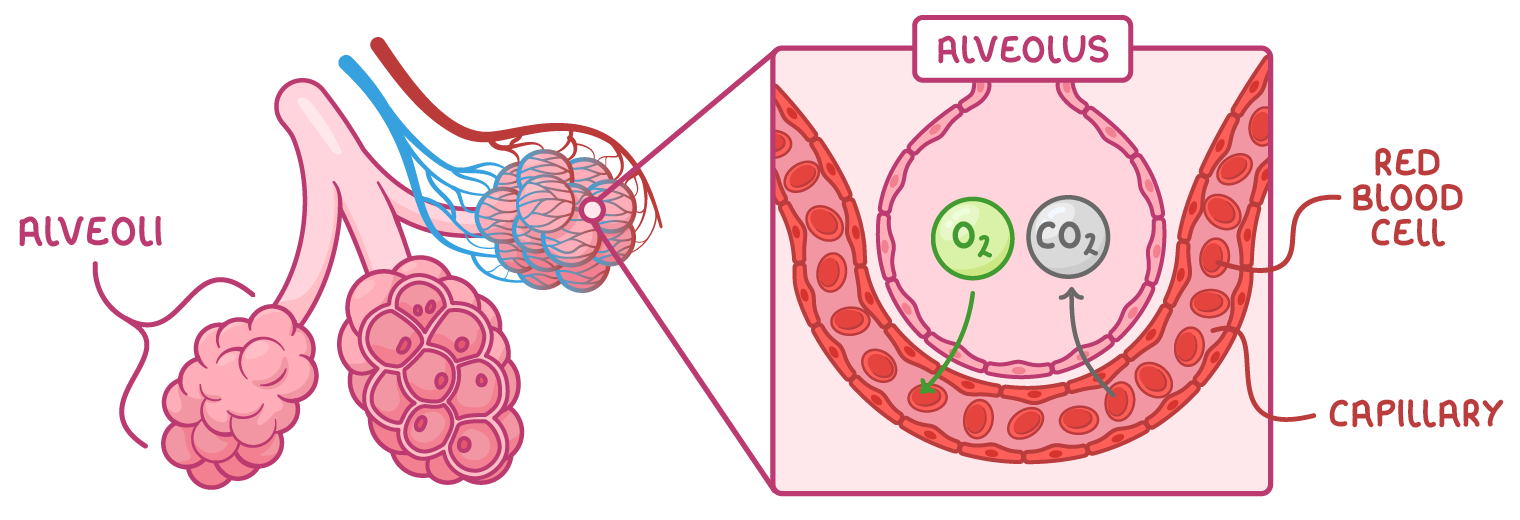
- Air breathed in travels down the trachea and through the branching airways until it reaches the alveoli - millions of tiny air sacs where gas exchange actually happens.
- Each lung contains a huge number of alveoli, and every alveolus is wrapped in a dense network of blood capillaries. This brings the air inside an alveolus and the blood in the capillary very close together.
How the gases are exchanged
- Blood arriving at the alveoli has just returned from the body, so it is low in oxygen and high in carbon dioxide. This sets up a concentration gradient for each gas.
- Oxygen - High concentration in the alveolar air, low in the blood, so oxygen diffuses out of the alveolus into the blood.
- Carbon dioxide - High concentration in the blood, low in the alveolar air, so carbon dioxide diffuses out of the blood into the alveolus, ready to be breathed out.
- The oxygen-rich blood then leaves the lungs to be carried to the body's cells, while the carbon dioxide is removed when the next breath is exhaled.
Protecting the lungs
- The lungs sit inside the chest, protected by the ribcage.
- A thin layer of pleural fluid between the membranes around the lungs reduces friction as the lungs move during breathing.
How the alveolus is adapted for gas exchange
- The alveolus is specialised so oxygen and carbon dioxide diffuse across it as fast as possible.
- Several features work together to make it an efficient exchange surface.
The adaptations
- Large surface area - There are so many alveoli (a total of roughly 75 square metres in an adult) that a large amount of gas can diffuse across at the same time.
- Thin walls - Each alveolus wall is only one cell thick, so gases have only a tiny distance to travel between the air and the blood. A short diffusion path means exchange is fast.
- Moist lining - Gases dissolve in the moisture so they can cross the surface more easily.
- Permeable wall - The wall lets the gases pass through.
- Good blood supply - Capillaries wrapped around each alveolus constantly bring fresh blood that is low in oxygen and high in carbon dioxide, and carry away the exchanged gases, keeping the concentration gradient across the wall steep.
- Good ventilation - Breathing keeps moving fresh air in and stale air out, which also helps keep the concentration gradients steep.
TermDefinition
AlveoliThe tiny air sacs in the lungs where gas exchange takes place.
TracheaThe tube, held open by rings of cartilage, that carries air from the mouth and nose to the lungs.
Key points to remember
How were these notes?