3.6 - Alleles & Phenotype
Alleles, dominant and recessive
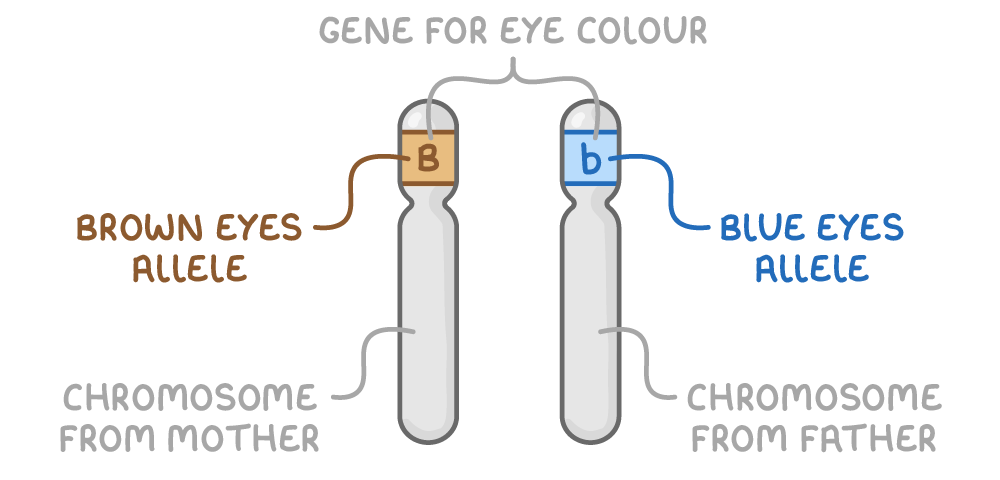
- A gene can exist in more than one version. These different versions of the same gene are called alleles (sometimes called variants).
- Example: an eye-colour gene might have one allele for blue eyes and another for brown.
- Chromosomes in a body cell come in pairs, so an organism normally has two alleles of each gene - one on each chromosome, one inherited from each parent.
- The two alleles an organism has may be the same or different.
- In genetic diagrams, alleles are written as letters.
How alleles pass to offspring
- A gamete is a sex cell, such as a sperm cell or an egg cell.
- A gamete carries only one chromosome from each pair, so it passes on just one allele of each gene.
- At fertilisation two gametes join, so the offspring gets one allele of each gene from each parent - ending up with the usual two alleles of every gene.
Dominant and recessive alleles
- When an organism has two different alleles, they often don't have an equal say.
- Dominant allele - Expressed whenever it's present, so its characteristic shows. Written as a capital letter (e.g. B).
- Recessive allele - Only expressed when no dominant allele is present, i.e. both alleles are recessive. Written as the matching small letter (e.g. b).
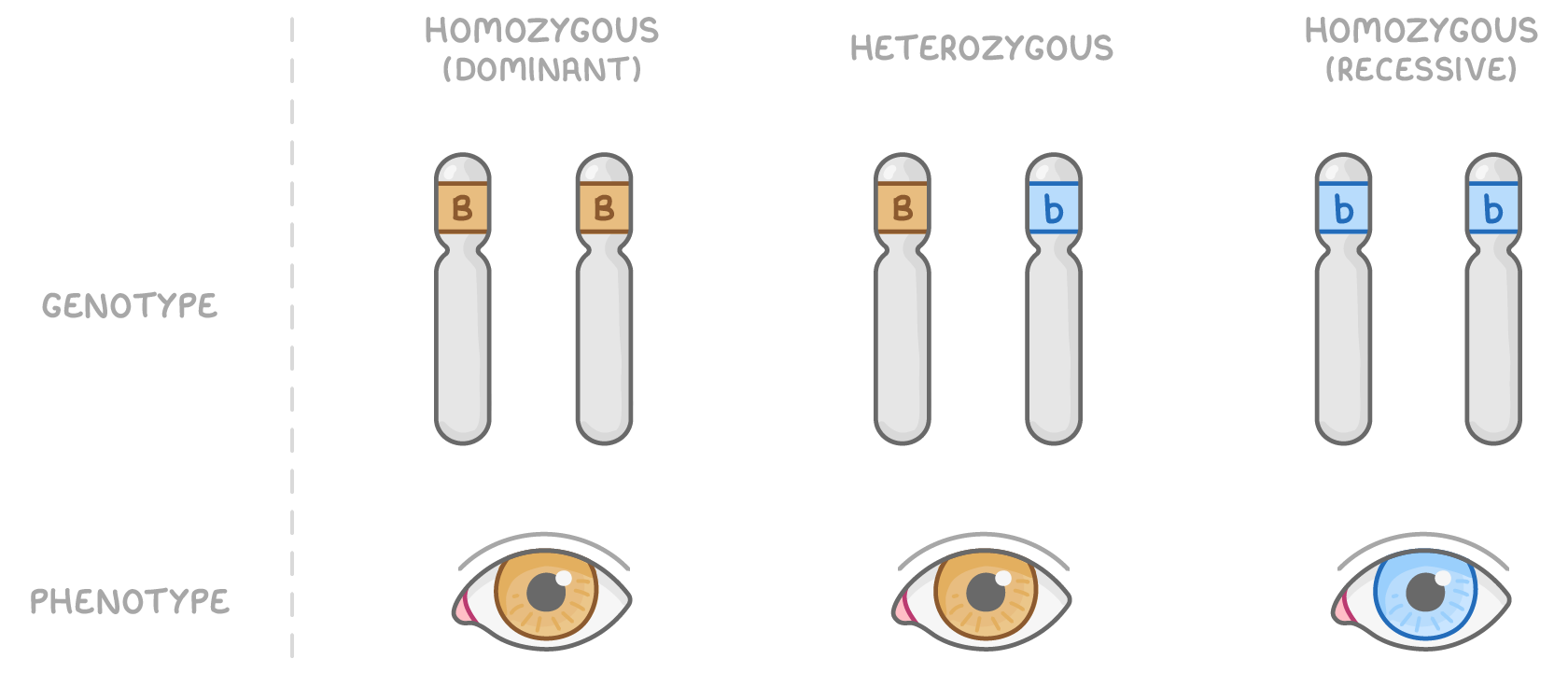
- So a recessive characteristic appears only when both alleles are recessive, while a dominant characteristic shows with either two dominant alleles or one of each.
Genotype, phenotype, homozygous and heterozygous
These four terms describe the alleles an organism has and what they produce.
| Term | What it means | Example |
|---|---|---|
| Genotype | The combination of alleles an organism has for a gene - its genetic make-up | BB, Bb or bb |
| Phenotype | The observable characteristics those alleles produce | Brown eyes, blue eyes |
| Homozygous | The two alleles for a gene are the same | BB or bb |
| Heterozygous | The two alleles for a gene are different | Bb |
Different genotypes, same phenotype
- Two organisms can have different genotypes but the same phenotype.
- A dominant allele gives the same appearance whether it's paired with a second dominant allele or with a recessive one - so BB and Bb look the same.
- An organism only shows a recessive characteristic when its genotype is two recessive alleles (bb).
Passing on alleles
- A homozygous organism can only pass on one type of allele. Two homozygous individuals of the same type bred together are pure-breeding - their offspring are all of the same kind.
- A heterozygous organism carries two different alleles, so it can pass on either one.
TermDefinition
AlleleOne of the different forms of a gene.
Dominant alleleAn allele that is always expressed (shows its effect), even if only one copy is present.
Recessive alleleAn allele that is only expressed (shows its effect) when two copies are present.
GenotypeThe combination of alleles an organism has for a particular gene.
PhenotypeThe observable characteristics of an organism, which result from its genotype and its environment.
HomozygousHaving two identical alleles for a particular gene.
HeterozygousHaving two different alleles for a particular gene.
Key points to remember
How were these notes?