10.4 - Rate of Aerobic Respiration
The experiment
Aim
To measure the rate of aerobic respiration in small living organisms (for example germinating peas, woodlice, or maggots) by measuring how much oxygen they take up, and to find out how temperature affects that rate.
Background
- Aerobic respiration uses oxygen to release energy from glucose, and gives out carbon dioxide (glucose + oxygen → carbon dioxide + water).
- Germinating peas respire quickly because they're growing. Dead (boiled) peas don't respire at all.
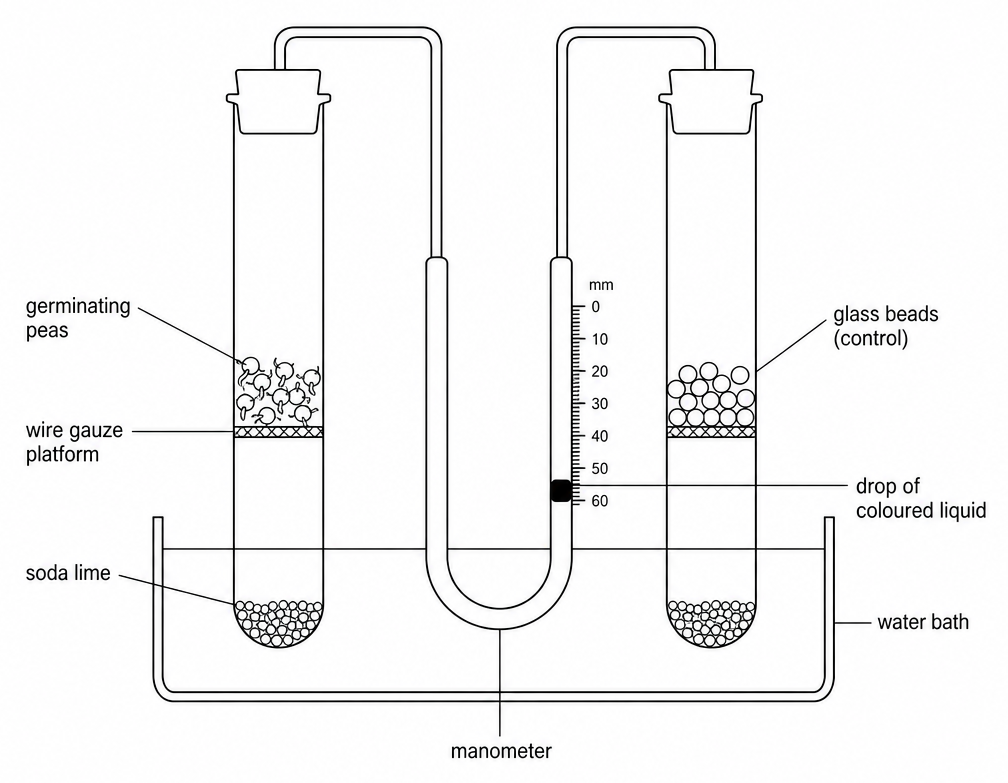
- You can't see respiration happening, but you can measure the oxygen the organisms take up. It shows as how far a drop of coloured liquid moves along a thin glass tube, the manometer.
- So in this practical you use a respirometer to measure how far the coloured liquid moves in a set time, at different temperatures. The further it moves, the faster the organisms are respiring.
Variables
- Independent variable - The temperature of the water bath the respirometer sits in, for example 15, 25, and 35 °C.
- Dependent variable - The volume of oxygen taken up in a set time, found from how far the coloured liquid moves along the manometer.
- Control variables - The type, number, and mass of organisms, the amount of soda lime, the length of time, and the width (bore) of the manometer tube.
Method
- Add the soda lime - Put a fixed amount of soda lime (or cotton wool soaked in potassium hydroxide solution) in the bottom of a test tube, with a gauze platform above it so the organisms can't touch it.
- Add the organisms - Place the germinating peas on the gauze, seal the tube with a bung fitted with a tap, and connect it to a manometer holding a drop of coloured liquid. Close the tap before you take a reading.
- Set up a control tube - Set up a second, identical tube holding the same mass of dead (boiled) peas or glass beads.
- Put both tubes in a water bath - At the first temperature, and leave them for a few minutes to settle.
- Measure the movement - Note the starting position of the coloured liquid, then record how far it has moved towards the organisms after 5 minutes.
- Repeat at other temperatures - Open the tap to let air back in and reset the liquid, then repeat at each temperature. Repeat the whole experiment to find a mean.
Safety
- Soda lime and potassium hydroxide are corrosive - Wear eye protection and gloves, wash off any splashes at once, and keep them below the gauze so the organisms never touch them.
- The manometer is thin glass - Handle it gently.
- Live animals - If you use woodlice or maggots, handle them carefully, keep them in the tube for as short a time as possible, and return them to where they were kept. Wash your hands afterwards.
Worked example - Rate of oxygen uptake in a respirometer
A student used a respirometer of germinating peas to measure how far the coloured liquid moved in 5 minutes at three temperatures. The manometer tube has a cross-sectional area of 2 mm2.
| Temperature (°C) | Distance moved in 5 min (mm) |
|---|---|
| 15 | 30 |
| 25 | 60 |
| 35 | 90 |
Calculate the rate at each temperature as a distance per minute, and the rate at 25 °C as a volume of oxygen per minute. Then describe the trend.
Step 1 - Turn the distance at 15 °C into a rate
The rate is how far the liquid moves each minute, so divide the distance by the time. At 15 °C the liquid moved 30 mm in 5 minutes.
Step 2 - Find the rate at the other temperatures
- At 25 °C, the rate is 60 ÷ 5 = 12 mm/min.
- At 35 °C, the rate is 90 ÷ 5 = 18 mm/min.
Step 3 - Turn the distance at 25 °C into a volume of oxygen
Knowing the cross-sectional area of the tube lets you give the rate as a volume of oxygen instead of a distance. At 25 °C the liquid moved 60 mm in 5 minutes, in a tube with a cross-sectional area of 2 mm2.
Volume of oxygen = distance × cross-sectional area = 60 × 2 = 120 mm3
Step 4 - Describe and explain the trend
As the temperature rises from 15 to 35 °C, the rate of oxygen uptake increases. Respiration is controlled by enzymes, and enzymes work faster as it gets warmer. Above the optimum temperature, around 40 °C, the enzymes would start to denature, so the rate would fall again.
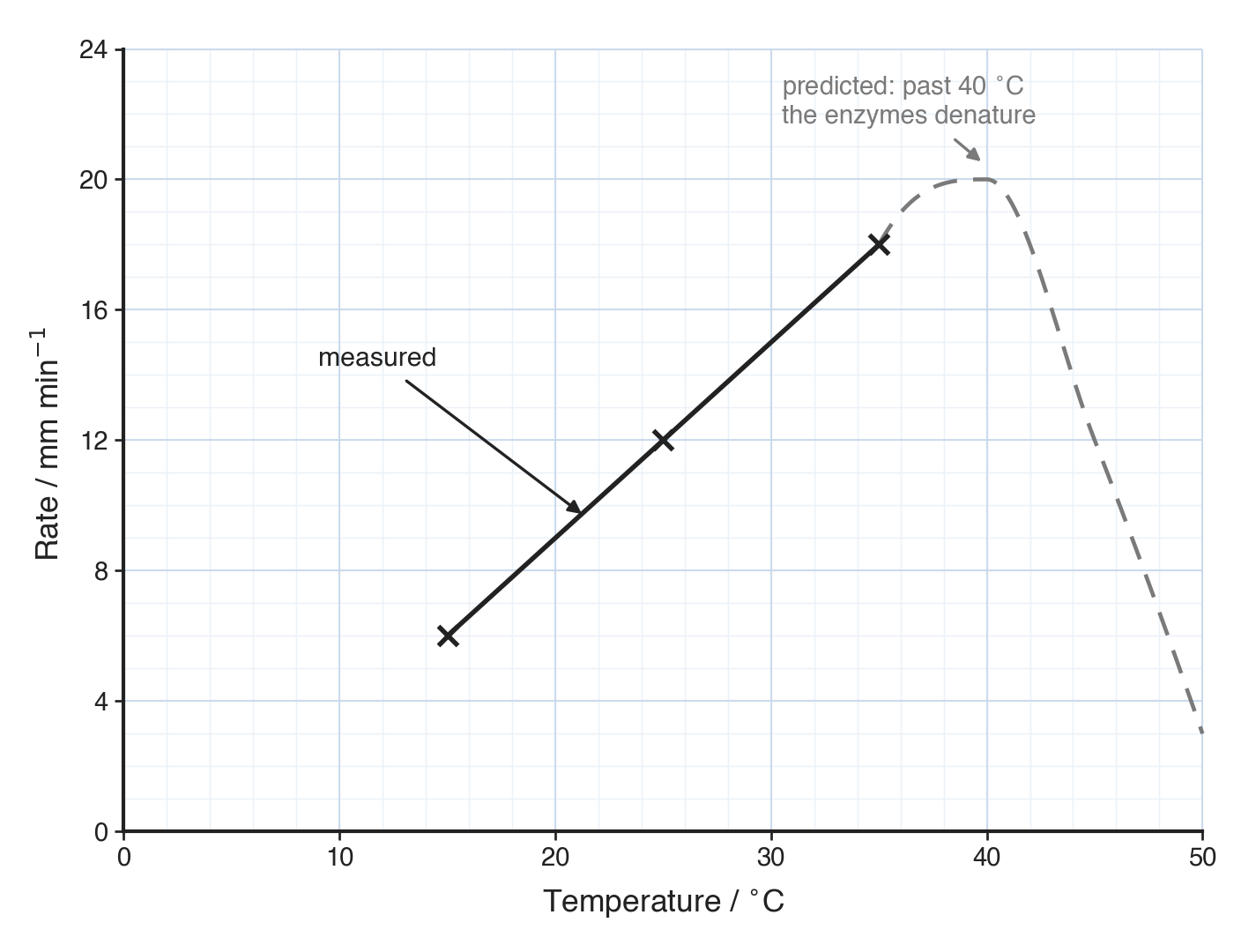
The dashed part is a prediction; only the solid line was measured.
Common exam questions
Question 1
Why is soda lime (or potassium hydroxide) put in the tube?
To absorb the carbon dioxide the organisms give off. Then the only gas whose volume changes is the oxygen being used up, so the movement of the liquid measures oxygen uptake.
Question 2
Why does the coloured liquid move towards the organisms?
As the organisms use up oxygen and the carbon dioxide is absorbed, the volume of gas in the tube falls. The pressure drops, so the liquid is pushed that way.
Question 3
Why is a control tube with dead peas (or glass beads) set up?
To allow for any movement caused by changes in room temperature or pressure rather than by respiration, so the reading can be corrected against it.
Question 4
Why is the apparatus left for a few minutes before the first reading?
So the organisms and the air in the tube reach the temperature of the water bath. Otherwise the gas would still be expanding or contracting and give a false reading.