1.8 - Diffusion
What diffusion is
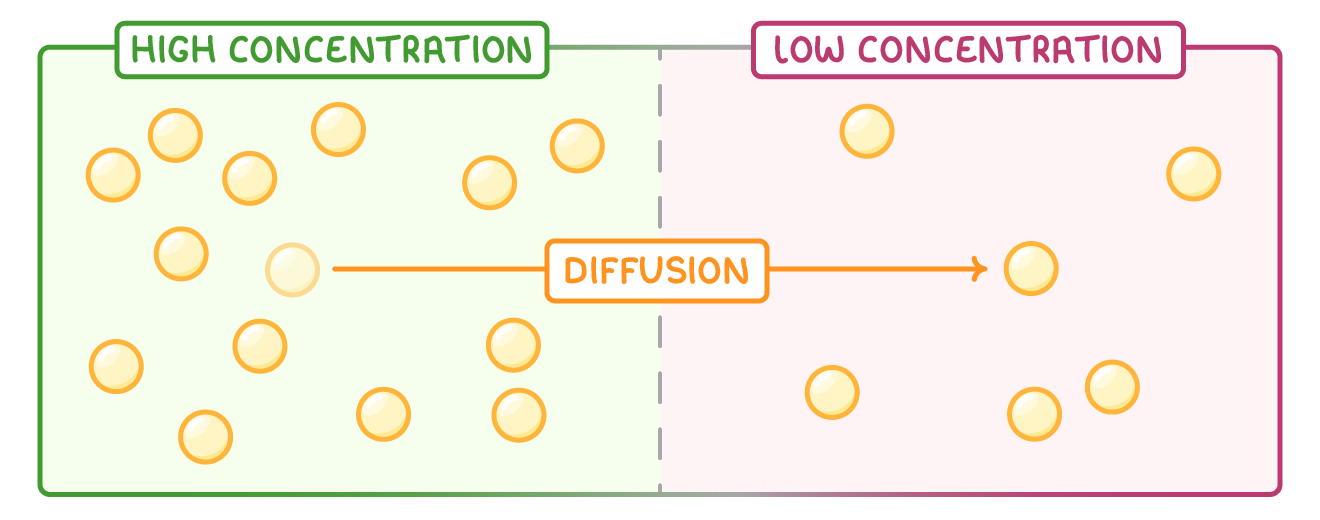
- Diffusion is the net movement of particles from an area of higher concentration to an area of lower concentration.
- The particles spread out from where there are lots of them to where there are fewer of them.
- Because the movement is from high to low concentration, the particles are said to move down a concentration gradient.
Where and how diffusion happens
- Diffusion happens in both solutions and gases, because the particles here are free to move about randomly.
- The particles keep moving in all directions, so they actually travel both ways. But when there are many more on one side than the other, the overall result is a net movement from the crowded side to the less crowded side.
- The particles carry on spreading until they are evenly distributed.
- Example: the smell of perfume spreads through the air in a room - the perfume particles diffuse out from where they are concentrated until they spread through the whole room.
Diffusion is a passive process
- It does not need any energy from the cell to make it happen.
- The particles move on their own, driven only by the kinetic energy of their own random motion.
- The bigger the difference in concentration between the two areas, the faster diffusion takes place.
Diffusion across cell membranes
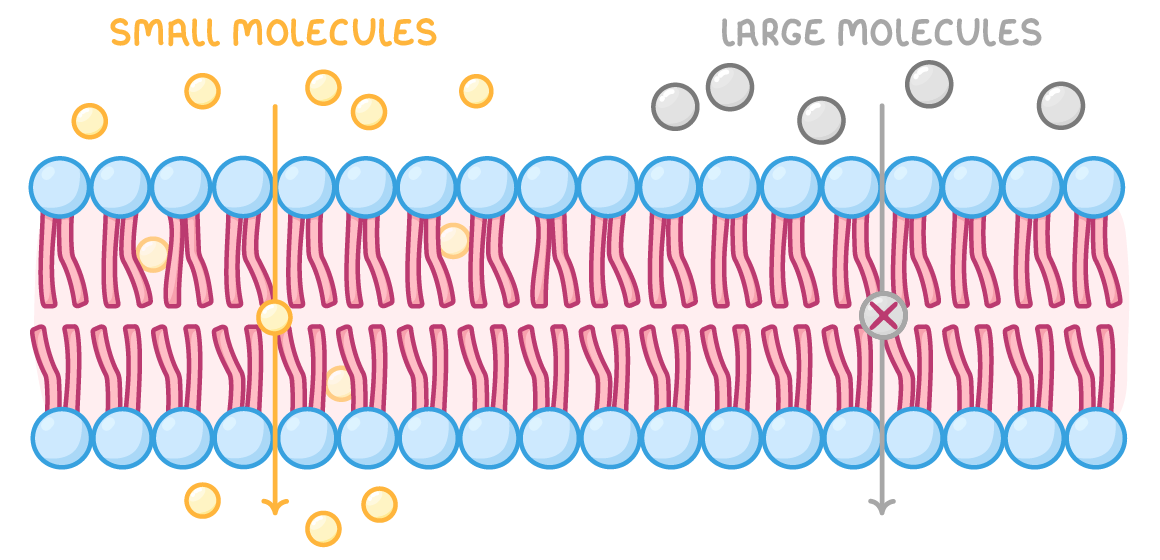
- A cell membrane is partially permeable (also called selectively permeable): it holds the cell together but still lets some substances in and out.
- The gaps between the molecules that make it up are so small that only tiny molecules can pass through.
Which molecules can cross
- Small enough to diffuse through - Oxygen, carbon dioxide, glucose, amino acids, and water.
- Too big to pass through - Large molecules such as starch and proteins.
Visking tubing as a model membrane
- Visking tubing (also called dialysis tubing) is partially permeable, so it is used in experiments as a model of a cell membrane.
- If a bag of it holding a mixture of starch and glucose solution is left in a beaker of water, glucose soon appears in the water but starch does not.
- This is because glucose molecules are small enough to pass through the tiny pores in the tubing, while starch molecules are too big.
How diffusion moves substances in and out
- Dissolved substances and gases move in and out of cells across the membrane by diffusion.
- Particles pass through from the side of higher concentration to the side of lower concentration.
- As in any diffusion, particles move randomly and travel both ways through the membrane, but when there are many more on one side there is a net movement from that side to the other.
- This lets a cell take in the substances it needs and lose the substances it must get rid of, simply by diffusing down each substance's concentration gradient.
TermDefinition
DiffusionThe net (overall) movement of particles from an area of higher concentration to an area of lower concentration.
Net movementThe overall movement of particles from one area to another, taking into account particles moving in both directions.
Concentration gradientThe difference in concentration between two areas.
Passive processA process that does not require any energy from the cell to make it happen.
Partially permeable membraneA membrane that lets small molecules, such as water, pass through but not larger molecules.
Key points to remember
How were these notes?