6.3 - Leaf Structure
Guard cells and the stomata
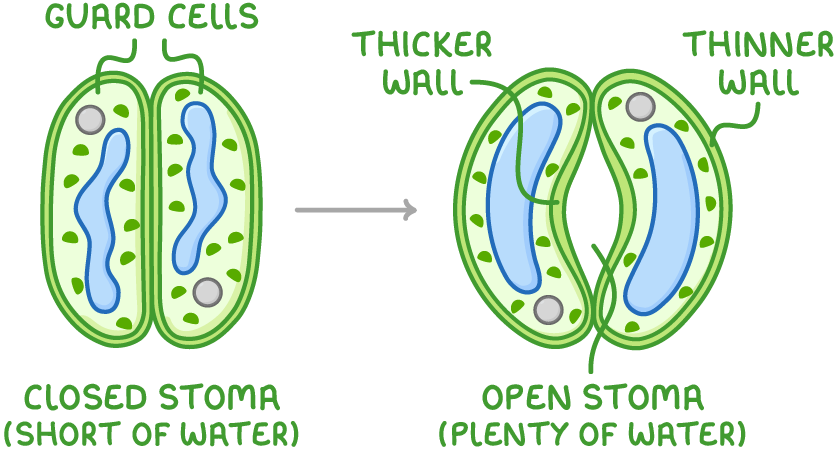
- Each stoma (pore) is bordered by a pair of guard cells, which open and close the pore to control gas exchange and water loss.
- A guard cell has a kidney shape, with:
- A thicker, less flexible wall on the inner side (next to the pore)
- A thinner wall on the outer side
- This uneven thickening is what makes the opening and closing work.
Opening and closing
- Plenty of water - Guard cells take in water and become turgid (plump and swollen). The uneven wall thickness makes the pair curve apart, so the stoma opens - letting carbon dioxide and oxygen be exchanged for photosynthesis.
- Short of water - Guard cells lose water and become flaccid (limp and floppy). They straighten and close together, so the stoma closes - helping to stop too much water vapour escaping from the leaf.
Sensitivity to light
- Guard cells are also sensitive to light.
- They close the stomata at night, when photosynthesis cannot happen.
- This saves water without any loss of photosynthesis.
TermDefinition
StomataTiny pores, mostly in the lower surface of a leaf, that let carbon dioxide and oxygen diffuse in and out and let water vapour escape.
Guard cellsA pair of cells that border a stoma and change shape to open and close the pore.
Key points to remember
How were these notes?