1.2 - Specialised Cells & Differentiation
Specialised cells adapted to their function
- Most cells are specialised - they have a structure that adapts them to a particular function.
- This means the same basic cell type can take many different forms, each matched to its job.
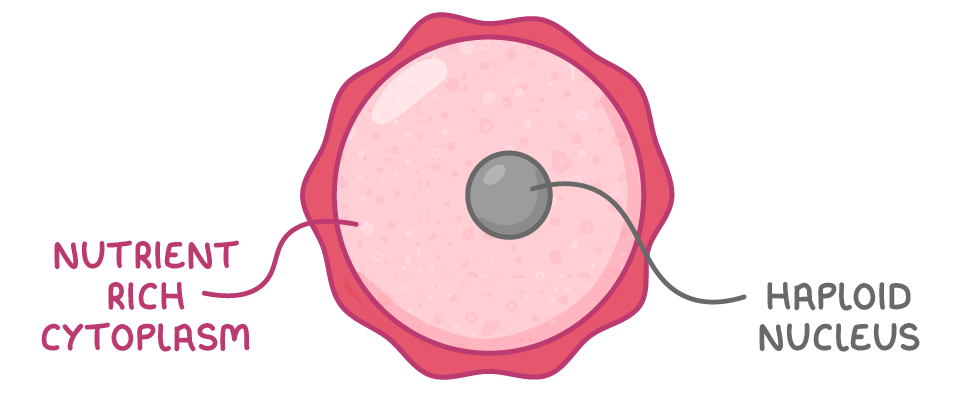
Egg cell - Carries female DNA and nourishes the embryo
- Contains nutrients in its cytoplasm to feed the developing embryo in its early stages.
- Has a haploid nucleus - only half the usual number of chromosomes, so a normal number is restored when egg and sperm fuse.
- Straight after fertilisation, its membrane changes structure to stop any more sperm getting in - this keeps the offspring's amount of DNA correct.
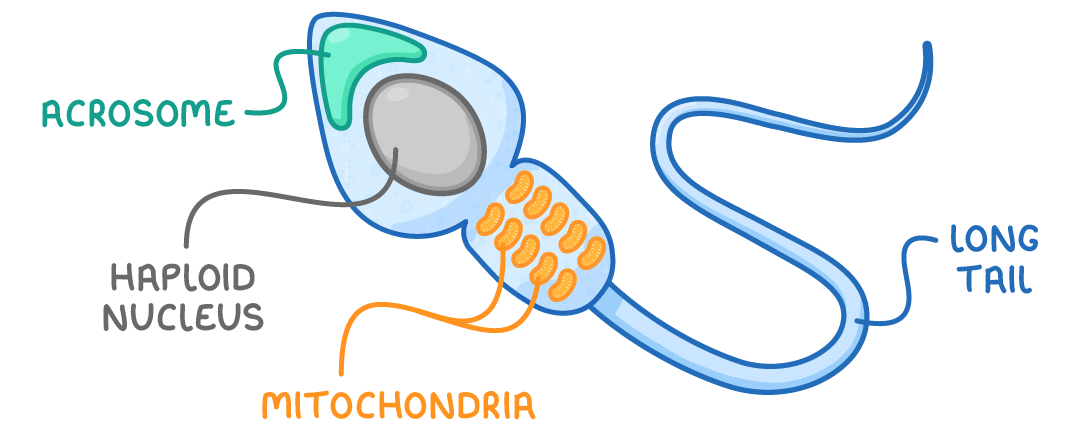
Sperm cell - Carries male DNA to the egg
- Has a long tail so it can swim to the egg.
- Has a haploid nucleus.
- Has many mitochondria in the middle section to release the energy (from respiration) needed to swim.
- Has an acrosome at the front of the head, which releases enzymes to digest through the egg's outer layer.
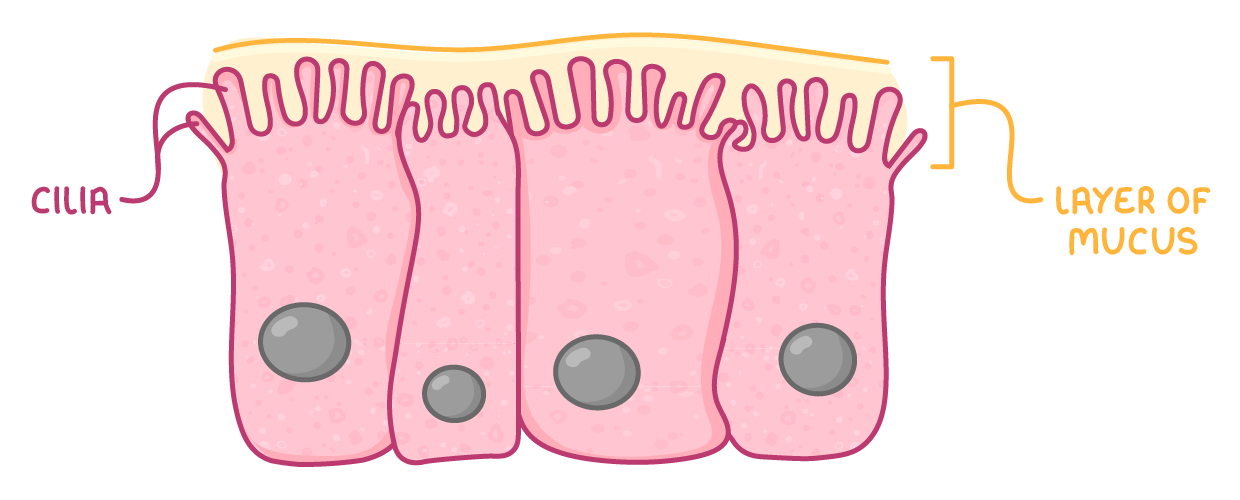
Ciliated epithelial cell - Moves substances along a surface
- Epithelial cells line the surfaces of organs; some have cilia - hair-like structures on the top surface of the cell.
- The cilia beat to move substances in one direction along the surface of the tissue.
- Example: the lining of the airways carries many ciliated epithelial cells, which move mucus (and the particles trapped in it) up to the throat to be swallowed, so it does not reach the lungs.
Differentiation
- Differentiation (also called specialisation) is the process by which a cell changes to become specialised for a particular function.
- As a cell differentiates, it develops the sub-cellular structures that let it do its specific job - turning a general, unspecialised cell into a specialised one such as a nerve cell or a muscle cell.
- Having a range of specialised cells lets a multicellular organism work more efficiently than if all its cells were the same.
When differentiation happens - Animals vs plants
- Most differentiation happens as an organism develops from its earliest stages.
- The key difference is whether the ability to differentiate is kept:
- Animal cells - Most lose the ability to differentiate at an early stage, soon after becoming specialised
- Plant cells - Many never lose the ability and can differentiate throughout the plant's life, helping the plant keep growing new parts such as leaves and roots
- Because most mature animal cells can no longer differentiate freely, cell division in a mature animal is mainly used for repairing and replacing cells - for example making new skin cells or blood cells - rather than building new types of cell.
How differentiation works at the level of genes
- A cell differentiates by switching genes on and off.
- Every body cell contains the same full set of genes, but in a specialised cell most of those genes are switched off, so the cell makes only the particular proteins it needs for its job.
- Which genes stay switched on determines what type of specialised cell it becomes.
TermDefinition
Specialised cellA cell whose structure is adapted to perform a particular function.
HaploidDescribes a cell or nucleus that has a single set of chromosomes, which is half the normal number.
CiliaTiny hair-like structures on the surface of some cells that beat to move substances, such as mucus, in one direction.
DifferentiationThe process by which a cell changes to become specialised for a particular function.
Key points to remember
How were these notes?