9.9 - The Water Cycle
The water cycle
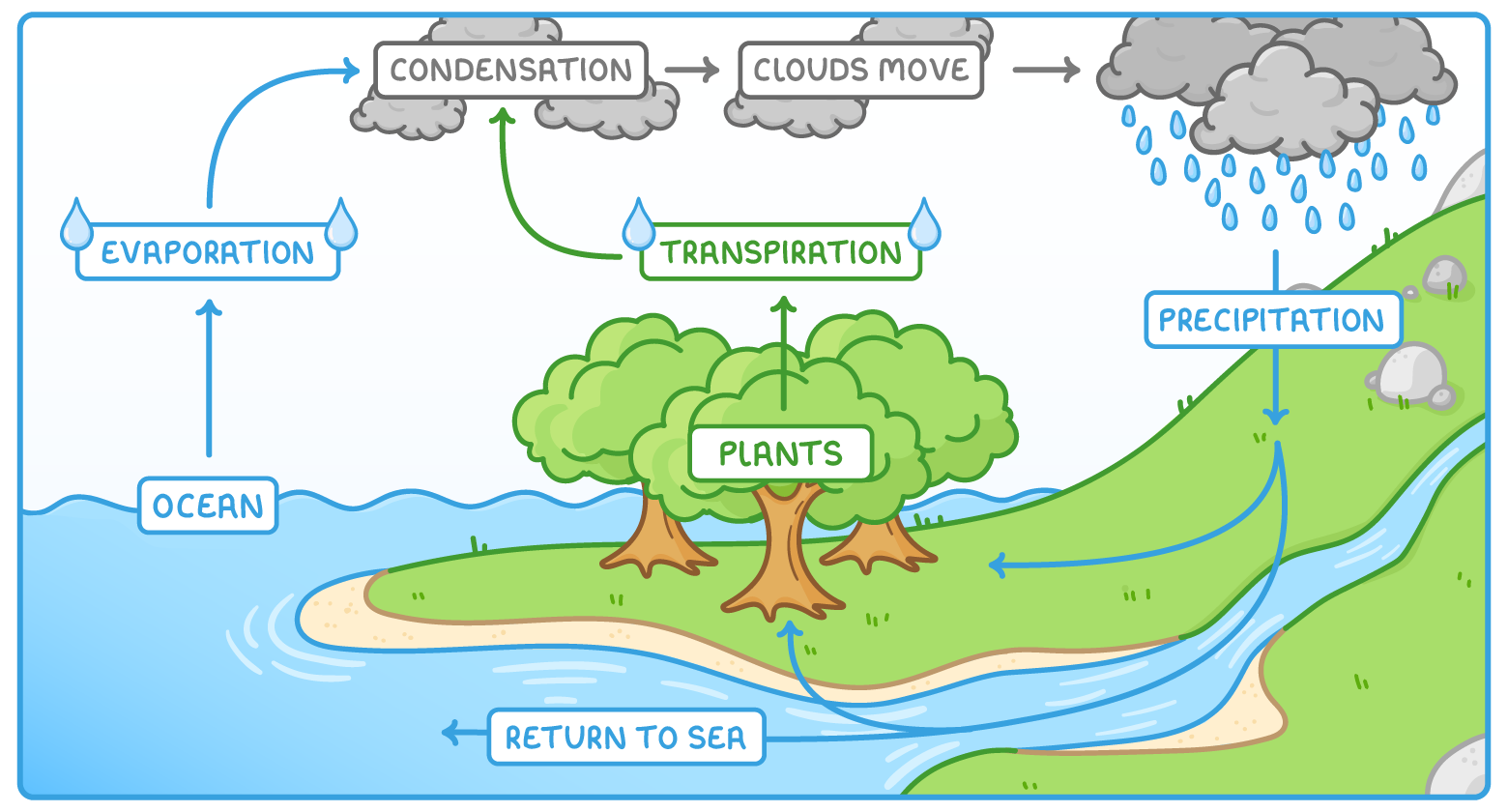
- Water is constantly recycled between the air, the land, and the sea - so the same water is used over and over again.
- This constant recycling is why living things always have a supply of fresh water. Without it, the water on land would soon run out, and all living things need water to survive.
Stages of the water cycle
- Evaporation - Energy from the sun warms water on the Earth's surface (lakes, oceans, rivers, puddles, and soil), making it evaporate - the liquid water turns into water vapour in the air.
- Transpiration - Water also evaporates from the leaves of plants, adding more water vapour to the air.
- Rising and condensing - The warm water vapour is carried upwards as the warm air rises. Higher up the air is cooler, so the vapour cools and condenses to form clouds.
- Clouds move - The clouds can be blown from one region to another.
- Precipitation - At some point the water falls back to the ground as precipitation, usually rain but sometimes snow or hail, providing fresh water for plants and animals on land.
- Return to the sea - Once fallen, the water can soak into the soil, be taken up by plants, or flow into rivers. From there it drains into the sea, and the whole cycle begins again.
Potable water and desalination
- Most of the fresh water people use for drinking comes from precipitation.
- A drought happens when there isn't enough precipitation, so this normal supply of fresh water falls short.
- Sea water can't be used instead because it's too salty to drink.
- Potable water is water that's safe and suitable for drinking.
- In a drought, potable water can be produced from salt water by desalination - the removal of dissolved salts (mineral ions) from the water.
Thermal desalination
- Salt water is boiled in a large enclosed vessel so the water evaporates.
- The steam rises to the top; the salts are left behind at the bottom.
- The steam is led away through a pipe and condenses back into pure water, leaving the salts behind.
Reverse osmosis
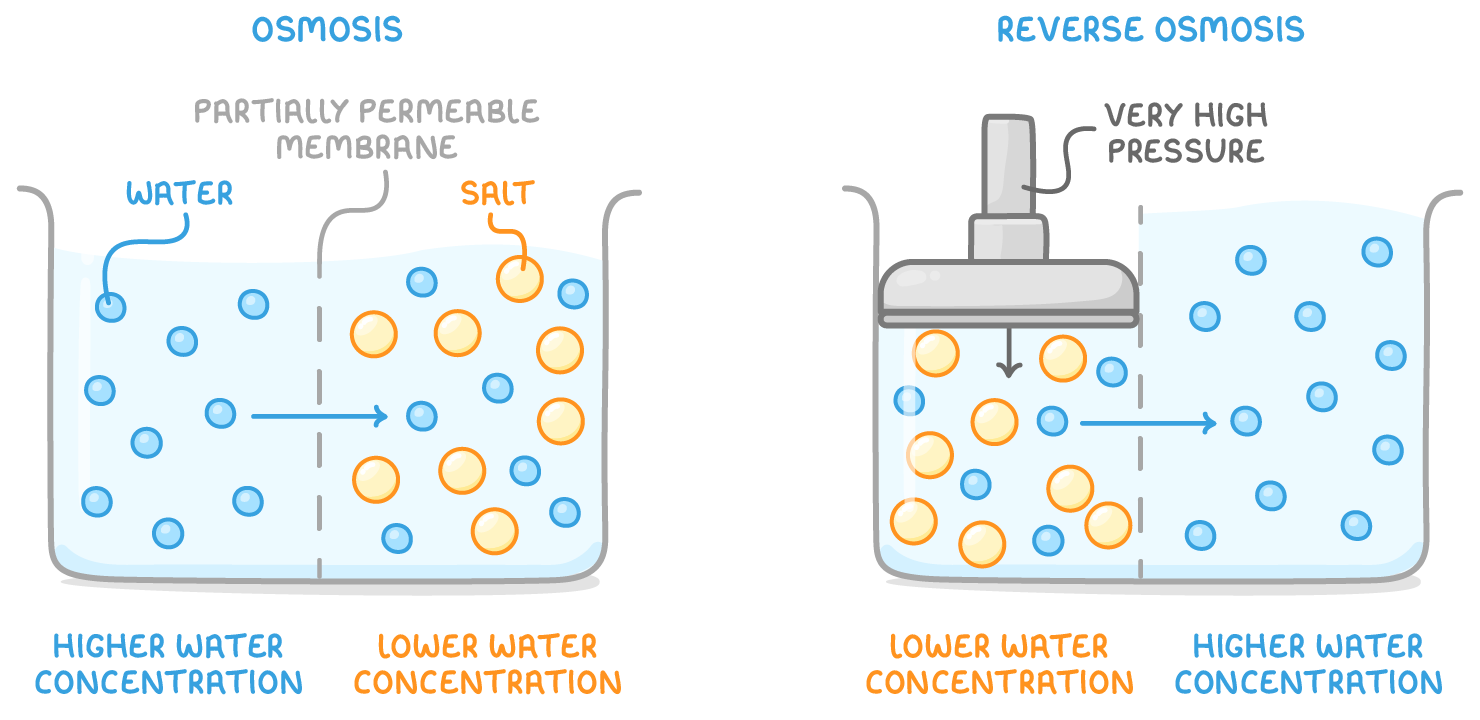
- In ordinary osmosis, water moves across a partially permeable membrane from a higher water concentration (lower salt concentration) to a lower water concentration (higher salt concentration).
- Reverse osmosis works the other way round:
- The salt water is first treated to remove solids.
- It's then forced at very high pressure against a partially permeable membrane.
- The pressure pushes water molecules through the membrane from the higher salt concentration (lower water concentration) to the lower salt concentration (higher water concentration) - the opposite direction to osmosis.
- The salts are too large to pass through the membrane, so they're left behind and removed from the water.
TermDefinition
TranspirationThe loss of water vapour from a plant, mostly from the leaves through the stomata.
PrecipitationWater falling from clouds to the ground, usually as rain, snow or hail.
Potable waterWater that is safe and suitable for drinking.
DesalinationThe removal of dissolved salts from water.
Reverse osmosisA process that uses high pressure to force water molecules from a salty solution through a partially permeable membrane.
Key points to remember
How were these notes?