3.4 - Structure of DNA
The double helix
- DNA (deoxyribonucleic acid) is the chemical that all of an organism's genetic material is made from.
- It carries the coded instructions that determine an organism's inherited characteristics.
- In animal and plant cells, DNA is found in the nucleus, packaged into long structures called chromosomes.
DNA is a polymer with a double-helix shape
- DNA is a polymer - a very large molecule built from many small repeating units joined into long chains.
- These repeating units are called nucleotides.
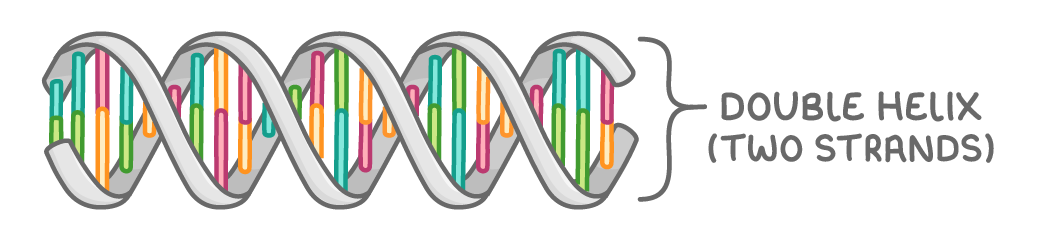
- A DNA molecule is made of two long strands.
- The two strands are coiled around each other in a spiral shape called a double helix (a double-stranded spiral).
- This twisted, two-stranded shape is the form DNA normally takes inside the cell.
- The strands contain four different compounds called bases.
- The order of the bases running down the molecule stores the coded information, so a single molecule can carry an enormous amount of instruction.
Nucleotides and the sugar-phosphate backbone
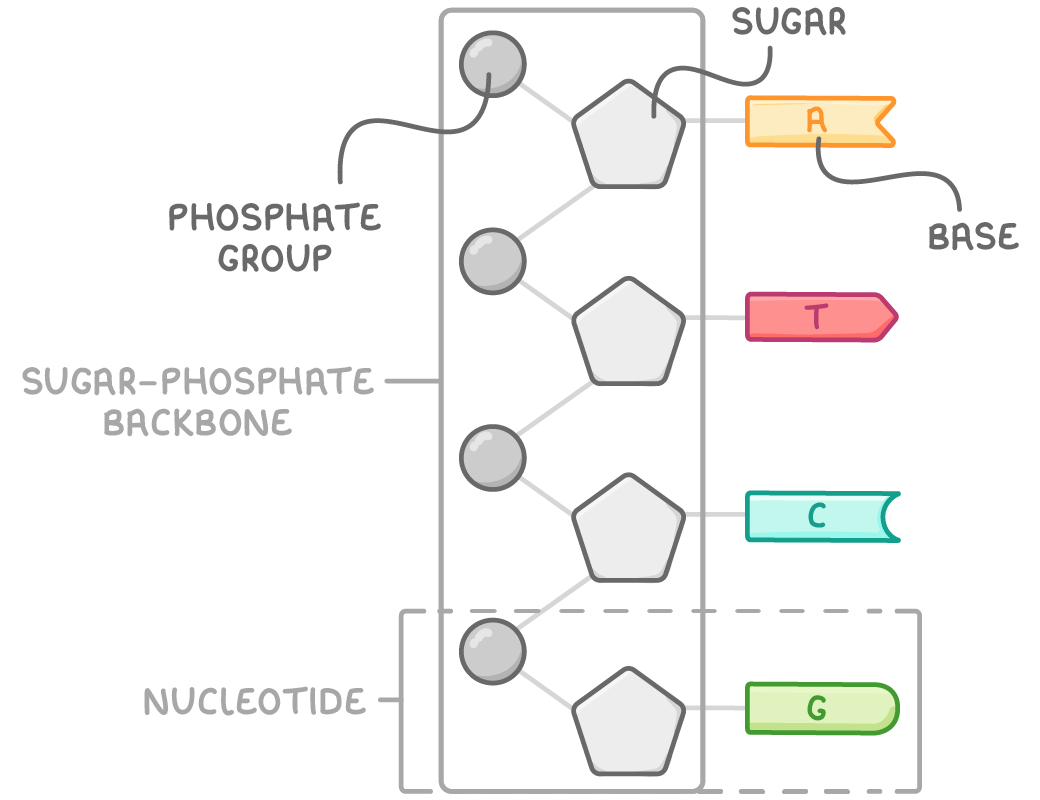
- Each of the two strands of a DNA molecule is a polymer, built from many small repeating units called nucleotides joined in a long chain.
- A DNA molecule is made from four different nucleotides.
The three parts of a nucleotide
- Phosphate group - The same in every DNA nucleotide
- Sugar (deoxyribose) - The same in every DNA nucleotide
- Base - The only part that varies, attached to the sugar
There are four possible bases:
- Adenine (A)
- Thymine (T)
- Cytosine (C)
- Guanine (G)
Because the base is the only part that changes, there are effectively four different nucleotides, one for each base.
The sugar-phosphate backbone
- The nucleotides join so that the phosphate of one is linked to the sugar of the next, repeating for thousands of nucleotides.
- The sugars and phosphates alternate all the way along each strand, forming a continuous chain called the sugar-phosphate backbone.
- A base is attached to each sugar and sticks out to the side from the backbone.
- Only one strand is shown here. In the whole molecule the bases on the two strands face inwards towards each other, in the middle.
Complementary base pairing
- DNA has four bases: adenine, thymine, cytosine, and guanine - written A, T, C, and G.
- The order of these bases along a strand stores the coded information - the sequence of bases is the genetic code.
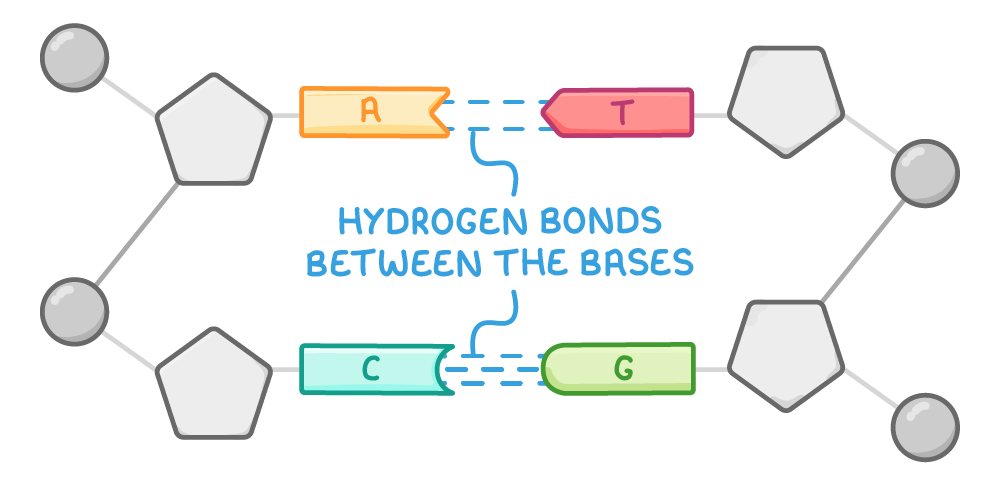
- The bases hold the two strands of the double helix together: a base on one strand lines up with a base on the other, reaching across the gap between the two backbones, and the two are joined by weak hydrogen bonds.
The base pairing rule
- Bases do not pair at random. The rule is fixed:
- A always pairs with T
- C always pairs with G
- This is called complementary base pairing, and a base and its partner form a base pair.
- The structure is like a twisted ladder: the paired bases form the rungs and the two sugar-phosphate strands form the sides. The many weak hydrogen bonds along the molecule hold the two strands together.
Complementary strands
- Because pairing always follows the same rule, the sequence on one strand fixes the sequence on the other - the two strands are said to be complementary.
- If you know the order of bases on one strand, you can work out the other by pairing each base with its partner.
- For example, a strand reading A-G-T-G-C must have the complementary strand T-C-A-C-G running opposite it (A with T, G with C, T with A, and so on).
- The particular order in which the four bases run along a strand is what differs from one DNA molecule to the next - which is why almost every individual's DNA sequence is unique (identical twins are the exception).
TermDefinition
DNAThe chemical that an organism's genetic material is made from. It stores the information the organism inherits.
ChromosomeA structure made of a long coiled molecule of DNA that carries many genes, found in the nucleus of plant and animal cells.
PolymerA very large molecule built from many small repeating units joined into long chains.
NucleotideThe repeating unit of DNA, made of a phosphate, a sugar, and a base.
Double helixThe twisted, two-stranded spiral shape of a DNA molecule.
Sugar-phosphate backboneThe continuous chain of alternating sugars and phosphates along a DNA strand.
Complementary base pairingThe rule that adenine always pairs with thymine, and cytosine always pairs with guanine.
Key points to remember
How were these notes?