10.5 - Rate of Photosynthesis
The experiment
Aim
To find out how light intensity affects the rate of photosynthesis in a water plant (pondweed such as Cabomba or Elodea), by measuring how much oxygen it gives off.
Background
- Photosynthesis uses light energy to turn carbon dioxide and water into glucose and oxygen (carbon dioxide + water → glucose + oxygen).
- The more light a plant gets, the faster it photosynthesises, up to the point where something else, such as the carbon dioxide level or the temperature, becomes the limiting factor.
- Moving a lamp further from the plant lowers the light intensity. It follows the inverse square law, so the light intensity is proportional to 1 divided by the distance squared, written .
- You can't see photosynthesis happening, but pondweed lives underwater, so the oxygen it makes comes off as bubbles you can see, count, or collect.
- So in this practical you put a lamp at different distances from pondweed and count the oxygen bubbles it gives off each minute. The more bubbles, the faster the rate of photosynthesis.
Variables
- Independent variable - The light intensity, changed by moving the lamp to different distances from the plant.
- Dependent variable - The rate of photosynthesis, as the number of oxygen bubbles given off per minute, or the volume of oxygen collected per minute.
- Control variables - The temperature, the piece of pondweed, the carbon dioxide level, and the time.
Method
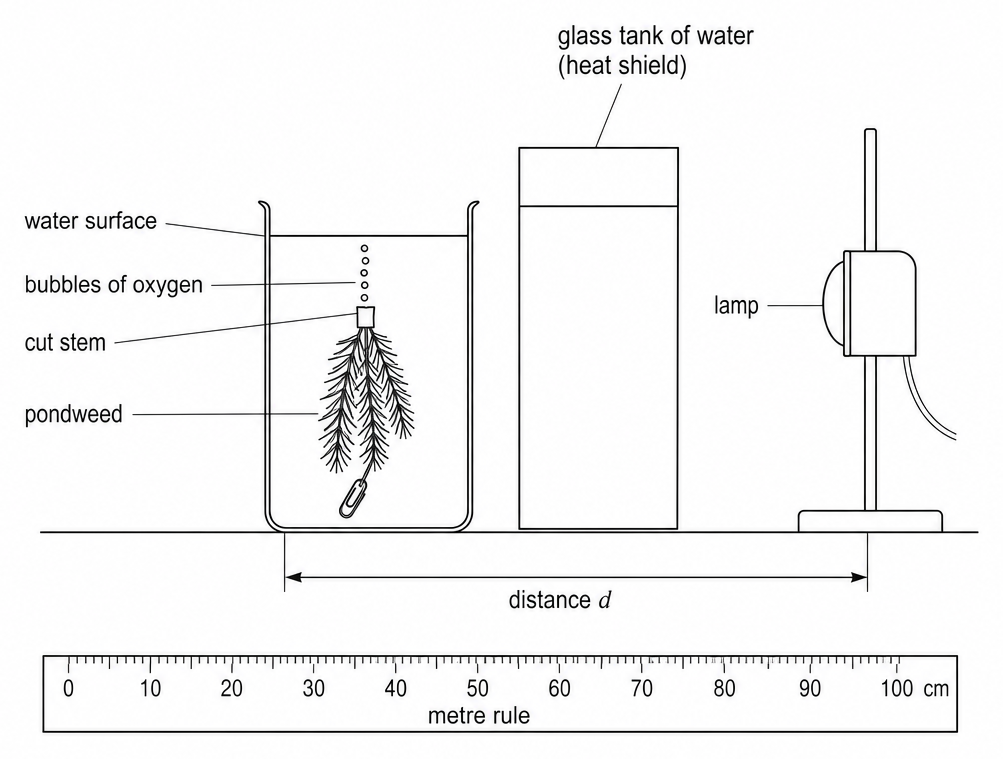
- Set up the pondweed - Put a piece of pondweed, cut end upwards, into a beaker of water with some sodium hydrogencarbonate dissolved in it.
- Place the lamp - Put a lamp 10 cm from the pondweed, with a clear beaker or tank of water between the lamp and the plant.
- Let the plant settle - Leave it for a few minutes at that light level.
- Count the bubbles - Count the oxygen bubbles given off in one minute, or collect the gas in an upside-down measuring cylinder or a gas syringe and read the volume.
- Move the lamp - Repeat at 20, 30, and 40 cm, leaving the plant to settle each time.
- Repeat - Repeat the whole experiment, and find a mean at each distance.
Safety
- The lamp runs off the mains and gets hot - Keep it well away from the water, dry your hands before you touch the switch, and don't touch the bulb.
- Sodium hydrogencarbonate - Wear eye protection when you make up the solution, and wash your hands after handling the pondweed.
Worked example - Light intensity and photosynthesis rate
A student counted the oxygen bubbles a piece of pondweed gave off in one minute at four lamp distances.
| Distance of lamp (cm) | Bubbles per minute |
|---|---|
| 10 | 40 |
| 20 | 10 |
| 30 | 4 |
| 40 | 3 |
Convert the distances into relative light intensities, and describe the trend.
Step 1 - Work out the relative light intensity at 10 cm
Light intensity is proportional to , so square the distance and divide 1 by it.
Step 2 - Work out the light intensity at the other distances
- At 20 cm, the light intensity is 1 ÷ 202 = 1 ÷ 400 = 0.0025, with 10 bubbles per minute.
- At 30 cm, the light intensity is 1 ÷ 302 = 1 ÷ 900 = 0.0011, with 4 bubbles per minute.
- At 40 cm, the light intensity is 1 ÷ 402 = 1 ÷ 1,600 = 0.000625, with 3 bubbles per minute.
Step 3 - Compare the rate at 10 cm and 20 cm
Moving the lamp from 10 cm to 20 cm doubles the distance. It doesn't halve the light, it quarters it, from to . The bubble rate falls from 40 to 10, also a quarter, so the rate follows the light intensity, not the distance itself.
Step 4 - Describe the trend
The closer the lamp, the higher the light intensity and the faster the pondweed photosynthesises, so the more oxygen bubbles it gives off per minute. As the lamp moves away, the rate falls steeply, because the light intensity drops with the square of the distance.
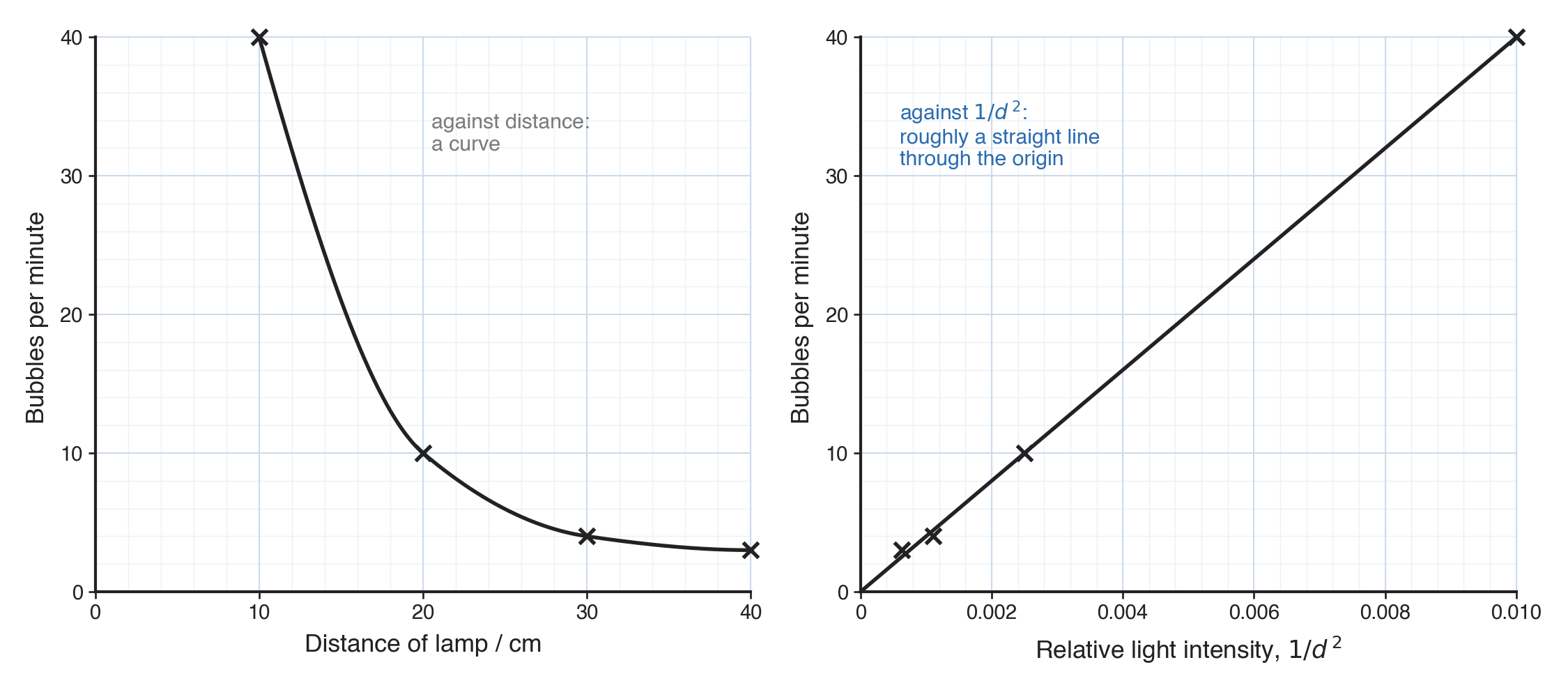
Plotted against distance the readings curve; against 1/d² they straighten out.
Common exam questions
Question 1
Why is sodium hydrogencarbonate added to the water?
It supplies carbon dioxide, which is a raw material for photosynthesis. That stops carbon dioxide becoming the limiting factor, so only the light intensity is being tested.
Question 2
Why is a beaker of water placed between the lamp and the plant?
It absorbs the heat from the lamp and keeps the temperature constant. Then moving the lamp changes only the light, and not the temperature.
Question 3
Why is counting bubbles not a perfect way to measure the rate?
The bubbles can be different sizes, and some may be missed, so collecting the gas and measuring its volume gives a more accurate result.
Question 4
The pondweed gave off 60 bubbles in 3 minutes. Calculate the rate.
Rate = 60 ÷ 3 = 20 bubbles per minute.
Question 5
At very high light intensity the rate stopped increasing. Suggest why.
Another factor, such as the carbon dioxide level or the temperature, had become the limiting factor, so more light no longer sped the reaction up.