2.1 - Mitosis
What mitosis is and why the body needs it
- Most body cells have a nucleus holding genetic material as chromosomes - coiled-up lengths of DNA.
- Each chromosome carries many genes, and different genes control the development of different characteristics.
- Body cells normally carry two copies of each chromosome, one from each parent, which makes them diploid.
What mitosis produces
- Mitosis is a type of cell division in which one cell divides to produce two new cells (daughter cells).
- The daughter cells are genetically identical to each other and to the original parent cell - each has exactly the same chromosomes, and so the same genes.
- The chromosome number is kept constant: because the body cell is diploid, each daughter cell is also diploid, with the full set, and no genetic information is lost.
- The full number of chromosomes, counting both copies, is the diploid chromosome complement.
Why the body needs mitosis
- Mitosis is the stage of a repeating sequence called the cell cycle at which the cell actually divides.
- Multicellular organisms use it to:
- Grow - By increasing the number of body cells
- Replace cells that have worn out or been damaged, repairing the tissue
- Mitosis is also how some organisms reproduce asexually, producing offspring genetically identical to the single parent.
The cell cycle
- The cell cycle is the repeating sequence a cell goes through: grow, copy its DNA, divide, and round again.
- A cell that isn't dividing has its DNA spread out in long strings.
- Before a cell can divide, it must prepare so there's enough of everything to share between the two new cells.
Preparing to divide
- The cell grows and increases the number of its sub-cellular structures, such as mitochondria and ribosomes, so there's enough for both new cells.
- It then duplicates its DNA, making one full copy for each new cell.
- The copied DNA forms X-shaped chromosomes, where each half is an exact copy of the other.
- Once its contents and DNA have been copied, the cell is ready for mitosis.
Interphase takes up most of the cycle
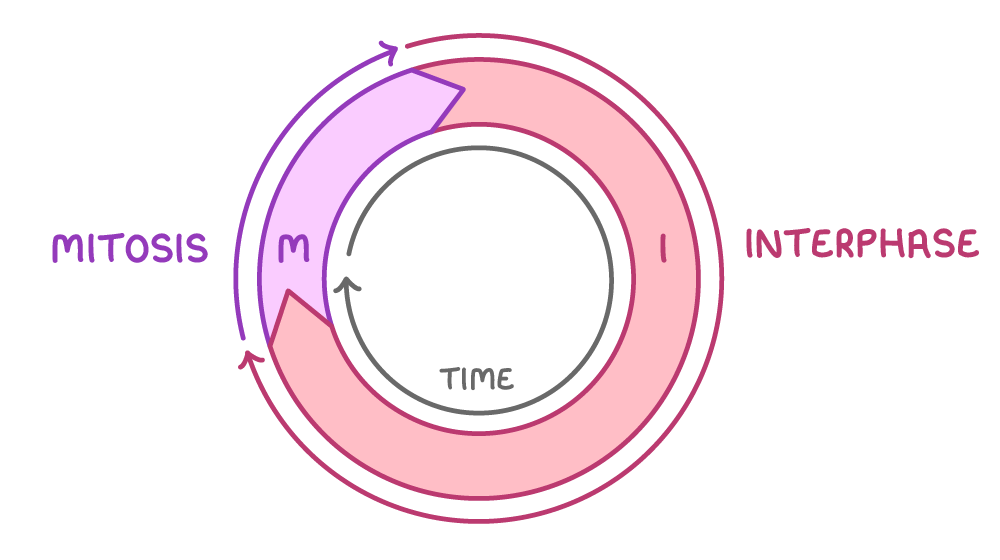
- The long growth-and-preparation period is called interphase.
- A cell spends most of its time in interphase, with mitosis only a small part of the cycle.
The stages of mitosis
- Once the cell's contents and DNA have been copied, it is ready for mitosis.
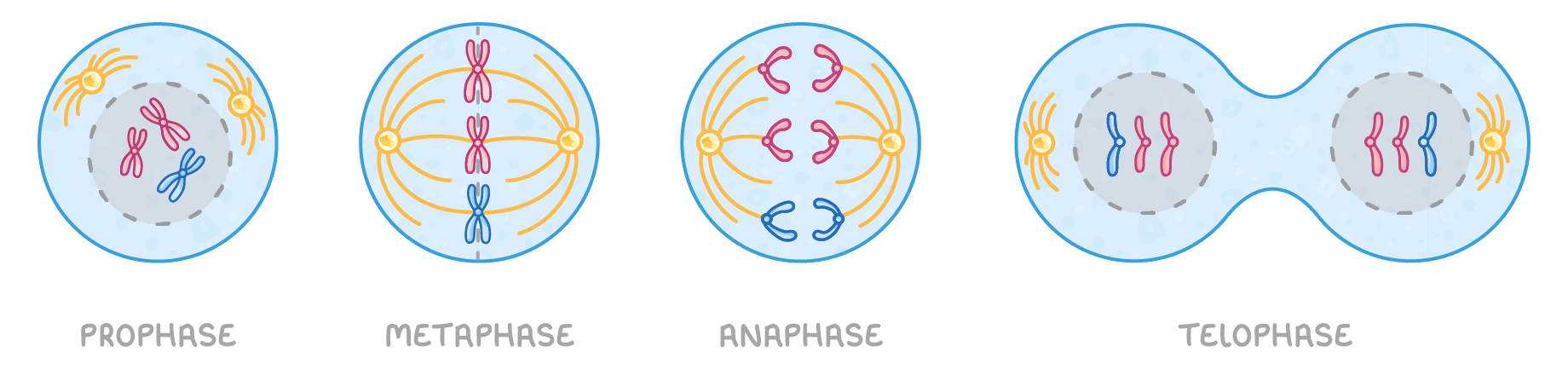
- Mitosis is divided into four named stages that run one after another, ending with telophase.
The four stages
- Prophase - The chromosomes condense (get shorter and fatter), the membrane around the nucleus breaks down, and the chromosomes lie free in the cytoplasm.
- Metaphase - The chromosomes line up across the centre of the cell.
- Anaphase - Spindle fibres pull the chromosomes apart, dragging the two chromatids (the two identical copies that make up each chromosome) to opposite ends of the cell.
- Telophase - A membrane forms around each set of chromosomes, creating the two new nuclei - the nucleus has divided.
Cytokinesis and the result
- Before telophase fully ends, the cytoplasm and cell membrane divide to form two separate cells. This division of the cytoplasm is called cytokinesis.
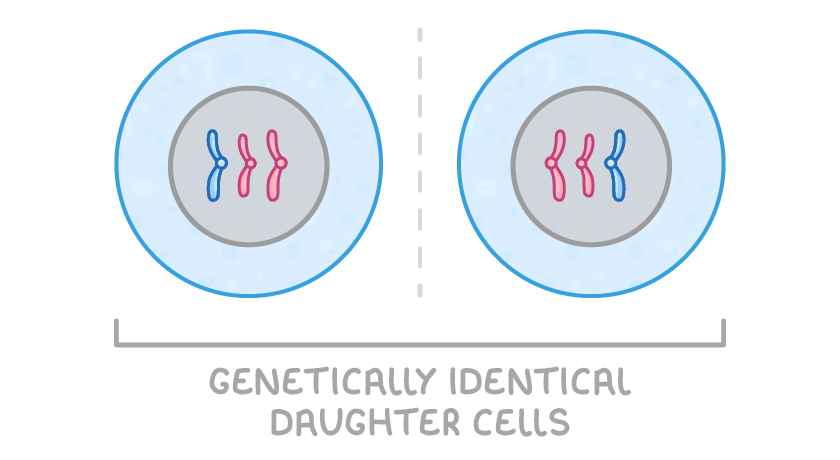
- The result is two daughter cells, each with an identical set of chromosomes.
- The daughter cells are genetically identical diploid cells - identical to each other and to the parent cell.
Cancer - Uncontrolled mitosis
- The rate at which cells divide by mitosis is normally controlled by the genes (chemical instructions) in the cell's DNA - so the body only makes new cells when it needs them.
- If one of the genes that controls cell division changes, the cell may start dividing uncontrollably, far faster than the body needs.
- This produces a mass of abnormal cells called a tumour.
- If the tumour invades and destroys the surrounding tissue, it is called cancer.
Key points about the change
- A random change in a gene like this is called a mutation.
- Cancer is a non-communicable disease - it cannot be passed from one person to another.
TermDefinition
Mitosis
Diploid
Interphase
Prophase
Metaphase
Anaphase
Telophase
Chromatid
Cytokinesis
Tumour
Cancer
Mutation