4.4 - Classification
How classification has changed
- Classification systems have changed over time as scientists gained new tools and evidence.
- Early classification used observable characteristics - features you can see, such as how many legs an animal has or whether a plant flowers.
- As microscopes improved, this grew to include features visible only under magnification, such as cell structure.
- These characteristics were used to sort living things into the five-kingdom classification system, where organisms are first split into five large groups called kingdoms, then into smaller and smaller groups.
The rise of molecular evidence
- As biochemistry and genetics developed, scientists became able to work out the sequence of DNA bases in different organisms' genes, and of their RNA, and compare them.
- The more similar the base sequence of a gene is between two organisms, the more closely related they are.
- For example, human and chimpanzee DNA is about 94% the same, showing the two are close relatives.
- This evidence is far more precise than appearance alone, because it can show:
- Two organisms that look very similar are actually only distantly related.
- Two organisms that look different are in fact close relatives.
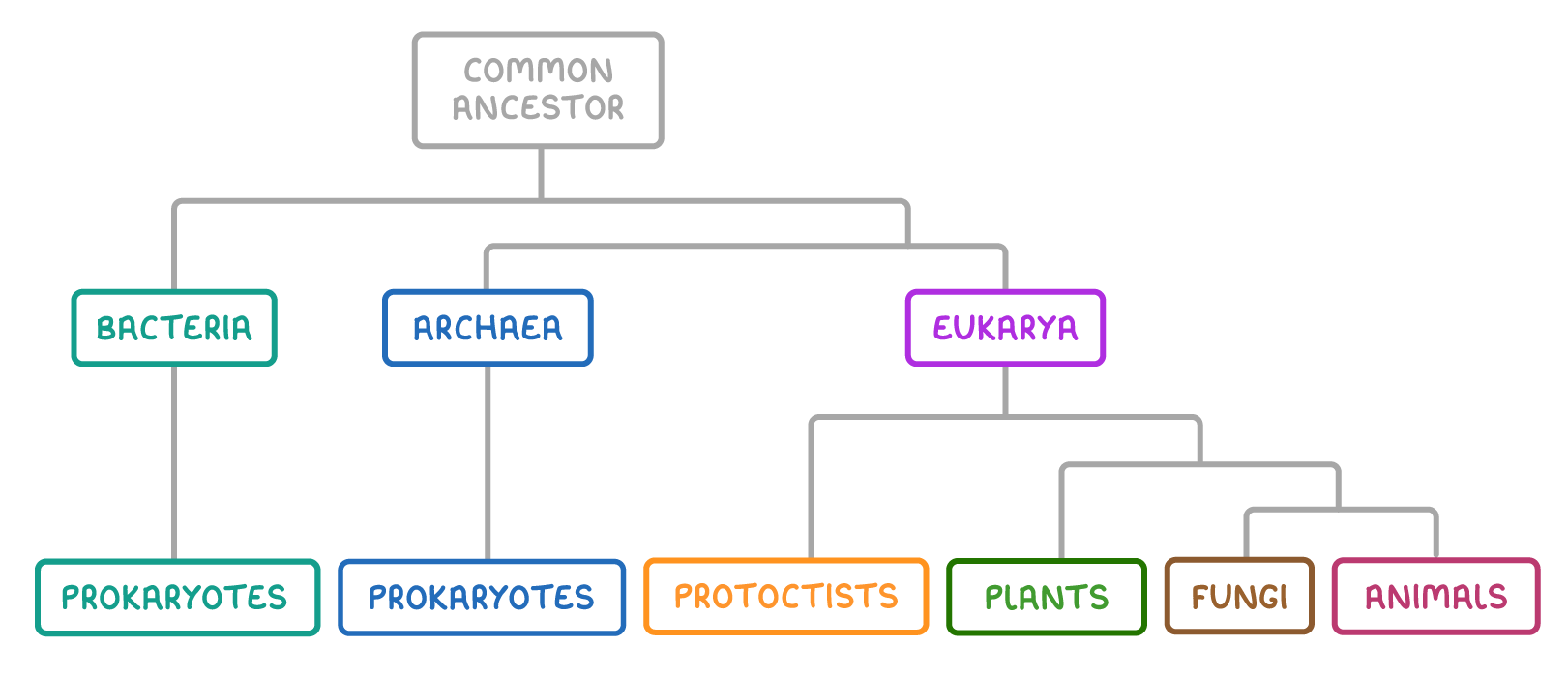
- These relationships are shown on an evolutionary tree (also called a phylogenetic tree), a branching diagram in which each branch point stands for a common ancestor. The more recently two species share a common ancestor, the more closely related they are.
The three-domain system
- Molecular evidence led to a rethink of how organisms are classified.
- Using RNA sequencing, the scientist Carl Woese found that some members of the prokaryote kingdom were far less closely related than had been assumed.
- He proposed a new top level of classification: three large groups called domains, placed above the kingdoms.
The three domains are:
- Archaea - Prokaryotic organisms once thought to be bacteria but genetically distinct, often living in extreme places such as hot springs and salt lakes
- Bacteria - The true bacteria
- Eukarya - All organisms with eukaryotic cells, including animals, plants, fungi, and protoctists
The five-kingdom scheme is still used, but the three domains now sit above it.
TermDefinition
Domain