7.2 - The Digestive System
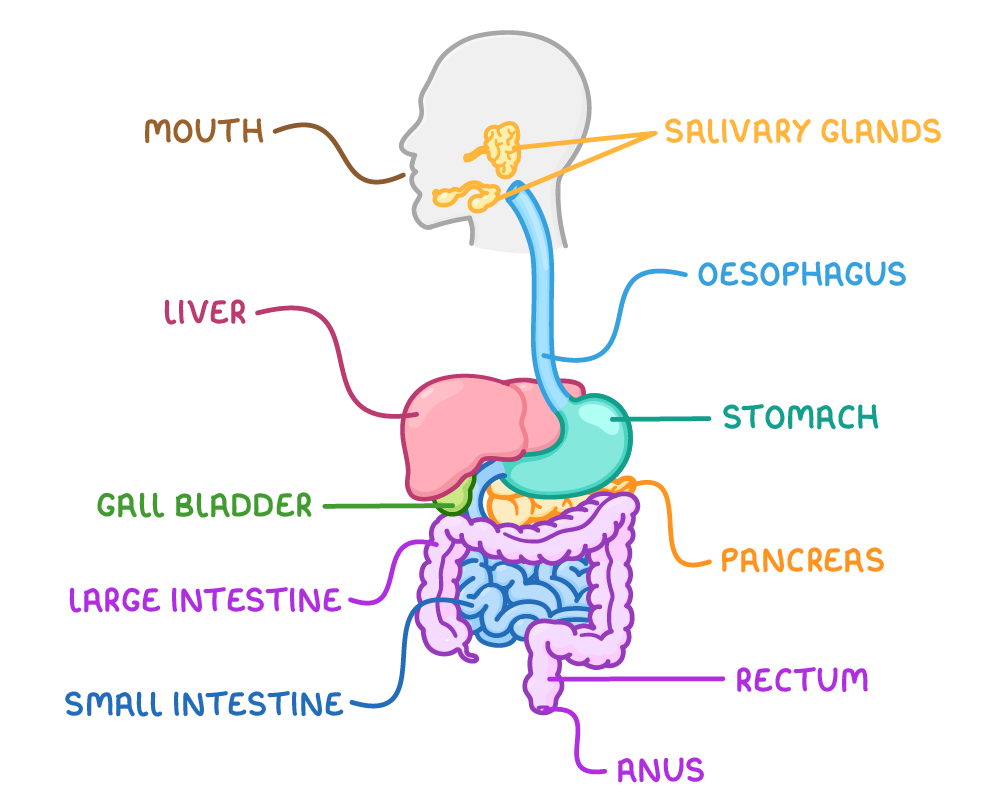
The organs of the digestive system
- The digestive system breaks food down into small molecules the body can absorb and use, and passes out what's left.
- Its central part is the alimentary canal (the gut) - a long muscular tube running from mouth to anus.
- The alimentary canal plus the organs that empty into it make up the whole digestive system.
- Food travels along the canal in one direction, and each region has its own job.
The alimentary canal, from mouth to anus
- Mouth - Takes food in and starts breaking it down. The teeth break food into smaller pieces, and the salivary glands release saliva, which contains a digestive enzyme that starts to digest starch.
- Oesophagus - The muscular tube carrying food from the mouth down to the stomach.
- Stomach - A muscular bag that churns food with its muscular walls into a paste. It releases gastric juice containing hydrochloric acid, which kills many bacteria taken in with food and makes the contents strongly acidic - the condition the stomach's own enzyme needs.
- Small intestine - A long, narrow tube whose first part is the duodenum and last part is the ileum. Digestion is completed here, and the small, soluble products of digestion (plus most of the water) are absorbed through the wall into the blood.
- Large intestine (the colon) - Most of the remaining water is absorbed back into the body, leaving a semi-solid waste.
- The waste, called faeces, is stored in the rectum (the last part of the large intestine) before being passed out through the anus.
Three organs sit alongside the canal and release their secretions into it:
- Liver - Makes bile, a fluid that helps with the digestion of fats.
- Gall bladder - Stores the bile made by the liver and releases it, through the bile duct, into the small intestine.
- Pancreas - Makes digestive enzymes and releases them into the small intestine to help complete digestion.
The five processes of the digestive system
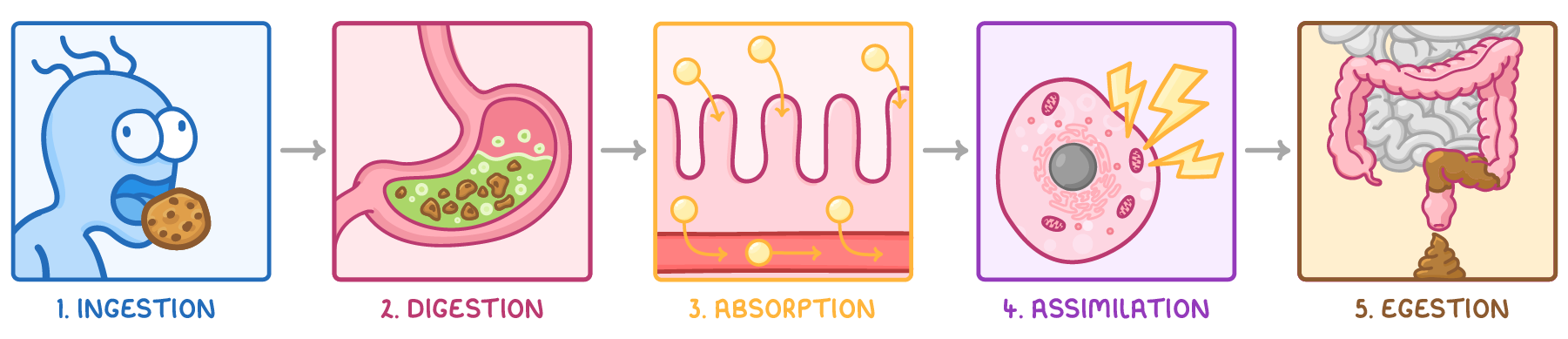
Food doesn't pass through the body unchanged - from being taken in to what's left being passed out, it goes through five processes.
The five processes in order
- Ingestion - The taking of substances, such as food and drink, into the body through the mouth
- Digestion - The breakdown of food, where large pieces and large molecules are broken down into small, soluble molecules
- Absorption - The movement of these small nutrient molecules out of the intestines and into the blood, happening mainly in the small intestine
- Assimilation - The absorbed nutrients are taken up by the body's cells and used, becoming part of the cells or being used to release energy
- Egestion - The removal from the body, as faeces, of food that was not digested or absorbed
Examples of assimilation include glucose being used in respiration to release energy or stored as glycogen, and amino acids being used to build the body's own proteins.
Egestion is not the same as excretion
- Excretion - The removal of waste products made by the body's own chemical reactions, such as carbon dioxide and urea, and of substances in excess of the body's needs
- Egestion - The removal of undigested food as faeces
Undigested food removed as faeces was never taken into the body's cells and never took part in its reactions, so it is not a waste product of the body's chemistry. Losing it is egestion, not excretion.
Physical and chemical digestion
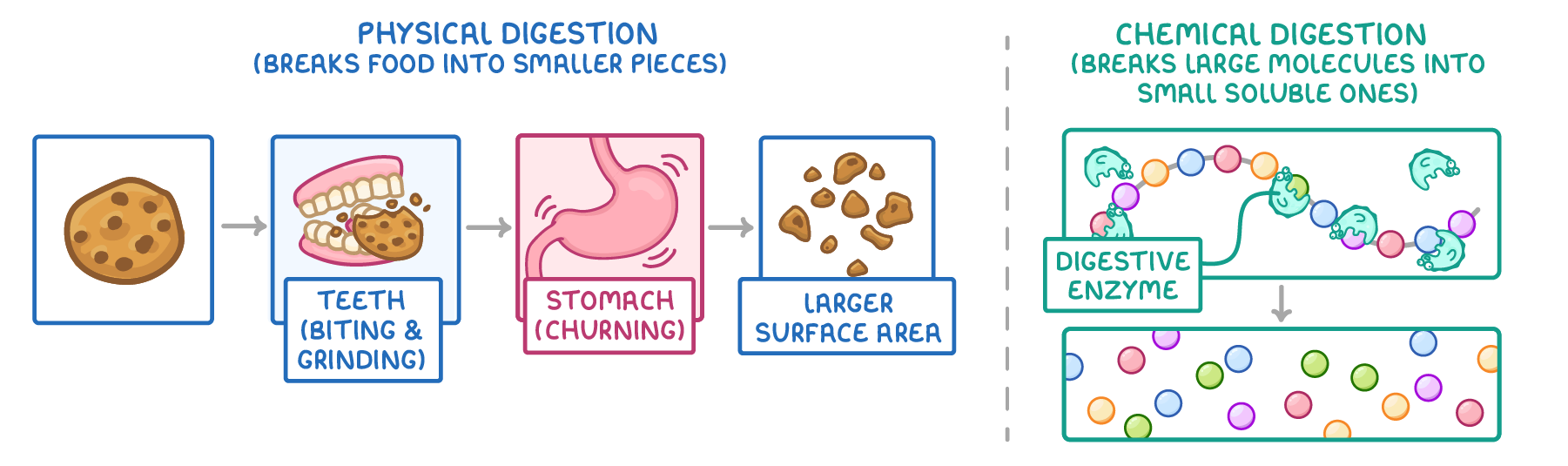
Digestion happens in two ways that work together: physical digestion and chemical digestion.
Physical digestion
- Physical digestion is the breaking of food into smaller pieces without changing the molecules themselves.
- It's carried out by:
- The teeth biting and grinding food
- The stomach churning food with its muscular walls
- Each piece is still made of the same molecules as before - no chemical change has happened.
- Breaking food up greatly increases its surface area:
- A large lump has only its outside exposed
- The same food in many small pieces exposes far more surface
- This gives the enzymes of chemical digestion a larger area to work on, so they can act faster.
Chemical digestion
- Chemical digestion is the breaking of large molecules into small ones - here the molecules really are changed.
- The starch, proteins, and fats in food are large molecules, and most are insoluble, so they're far too big to pass through the wall of the alimentary canal into the blood.
- Chemical digestion breaks these large, insoluble molecules into small, soluble ones, which can then dissolve and pass easily through the gut wall to be absorbed.
- This breakdown is carried out by digestive enzymes.
TermDefinition
Alimentary canalThe long muscular tube that food passes along, from the mouth to the anus.
IngestionThe taking of substances, such as food and drink, into the body through the mouth.
DigestionThe breakdown of food into smaller pieces, and of large molecules into small, soluble molecules.
AbsorptionThe movement of water and the soluble products of digestion out of the gut and into the blood.
AssimilationThe uptake and use of absorbed nutrients by the body's cells, for example to build proteins from amino acids.
EgestionThe removal of food that has not been digested or absorbed, which passes out of the body as faeces.
Physical digestionThe breakdown of food into smaller pieces without chemical change to the food molecules.
Chemical digestionThe breaking down of large, insoluble molecules into small, soluble molecules by digestive enzymes.