1.2 - Variety of Living Organisms
The features of bacteria and viruses
Bacteria
- Bacteria make up the prokaryote kingdom.
- A bacterium is a microscopic, single-celled organism.
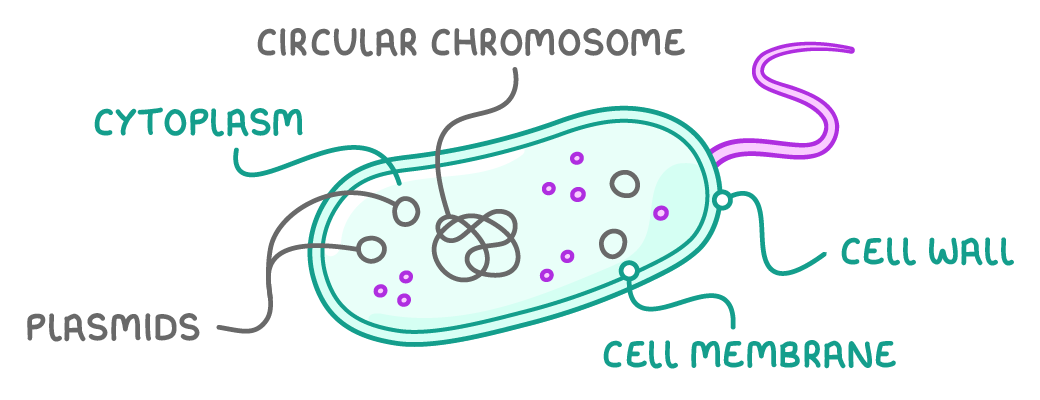
- The cell has no nucleus - instead the genetic material is a single circular chromosome of DNA loose in the cell.
- Every bacterial cell has a cell wall, a cell membrane, and cytoplasm.
- Many also carry small separate rings of DNA called plasmids.
- Some bacteria can photosynthesise, but most feed off other organisms, living or dead.
Examples of bacteria:
- Lactobacillus bulgaricus - A rod-shaped bacterium used to turn milk into yoghurt
- Pneumococcus - A spherical bacterium that causes pneumonia
Viruses
- Viruses are not living organisms and are not placed in any kingdom.
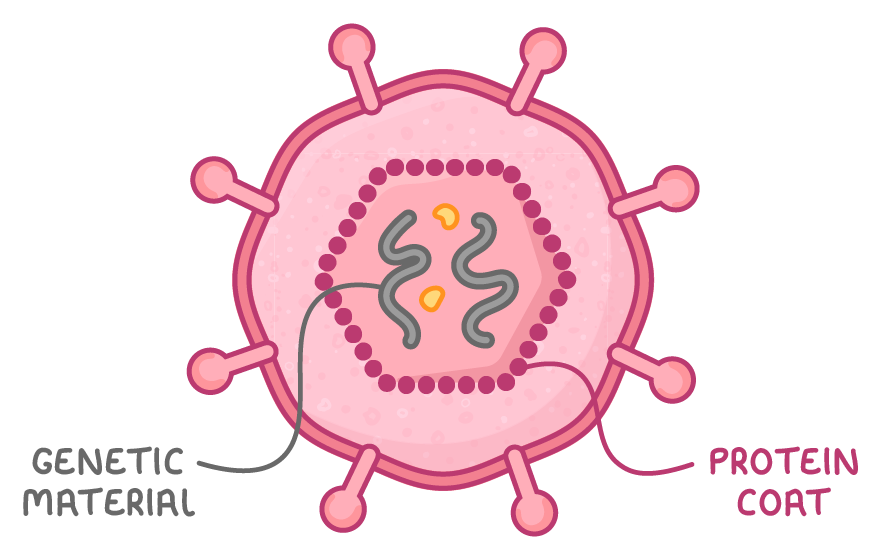
- A virus is a particle, much smaller than a bacterium, with no cellular structure at all.
- It is simply a protein coat wrapped around a small amount of genetic material, which can be either DNA or RNA.
- Viruses come in a wide variety of shapes and sizes, and the one shown below is just one of them.
How viruses reproduce
- A virus cannot reproduce on its own.
- It can only reproduce inside the living cells of another organism, which it takes over.
- A virus therefore depends entirely on a host and acts as a parasite.
- Because of this, all viruses are pathogens - they cause disease.
- A pathogen is any organism that causes disease. Pathogens can be fungi, bacteria, protoctists, or viruses.
- Viruses aren't living organisms, but they still count as pathogens.
Examples of viruses:
- Tobacco mosaic virus - Discolours the leaves of tobacco plants by stopping them making chloroplasts
- Influenza virus - Causes flu
- HIV - Causes AIDS
TermDefinition
PathogenA microorganism that causes disease.