22.9 - Biological Drawing, Magnification & Comparing Specimens
What a specimen question looks like
- The second question on every Cambridge practical paper is built on a specimen - usually a photograph of a leaf, seed, flower, or part of an animal.
- It asks you to do three things: draw it, work out its real size, and compare it with a second specimen.
- These three tasks come up in the same order on nearly every paper, so Question 2 is as predictable as Question 1.
A typical question
Fig. 2.1 is a photograph of a leaf.
(a) Make a large drawing of the leaf. [4]
(b) The line AB on Fig. 2.1 is the length of the leaf. Measure the length of line AB. The magnification of the photograph is ×2. Calculate the actual length of the leaf. [3]
(c) Fig. 2.2 shows a second leaf from a different plant. Compare the two leaves. [3]
The three skills and their marks
-
The drawing (4 marks):
- One clear unbroken outline (1)
- A size greater than half the space provided (1)
- Two correct observed details (1 each)
- Shading and drawing individual cells score nothing
-
The magnification calculation (3 marks):
- Measure the line correctly (1)
- Put the numbers into the formula and calculate (1)
- Round to the stated precision (1)
- A wrong measurement still earns the calculation and rounding marks, because the marking carries your error forward
-
The comparison (2-3 marks):
- Each mark is a paired point that names a feature in both leaves
- For example, one leaf being smaller than the other, or one having a serrated edge and the other a smooth edge
Making a biological drawing
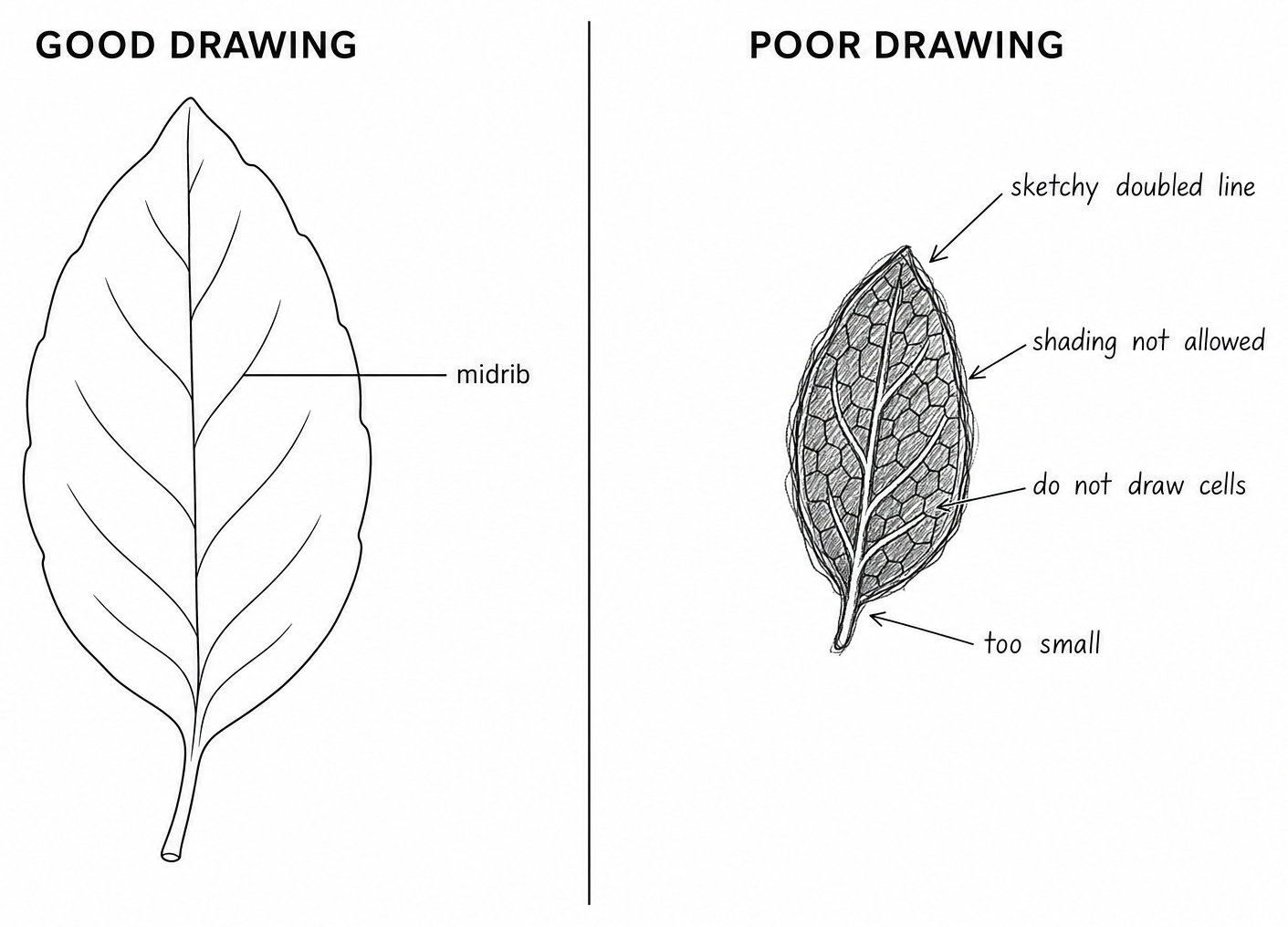
- A biological drawing is not an art drawing - it's a clear, plain record of a specimen's shape and the main structures you can see on it.
- The four marks are for four specific, checkable things, not for how good it looks.
What the marks are given for
- One clean, unbroken outline - Draw the outline as a single continuous line with a sharp pencil. The mark scheme wants "a single clear unbroken line", so draw it once - not sketched in several short strokes and not gone over twice. A sketchy or doubled outline is the most common way to lose this mark.
- Draw it large - The size mark is usually worded as the drawing being "greater than half of the space provided". On some papers it's pinned to a stated length, such as "at least 65 mm wide" or larger than a printed line. Fill the space you're given - a small drawing in the corner loses a mark even when its shape is perfect.
- Two observed details - Two of the four marks are for structural details you can actually see on the specimen: the lobes of a leaf, the veins running from the midrib, the pips in a fruit, the segments of an insect. Draw what's in front of you. If asked to label, use a ruler to draw a straight label line out to the name.
No shading, and no cells unless asked
- Shading scores nothing and can lose the outline mark - leave the drawing as clean lines, with no shadowing or colouring in.
- Do not draw individual cells. The mark scheme rejects a drawing with cells in it unless the question asks for a high-power drawing of cells - a low-power drawing of a whole specimen is about its overall structure, not its cells.
Magnification and actual size
- These questions give you a photograph or drawing at a stated magnification and ask for the specimen's real size.
- The question is worth 3 marks, awarded in three steps: measure the line, put the numbers into the formula, and round to the precision asked for.
The formula
You're usually asked for the actual size, so rearrange to:
- Image size - The length you measure on the page.
- Magnification - The number the question gives you (for example ×2 or ×8).
Working through the three steps
- Measure the line in millimetres - Lay a ruler along the marked line (usually labelled, e.g. line AB) and read its length to the nearest mm. The mark scheme states the value it wants with a small tolerance, e.g. "line AB = 90±1 mm". Measuring in mm keeps the numbers whole and the arithmetic cleaner.
- Watch the units - If the magnification is a plain number (×2, ×8), the actual size comes out in whatever unit you measured in - measure in mm and the answer is in mm. Convert at the end if a different unit is wanted: 11.25 mm is 1.125 cm, and 1 mm is 1,000 µm.
- Round to the stated precision - The last mark is for rounding correctly. The paper tells you what to round to - two significant figures, three significant figures, or a number of decimal places. Give the answer to the precision asked for and no finer.
A wrong measurement still scores
- The three marks are marked with error carried forward: if your line measurement is out, but you put your own value into the formula correctly and round it correctly, you still earn the calculation and rounding marks.
- So always finish the calculation even if you're unsure of the measurement.
Worked example - Actual length of a leaf
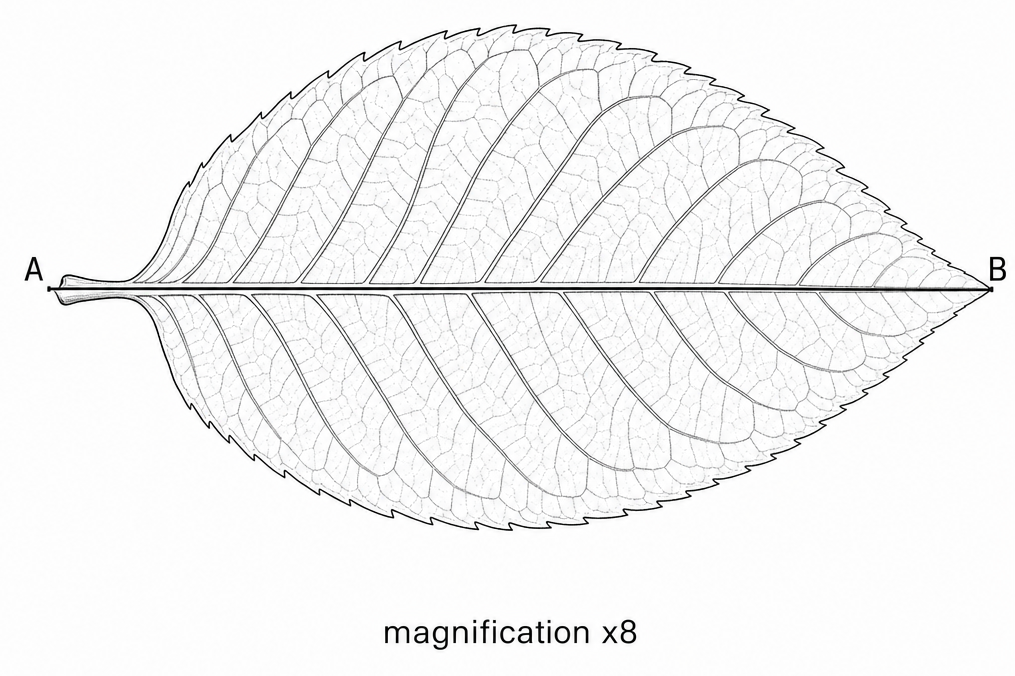
A photograph of a small leaf is printed at a magnification of ×8. The line AB drawn across the leaf measures 90 mm on the page. Give the answer to two significant figures.
Step 1 - Measure the line (1 mark)
Line AB = 90 mm.
Step 2 - Calculate (1 mark)
Actual size = image size ÷ magnification = 90 ÷ 8 = 11.25 mm
Step 3 - Round to the stated precision (1 mark)
11.25 mm to two significant figures is 11 mm, so the leaf is 11 mm long.
The calculation mark is given for the 11.25 to any number of figures, and the rounding mark is separate - so writing "11.25" and stopping there would leave the rounding mark unclaimed. Equally, a wrong line measurement fed correctly through the same two steps still scores them both.
Comparing two specimens
- The comparison task shows a second specimen and asks you to compare it with the first.
- It's worth 2 or 3 marks, and each mark is one paired comparative point - a single statement saying how a named feature differs, mentioning both specimens.
- You need as many separate paired points as there are marks: two marks = two comparisons; three marks = three.
Name both specimens in each point
- A comparison mark is only earned if the statement makes the contrast explicit.
- "The strawberry leaf is smaller than the banana leaf" scores - it names both specimens and the feature they differ in.
- "It is small" does not score - it describes one specimen without comparing it to the other.
- Mark schemes list these as paired rows (e.g. "smaller ... or larger", "serrated leaf edge ... or smooth leaf edge"). Either side of the pair, written as a full comparison, earns the mark.
Use observation vocabulary
The features worth comparing are the things you can see and describe. Run through this checklist:
| Feature | What to compare | Example comparative statement |
|---|---|---|
| Size | Overall length or width | The first leaf is smaller than the second. |
| Shape | Whole outline; simple or divided | The first leaf has three leaflets, while the second is one complete leaf. |
| Margin | The edge - smooth or serrated | The first leaf has a serrated edge, whereas the second has a smooth edge. |
| Veins | Their width, angle, or branching | The first leaf has narrower veins, while the second has wider veins. |
| Texture / other | Surface, hairs, stalk thickness or length | The first leaf has a thinner stalk than the second. |
You don't need all five features - just as many genuine paired points as there are marks.
Make each point a genuine difference
- A comparison of two features that are actually the same in both specimens scores nothing - pick features where the two clearly differ.
- Working down the checklist (size → shape → margin → veins → texture) is a quick way to find real differences without staring at the specimens hoping something jumps out.
Common exam questions
Question 1
A biological drawing question is worth 4 marks. What four things is it marked on?
One clear unbroken outline; a drawing larger than half the space provided; and two observed structural details, one mark each. Shading and drawing individual cells are not credited.
Question 2
Why does shading a biological drawing lose marks rather than gain them?
The outline mark needs a single clean line, and shading is rejected by the mark scheme, so a shaded drawing can lose the outline mark and gains nothing for the shading itself.
Question 3
A photograph is printed at a magnification of ×5. A line across the specimen measures 60 mm. What is the actual size of the specimen?
Actual size = image size ÷ magnification = 60 ÷ 5 = 12 mm.
Question 4
In a magnification calculation you measure the line wrongly, but then put your own value into the formula correctly and round it correctly. Can you still score?
Yes. The calculation and rounding marks are awarded with error carried forward, so a correct method applied to your own measurement still earns those two marks even though the first mark is lost.
Question 5
Why does "the leaf is small" not score as a comparison of two leaves?
Because a comparison mark needs both specimens named in the statement; "small" describes one leaf without saying how it differs from the other, so it has to be written as "the first leaf is smaller than the second".
Question 6
Give two paired points you could make when comparing two leaves.
Any two genuine differences that name both, such as: the first leaf has a serrated edge while the second has a smooth edge; and the first leaf has three leaflets while the second is a single complete leaf.