19.3 - Trophic Levels
Trophic levels and producers
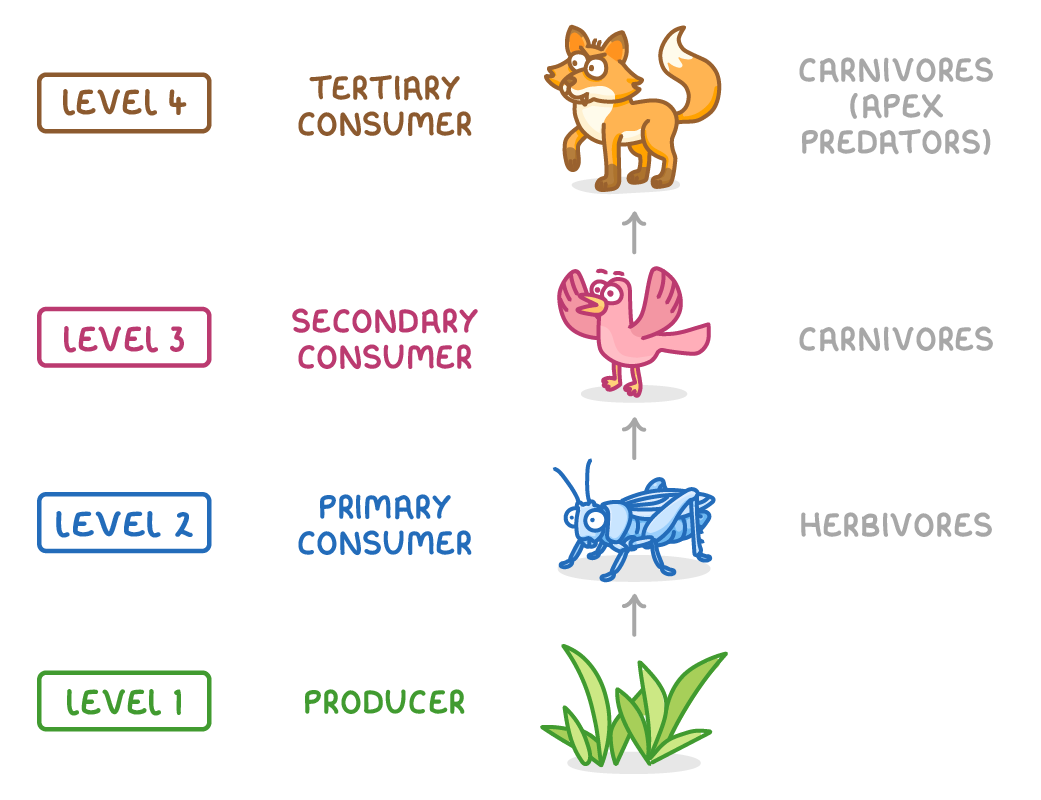
- A trophic level is the position (feeding level) an organism occupies in a food chain.
- The levels are numbered from level 1 upwards, so a food chain reads as a sequence of trophic levels from the producer at the bottom to the top predator.
- Each step up the chain is the next number.
Level 1 - Producers
- Level 1 is always a producer.
- Producers are plants and algae. They're called producers because they make their own food by photosynthesis, using light energy from the Sun.
- This makes them the base of the whole chain:
- They capture the energy that everything else depends on.
- They produce the biomass (the mass of living material) that is passed along the chain to organisms above them.
- All the energy in a food chain originally enters through the producers.
The consumer levels
The levels above the producer are the consumers - animals that get their energy by eating other organisms.
| Level | Consumer | What they eat |
|---|---|---|
| 2 | Primary consumers - herbivores | Plants and algae |
| 3 | Secondary consumers - carnivores | The herbivores |
| 4 | Tertiary consumers - carnivores | Other carnivores |
- A fourth consumer can also be called a quaternary consumer.
- The pattern then keeps repeating up the chain.
- A carnivore at the very top of a chain, with no predators of its own, is an apex predator.
Organisms that don't fit the ladder
- Omnivores, such as bears, eat both producers and other animals, so they don't sit cleanly at one level. They feed at more than one trophic level: level 2 when they eat producers and level 3 when they eat primary consumers.
- Food chains rarely have more than four or five levels, because energy is lost at each transfer (only about a tenth passes on each time), so there's too little left to support organisms much higher up.
Decomposers as a trophic level
- Decomposers are a further feeding group in a food chain.
- They get their energy from dead and waste organic matter, not from living prey - the remains of dead plants and animals, plus waste such as droppings.
- The main decomposers are bacteria and fungi.
- Detritivores - Small animals such as earthworms that feed on dead material and break it into smaller pieces - are also involved.
How decomposers feed
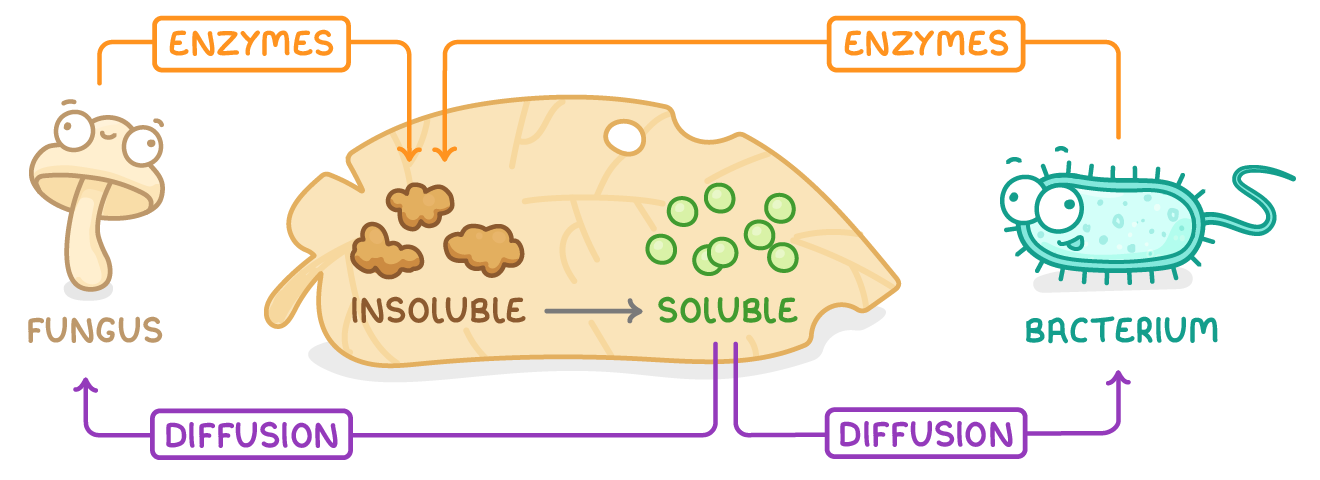
- Decomposers don't take food into a gut. Instead they secrete enzymes out into the dead matter around them.
- These enzymes break large insoluble molecules down into small soluble ones.
- The soluble food molecules then diffuse back into the decomposer, where they're used for energy and growth.
- This is how a fungus or soil bacterium "eats" a dead leaf without ever swallowing it.
Recycling nutrients
- By breaking down dead matter, decomposers return its nutrients to the soil and environment.
- Producers can then take these nutrients up and use them again.
- This makes decomposers the link that closes the loop of a food chain, recycling the materials locked up in dead organisms back to the producers at the start.
TermDefinition
Trophic levelThe position an organism occupies in a food chain.
ProducerAn organism, usually a green plant or alga, that makes its own food by photosynthesis and begins a food chain.
BiomassThe material that living organisms are made of, or the mass of this material in an organism or at a trophic level (a feeding level in a food chain).
Apex predatorA carnivore at the top of a food chain with no predators of its own.
DecomposerAn organism, such as a bacterium or fungus, that gets its energy from dead and waste organic matter.
DetritivoreA small animal that feeds on dead material and breaks it into smaller pieces.