16.4 - Fertilisation & Germination
Fertilisation in flowering plants
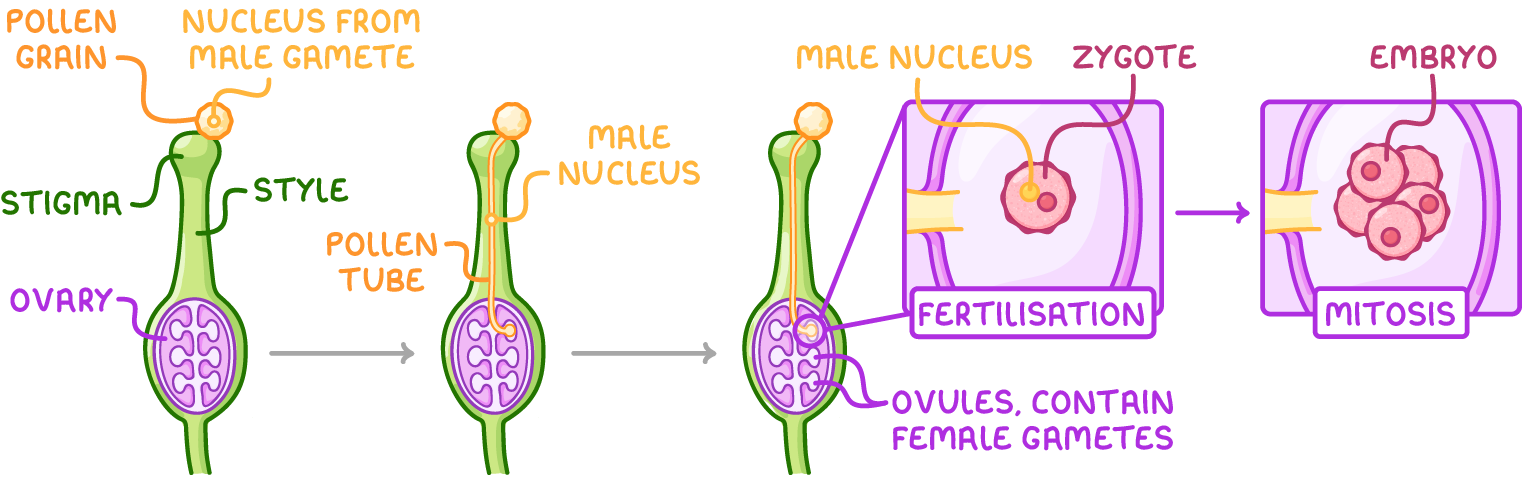
- After a pollen grain lands on the stigma, it does not fertilise the female gamete straight away - the male gamete still has to reach the ovule.
- A pollen tube grows out of the pollen grain and down through the style towards the ovary, entering the ovule.
- A nucleus from the male gamete then travels down this tube to join the female gamete inside the ovule.
- Fertilisation is the moment the male nucleus and female nucleus fuse to form a zygote.
- The zygote divides by mitosis to form an embryo.
What the flower becomes after fertilisation
- Each ovule containing a fertilised female gamete becomes a seed.
- The ovary that surrounded the ovules develops into a fruit around the seed or seeds.
The structure of a seed and its food reserves
A seed has three main parts:
- Embryo - The young plant, made up of an embryo root and an embryo shoot that grow into the adult plant
- Food store - A supply of lipids and starch that the young plant lives on at first
- Seed coat - A tough protective outer covering that keeps the inside safe until the seed germinates
Why the seed relies on its food store
- At first the seed cannot photosynthesise - it has no green leaves and may be underground in the dark - so it lives entirely on its food store.
- When the seed germinates, it draws glucose from its food store and respires it. This provides the energy and materials the seedling needs to grow its first root and shoot.
- The seed keeps relying on its food store until the young plant has grown above the soil and produced green leaves.
- Once it has green leaves, it can make its own glucose by photosynthesis and no longer depends on the food stored in the seed.
The conditions needed for germination
- Germination is the process by which a seed develops into a young plant.
- It's controlled by enzymes inside the seed.
- A seed often lies dormant (inactive) until conditions are right.
- Germination only begins when three conditions are all present together: water, oxygen, and warmth.
- If any one of these is missing, the seed stays dormant and does not germinate.
Why each condition is needed
- Water - Makes the seed swell and activates the enzymes inside it, which control the growth of the seedling.
- Oxygen - Needed for aerobic respiration, the process that provides the energy the seed needs to grow.
- Warmth (a suitable temperature) - Raising the temperature raises enzyme activity and so the rate of growth.
- If it's too cold, the enzymes work too slowly.
- Very high temperatures denature the enzymes and stop germination altogether.
- The temperature that suits germination depends on the type of seed.
TermDefinition
FertilisationThe fusion of the nucleus of a male gamete with the nucleus of a female gamete.
ZygoteThe single cell formed when the nuclei of a male gamete and a female gamete fuse at fertilisation.
Seed coatA protective outer covering that keeps the inside of a seed safe until it germinates.
GerminationThe process by which a seed develops into a young plant.