16.5 - Puberty & the Menstrual Cycle
Puberty and reproductive hormones
- Puberty is the stage during which adolescents become sexually mature and develop secondary sexual characteristics.
- Secondary sexual characteristics are physical changes in the body - e.g. facial hair developing in males and breasts developing in females.
- Puberty is triggered by reproductive hormones.
Testosterone - The main male hormone
- Produced by the testes.
- Stimulates sperm production.
- Causes male secondary sexual characteristics to develop:
- Facial and body hair
- A deeper voice
- Increased muscle development
- Growth of the penis and testes
Oestrogen - The main female hormone
- Produced by the ovaries.
- Causes female secondary sexual characteristics to develop:
- Breast development
- Widening of the hips
- Growth of underarm and pubic hair
- Also involved in the menstrual cycle.
The female reproductive system and the menstrual cycle
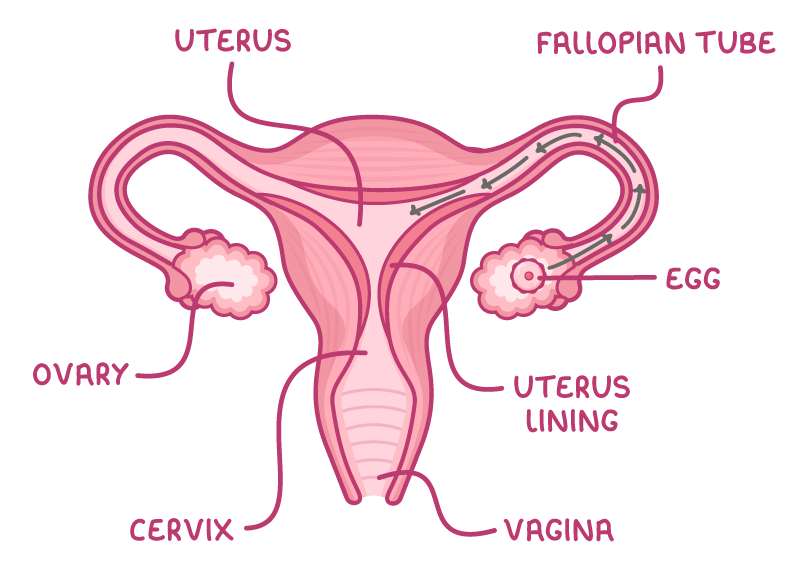
- The female reproductive system includes the ovaries, fallopian tubes, uterus, and uterus lining, as well as the cervix and the vagina.
- The menstrual cycle coordinates two main things:
- The release of an egg from an ovary.
- The preparation of the uterus lining in case that egg is fertilised.
The parts and what they do
- Ovaries - Contain egg cells. During the cycle, one egg usually matures and is released from one of the ovaries. This release is called ovulation.
- Fallopian tubes - After ovulation, the egg travels from the ovary through one of the fallopian tubes towards the uterus.
- Uterus - Also called the womb. This is where a fertilised egg can implant and develop during pregnancy.
- Uterus lining - Also called the endometrium. It changes during the cycle, building up to prepare for a fertilised egg.
What happens to the lining
- If a fertilised egg implants in the uterus lining, pregnancy can begin.
- If fertilisation does not happen, the lining breaks down and is lost from the body during menstruation.
The stages of the menstrual cycle
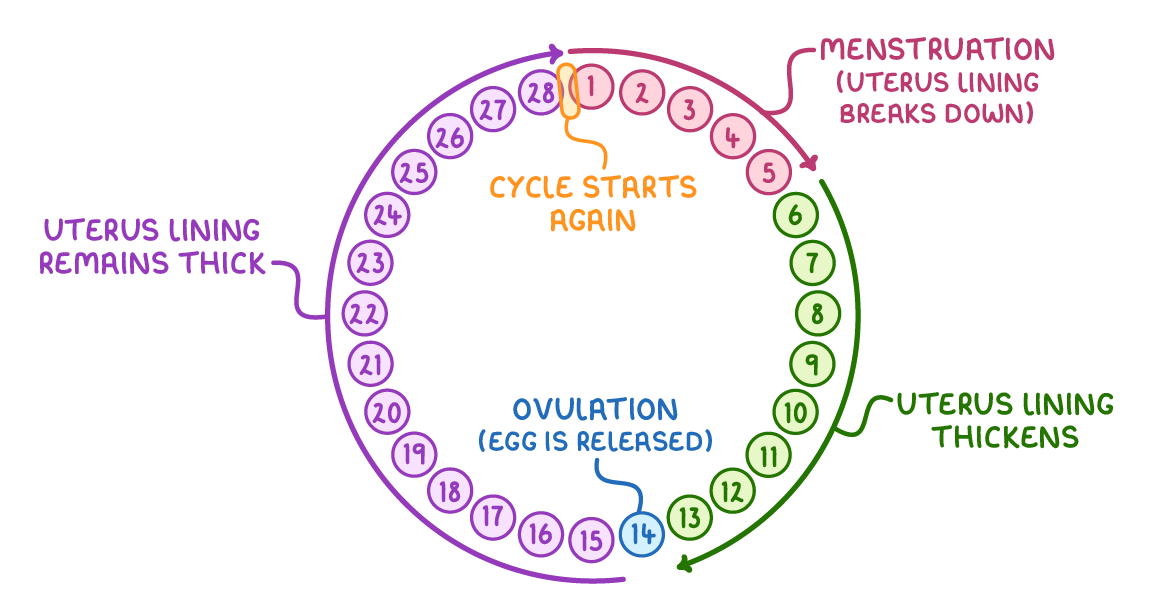
- The menstrual cycle is the monthly sequence of events in which the body releases an egg and prepares the uterus in case the egg is fertilised.
- It's usually described as taking about 28 days, though the length can vary between people.
- The cycle is counted from the first day of a period.
The four stages
- Stage 1 (about day 1-5) - menstruation - The uterus lining breaks down and is lost from the body, causing bleeding. This usually lasts around five days.
- Stage 2 (about day 5-14) - The uterus lining builds up again into a thick, spongy layer with many blood vessels, ready in case a fertilised egg implants there.
- Stage 3 (about day 14) - ovulation - An egg is released from one of the ovaries and travels along one of the fallopian tubes towards the uterus.
- Stage 4 (about day 14-28) - The uterus lining is maintained in its thickened state.
What happens at the end of the cycle
- If the egg is fertilised and implants in the uterus lining, the lining stays in place and pregnancy can begin.
- If no fertilised egg implants, the uterus lining starts to break down again, menstruation begins, and the cycle repeats.
TermDefinition
Puberty
Secondary sexual characteristics
Testosterone
Oestrogen
Ovulation
Menstruation
Menstrual cycle