3.3 - Active Transport
What active transport is
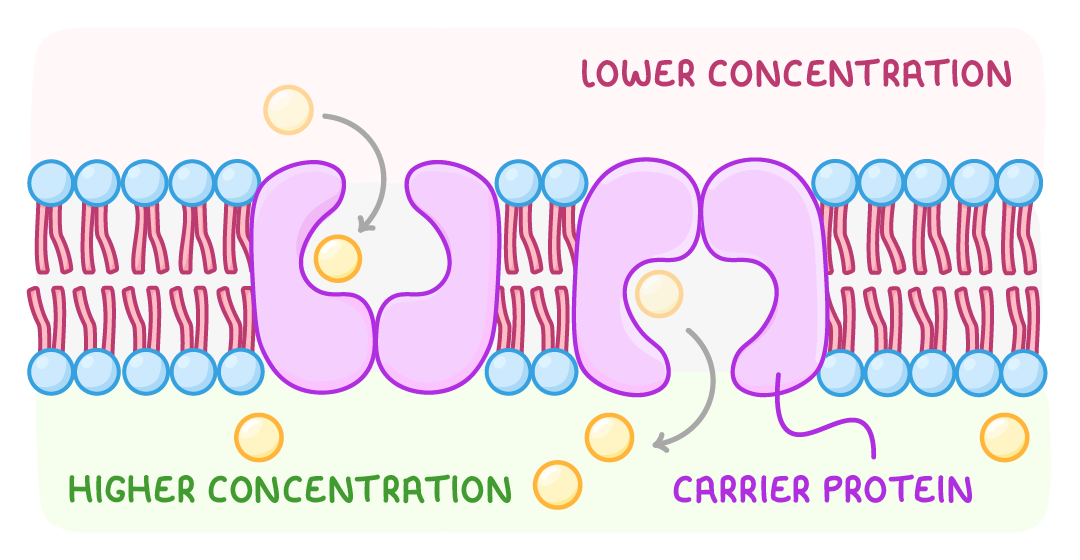
- Active transport is the movement of particles across a cell membrane against a concentration gradient - from an area of lower concentration to an area of higher concentration.
- It requires energy transferred by respiration to make it happen.
Active transport is the opposite of diffusion
- In diffusion, particles move down the concentration gradient on their own, and no energy is needed.
- Active transport moves particles the other way - up the gradient - so it cannot happen by itself.
- It has to be driven by energy from respiration. This energy is carried by a molecule called ATP, which the cell uses to power the transport.
Carrier proteins do the moving
- Carrier proteins are embedded in the cell membrane.
- They pick up the particles on one side and move them across to the other side, against the gradient.
TermDefinition
Active transport
ATP
Carrier protein