1.4 - Magnification & Units
The magnification equation
- Magnification is a measure of how many times bigger an image is than the real object it shows.
- Image size - The size of the cell or structure as it appears in the photograph, drawing, or microscope image.
- Actual size - Its true size (also called the real size).
- Magnification has no units, because it is one size divided by another - a magnification of x100 simply means the image is one hundred times bigger than the real object.
- The image size and actual size must be in the same units. If they're in different units (e.g. image in millimetres, specimen in micrometres), convert one so both match before dividing.
Formula for magnification
The equation can be rearranged to find either of the other two quantities:
- Image size = magnification × actual size
- Actual size = image size / magnification
A formula triangle is a convenient way to remember these: with image size at the top and magnification and actual size at the bottom, covering up the quantity you want to find leaves the calculation you need.
Worked example - Using the magnification equation
These examples show the magnification equation used in each of its three directions. In every case the image size and the actual size are put into the same units before dividing or multiplying.
Example 1 - Finding an image size
A specimen is 40 μm wide and is viewed at a magnification of x250. Find the width of the image in mm.
Step 1 - Rearrange the equation
Image size = magnification × actual size
Step 2 - Substitute and calculate
Image size = 250 × 40 = 10,000 μm
Step 3 - Convert to millimetres
Divide by 1,000:
10,000 μm = 10 mm
The image is 10 mm wide.
Example 2 - Finding a magnification
A magnified image is 6 mm wide and the specimen it shows is 0.03 mm wide. Find the magnification.
Step 1 - Check the units
Both measurements are already in the same unit (mm), so nothing needs converting.
Step 2 - Apply the formula
The magnification is x200.
Example 3 - Finding an actual size
A cell measured in a photograph is 45 mm long and the magnification is x300. Calculate the actual size of the cell in μm.
Step 1 - Identify the values
- Image size = 45 mm
- Magnification = x300
Step 2 - Convert the units
Convert the image size to μm by multiplying by 1,000:
45 mm = 45 × 1,000 = 45,000 μm
Step 3 - Formula
Step 4 - Substitution and calculation
The cell is 150 μm long.
Units of length and converting between them
- Cells and the structures inside them are very small, so their sizes are written using small units of length.
- The relevant SI units, from largest to smallest, are:
| Unit | Symbol | As a fraction of a metre |
|---|---|---|
| Millimetre | mm | 10-3 m |
| Micrometre | μm | 10-6 m |
| Nanometre | nm | 10-9 m |
| Picometre | pm | 10-12 m |
- The micrometre (μm) is the unit most commonly used to measure cells and cell structures.
- Whole cells in a photograph or drawing - enlarged enough to see clearly - are often measured in millimetres (mm).
Converting between units
- The steps between these units each go in factors of one thousand:
- There are 1,000 micrometres in a millimetre.
- There are 1,000 millimetres in a metre.
- So there are one million (1,000,000) micrometres in a metre.
- To convert mm → μm, multiply by 1,000.
- To convert μm → mm, divide by 1,000.
- The nanometre is a further factor of one thousand smaller than the micrometre, and the picometre is a factor of one thousand smaller again.
Standard form and matching units
- These numbers can be very large or very small, so they are often written in standard form - for example, 0.0025 mm written as 2.5 × 10⁻³ mm - which keeps long strings of zeros manageable.
- Getting the units to match is the step that matters most whenever sizes are compared or calculated: two measurements must be in the same unit before one is divided by or multiplied with the other.
Using and interpreting scale bars
- A scale bar is a short labelled line on a photograph or diagram of a specimen. It shows what a given length on the image represents as a real length.
- For example, a bar labelled "10 μm" means that length on the image stands for 10 micrometres of the real specimen.
- Scale bars show size without printing a magnification figure - if the image is shrunk or enlarged, the bar shrinks or enlarges with it.
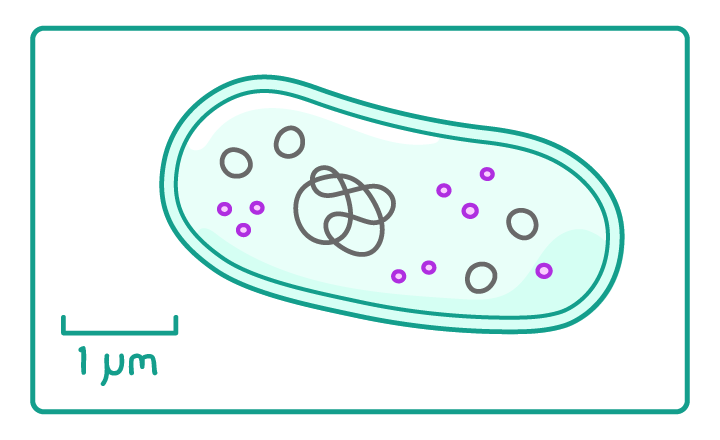
Finding the real size of a structure
- Measure how many times longer the structure is than the scale bar, then multiply that by the value the bar represents.
- This can be done by estimation: a cell about 4 times as long as a 1 μm scale bar is roughly 4 μm (0.004 mm) in reality.
Finding the magnification of the image
- Measure the drawn length of the scale bar and divide it by the real length it represents (both in the same units).
- This works because the scale bar is itself a small magnification calculation:
Adding a scale bar to your own drawing
- You can add a scale bar once you know the real size of what you have drawn.
- Choose a real length for the bar, then work out how long to draw it so it matches the magnification of the drawing.