6.11 - Inherited Disorders & Screening
Cystic fibrosis, a recessive inherited disorder
- Cystic fibrosis is a genetic disorder of the cell membranes, caused by the mutation of a single gene.
- The faulty protein this gene makes can no longer properly control the movement of salt and water into and out of cells.
- As a result, the body produces a lot of thick, sticky mucus that builds up in:
- The air passages of the lungs (the bronchioles)
- The pancreas
- This leads to frequent, serious lung infections and to problems with digesting food.
A recessive allele
- The disorder is caused by a recessive allele, usually written as a lowercase f.
- Because the allele is recessive, a person only has cystic fibrosis if they inherit two copies of it - so an affected person is homozygous recessive (ff).
- A person with just one copy (Ff) does not have the disorder, because the normal dominant allele still works. They are called a carrier and can pass the faulty allele on.
- The recessive allele is fairly common - about 1 person in 25 carries it, so many carriers have no idea they could pass it on.
Inheriting cystic fibrosis
- For a child to be born with cystic fibrosis, both parents must each pass on a recessive allele - so both must be carriers or have the disorder themselves.
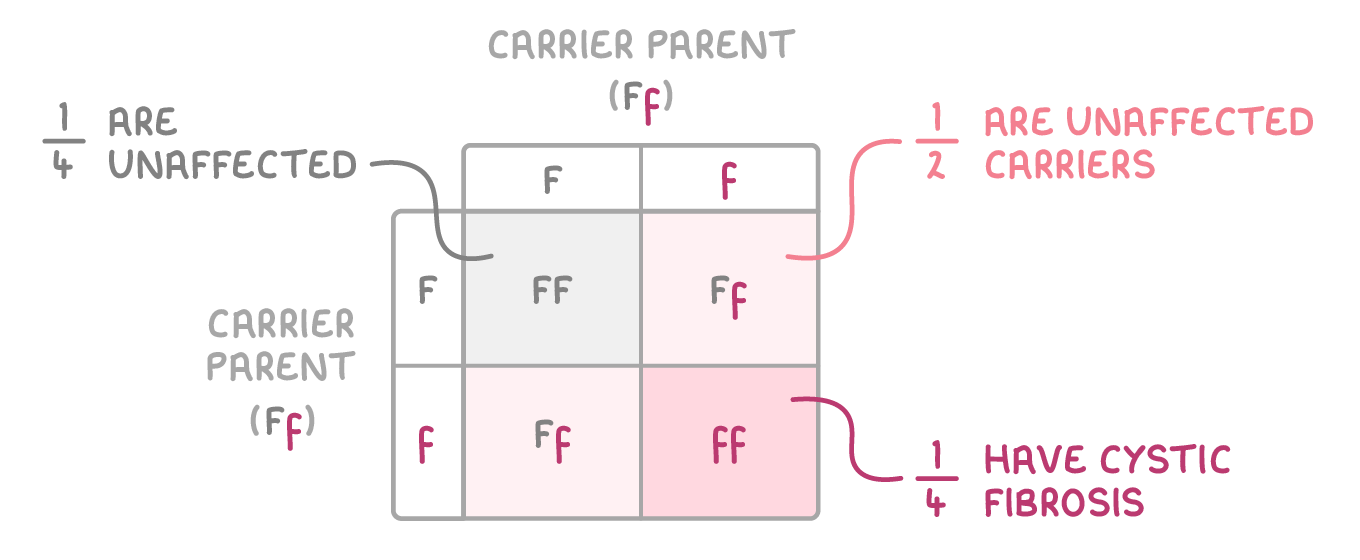
- Crossing two carriers (Ff × Ff) gives four equally likely combinations: FF, Ff, Ff and ff.
For any one child, the chances of each outcome are:
Polydactyly, a dominant inherited disorder
- Polydactyly is a genetic disorder in which a baby is born with extra fingers or toes.
- It doesn't usually cause any other problems and is not life-threatening.
Caused by a dominant allele
- Polydactyly is caused by a dominant allele, usually written as an uppercase D.
- Because the allele is dominant, a person needs only one copy to have the disorder - so it can be inherited even when just one parent carries the faulty allele.
- That parent will also have the condition themselves, because a single dominant allele is enough to cause it.
- This is the opposite of a recessive disorder: there are no hidden carriers of a dominant disorder, because anyone carrying the allele shows the condition.
Example - Affected parent (Dd) × unaffected parent (dd)
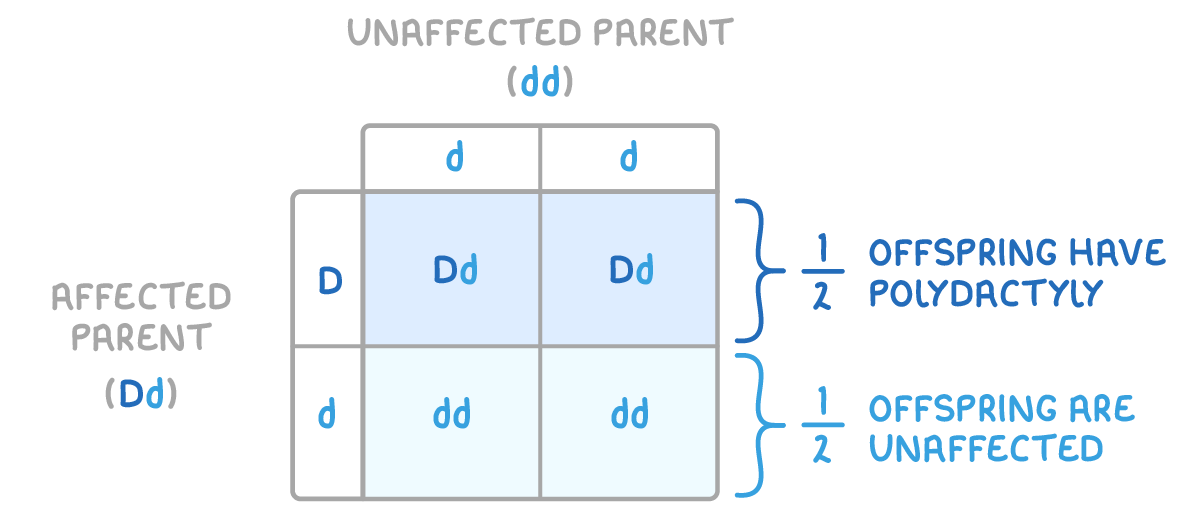
One parent has a single dominant allele (Dd) and shows polydactyly; the other has two normal alleles (dd) and is unaffected.
- Each child has a 1 in 2 (50%) chance of inheriting the dominant allele and having polydactyly.
- Each child has a 1 in 2 (50%) chance of inheriting only normal alleles and being unaffected.
- Half the offspring are heterozygous and affected, half are homozygous recessive and unaffected - a 1:1 ratio.
Screening embryos before implantation
- Embryo screening detects some genetic disorders in an embryo before a baby is born.
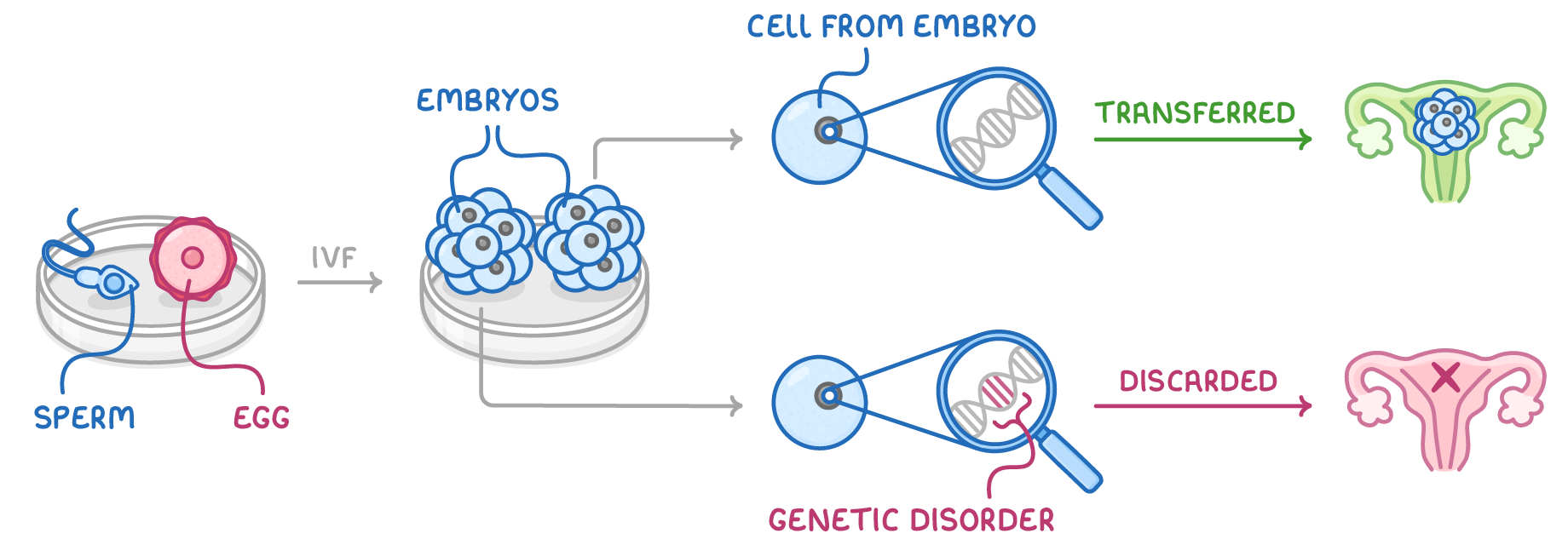
- During in vitro fertilisation (IVF), egg cells are fertilised by sperm in a laboratory rather than inside the body, and the embryos are later transferred into the woman's uterus.
- Before an embryo is transferred, a single cell can be removed and its genes analysed. Many disorders, including cystic fibrosis, can be detected this way.
- DNA can also be taken from an embryo already developing in the uterus and tested for disorders.
What happens next depends on the result
- For an IVF embryo: one found to carry alleles linked to a disorder would be discarded, and a different, unaffected embryo used instead.
- For an embryo already in the uterus: a positive result could lead to a decision to terminate the pregnancy.
- Because of these decisions, embryo screening is controversial, raising ethical, social, and economic concerns on both sides.
Arguments for and against
| For embryo screening | Against embryo screening |
|---|---|
| Reduces overall suffering - fewer people are born with serious genetic disorders. | Implies people with genetic conditions are somehow "less desirable", which could increase prejudice against them. |
| Saves money - treating genetic disorders over a lifetime is very expensive for the health service and taxpayer. | Parents might eventually want to screen for ordinary traits such as eye colour, physique, or sex, not just to avoid disease. |
| The screening itself is expensive. |
At present there are laws that limit how far screening can go - for example, parents cannot select the sex of their baby unless there is a medical reason.
TermDefinition
Cystic fibrosisA genetic disorder of the cell membranes caused by a recessive allele. It makes the body produce thick, sticky mucus.
CarrierA person who has one copy of a recessive allele. They do not show the characteristic it causes, but can pass the allele on to their children.
PolydactylyA genetic disorder in which a baby is born with extra fingers or toes. It is caused by a dominant allele.
Embryo screeningTesting an embryo for genetic disorders. For example, a single cell can be removed from an embryo made by IVF and analysed before the embryo is implanted.
Key points to remember
How were these notes?