3.4 - Bacterial, Protist & Fungal Diseases
Salmonella food poisoning
- Many bacteria are harmless or helpful, but a few are pathogens that cause disease.
- They often make you ill by producing toxins (poisons) that damage cells and tissues.
How salmonella spreads
- Salmonella is a bacterium that causes food poisoning.
- It is taken in by eating food contaminated with the bacteria, for example:
- Poultry that carried the disease while alive
- Food prepared in unhygienic conditions
Symptoms and control
- The toxins the bacteria produce cause fever, stomach cramps, vomiting, and diarrhoea.
- In the UK, most poultry are vaccinated against Salmonella to control its spread.
- Most people recover without treatment, but severe cases can be treated with antibiotics.
Gonorrhoea
- Gonorrhoea is a bacterial disease that is a sexually transmitted disease (STD) - it's passed on by sexual contact, such as unprotected sex.
- Symptoms are:
- Pain on urinating
- A thick yellow or green discharge from the vagina or penis
Controlling its spread
Its spread can be controlled by treating infected people with antibiotics and by using a barrier method of contraception such as a condom.
Treatment
- It was once easily cured with the antibiotic penicillin.
- Many strains are now resistant to penicillin, so rarer antibiotics have to be used instead.
Malaria
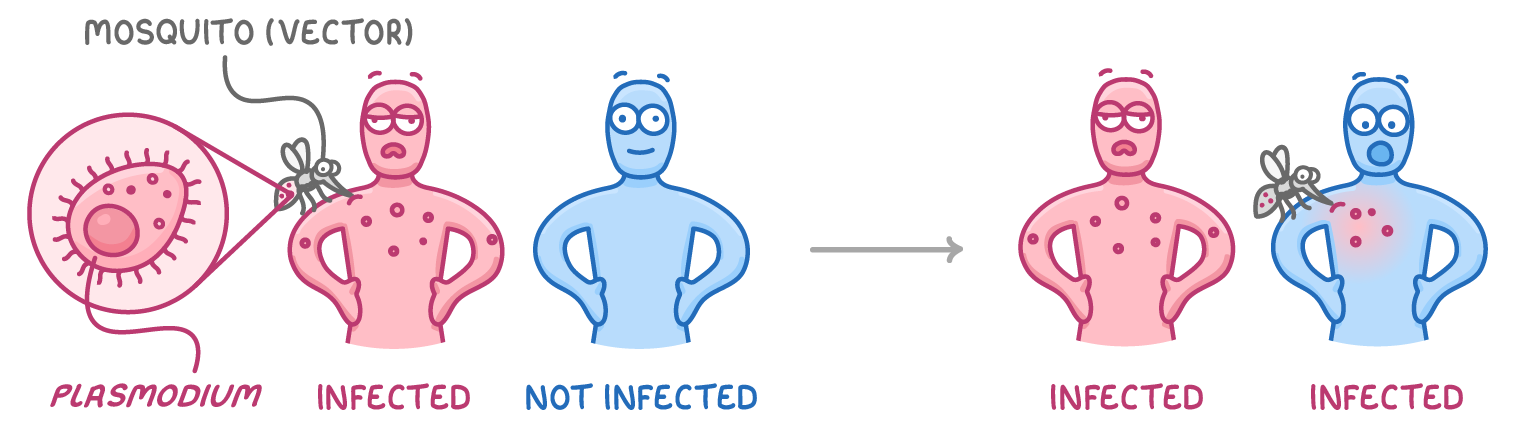
- Malaria is caused by a protist called Plasmodium - a single-celled parasite.
- It's spread from host to host by mosquitoes acting as vectors (organisms that carry a pathogen from one host to another without getting the disease themselves).
How malaria is spread
- A mosquito feeds on the blood of an infected animal and picks up the protist.
- When it next bites, it injects the protist into the blood of a new host.
Effects on the body
- Inside the body, the protist destroys red blood cells.
- In serious cases it also damages the liver.
- This causes recurrent episodes of fever, and malaria can be fatal.
Reducing the spread
- Stopping the mosquitoes breeding.
- Killing them with insecticides.
- Stopping them biting people, using mosquito nets and insect repellent.
Rose black spot
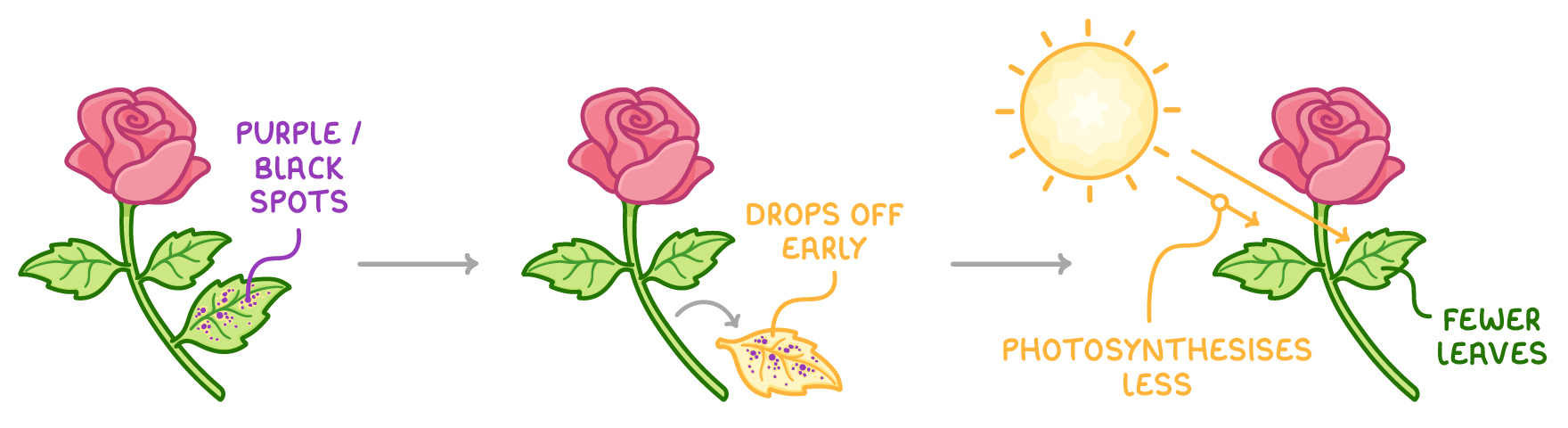
Rose black spot is a fungal disease of rose plants.
Symptoms
- Purple or black spots develop on the leaves.
- The affected leaves then turn yellow and drop off early.
- With fewer leaves, the plant photosynthesises less and so grows poorly.
How it spreads and is treated
- Spread - Through the environment in water or by the wind.
- Treatment - Spraying with fungicides, and removing and destroying the affected leaves so the fungus cannot spread to other plants.
TermDefinition
PathogenA microorganism that causes disease.
ToxinA poison produced by a pathogen that damages cells and tissues.
Sexually transmitted infection (STI)An infection that is passed from one person to another through sexual contact.
Vector (disease)An organism that carries a pathogen and passes it from one host to another.
Key points to remember
How were these notes?