2.6 - Food Tests
Testing for starch with iodine solution
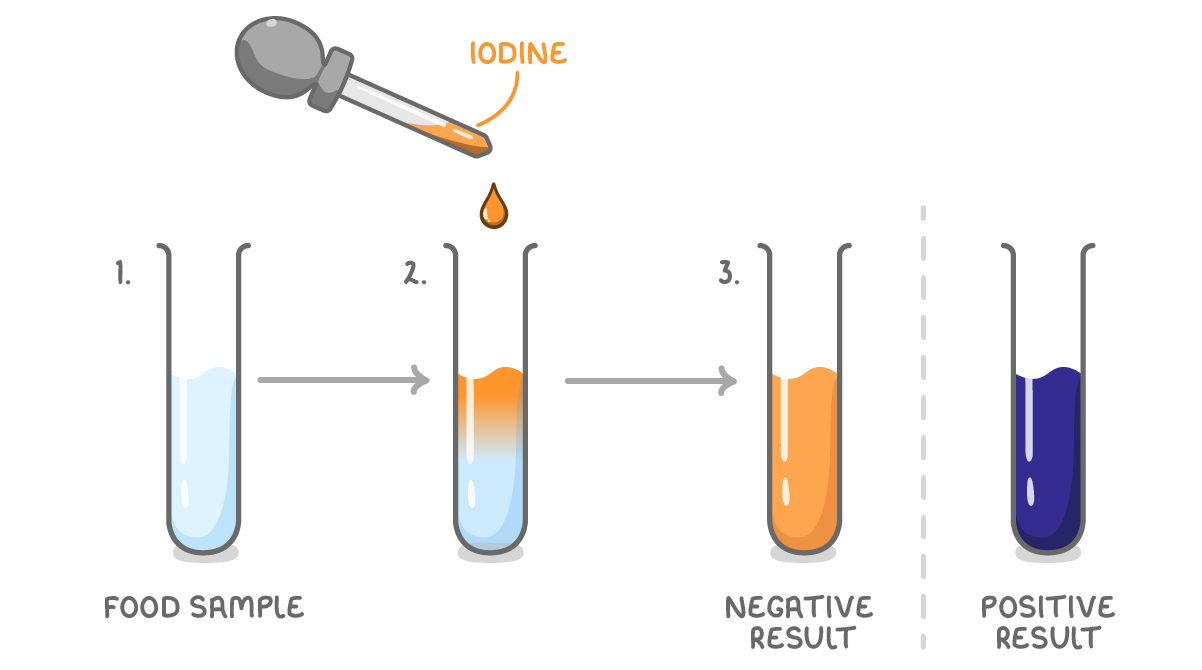
- Iodine solution is used to test a sample for starch.
- Add a few drops of iodine solution to the sample.
Reading the result
- Starch present - The iodine solution changes colour from yellow-brown to dark blue-black.
- No starch present - The solution stays yellow-brown.
The result is shown by the change in colour, so a positive starch test is described as a change from yellow-brown to blue-black - not simply as "blue-black".
Testing for reducing sugars with Benedict's solution
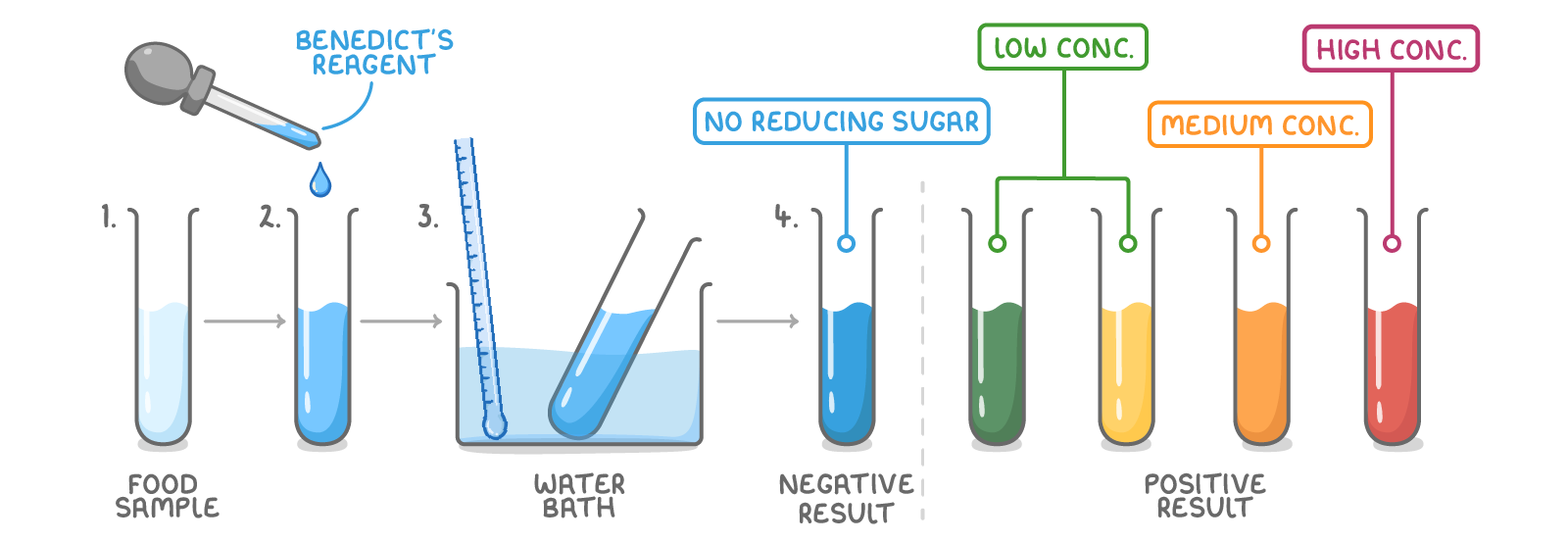
- Benedict's solution, also called Benedict's reagent, tests a sample for reducing sugars - the commonest of which is glucose.
- Benedict's solution starts off blue.
Carrying out the test
- Add Benedict's solution to the sample.
- Heat the sample in a hot water bath.
- If a reducing sugar is present, a coloured precipitate forms (solid particles suspended in the solution) and the colour changes from the original blue.
Reading the result
- The colour runs through a sequence: blue → green → yellow → orange → brick-red.
- The more reducing sugar there is, the further along the sequence the colour goes, so the test is partially quantitative:
- Brick-red - A high concentration of reducing sugar.
- Green or yellow - A lower concentration.
- If no reducing sugar is present, the solution stays blue.
- This is the only one of the common food tests that needs heating.
Testing for protein with biuret reagent
- The biuret test is used to test a sample for protein.
- The biuret reagent is blue.
Carrying out the test
The test can be done in one of two forms:
- Two-solution form - Add a few drops of an alkali (such as potassium hydroxide or sodium hydroxide) to make the sample alkaline, then add a little copper(II) sulfate solution (bright blue).
- Ready-mixed form - Add a single ready-mixed biuret solution to the sample.
Either way, the mixture is then gently shaken.
Reading the result
- Protein present - The solution changes from blue to purple (also described as lilac or violet).
- No protein present - The solution stays blue.
The colours can be pale, so the result is read carefully against the original blue.
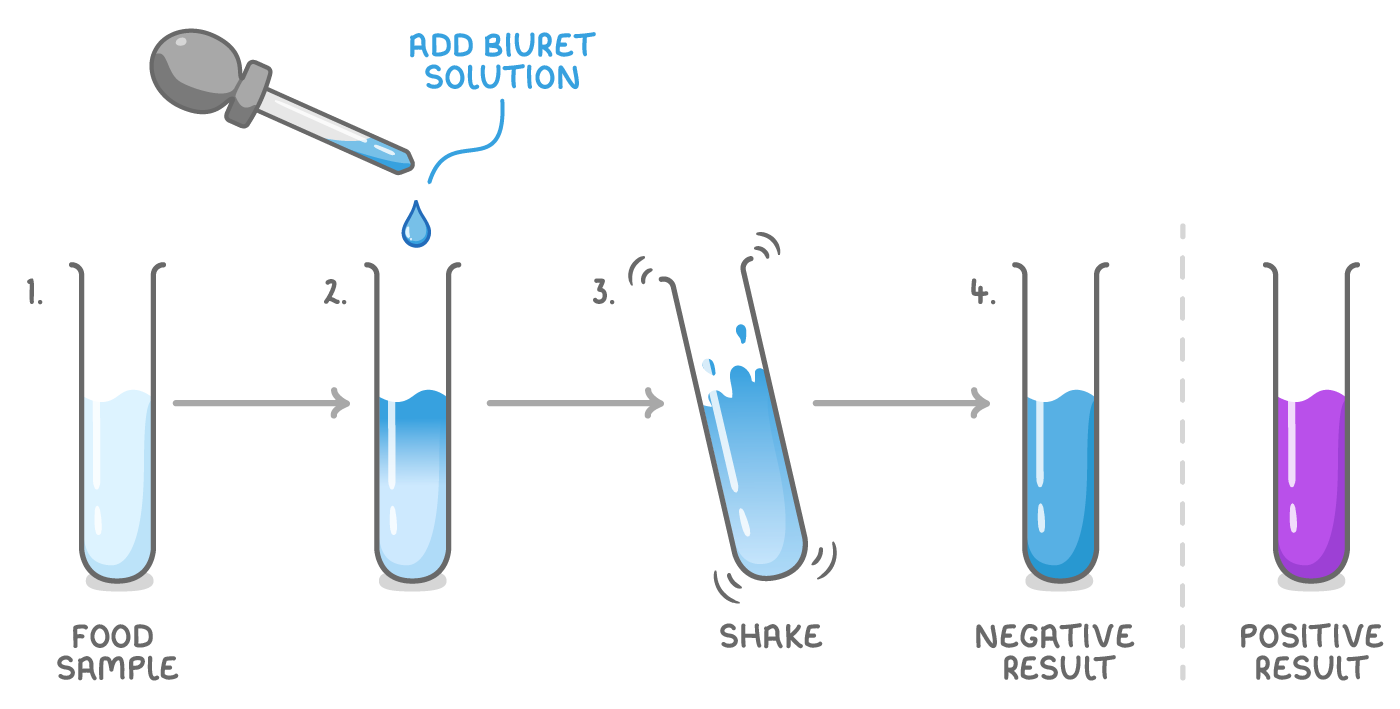
The ready-mixed form of the biuret test, from food sample to result.
Testing for lipids (Sudan III test)
- The Sudan III stain test checks a sample for lipids (fats and oils).
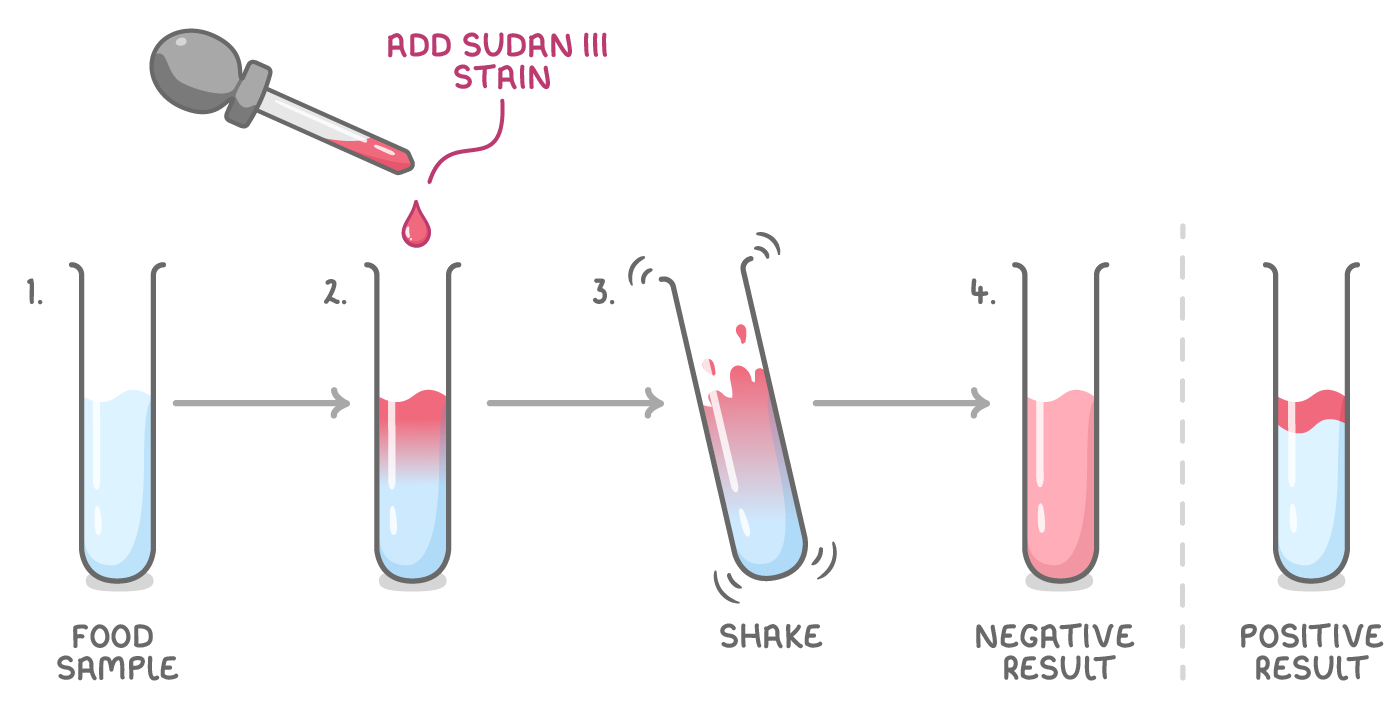
- Sudan III is a dye that stains lipids.
Method
- Add a few drops of Sudan III stain solution to the food sample.
- Gently shake the tube.
Results
- Positive - The mixture separates into two layers, and the top layer takes up the dye and turns bright red.
- Negative - No separate red layer forms.
Another accepted lipid test
- Lipids can also be tested for with the ethanol emulsion test.
- Shake the sample with ethanol, then add water. A cloudy white emulsion shows that lipids are present.
Food tests summary
Each food test uses a specific reagent that changes colour when the food substance is present. The four common tests are summarised below.
| Food substance | Reagent | Positive result (colour change) |
|---|---|---|
| Starch | Iodine solution | Yellow-brown to blue-black |
| Reducing sugar | Benedict's solution (heated in a water bath) | Blue to a brick-red precipitate (through green, yellow and orange) |
| Protein | Biuret reagent | Blue to purple (lilac) |
| Lipid (fat or oil) | Ethanol then water (emulsion test), or Sudan III stain | Cloudy white emulsion, or a bright red top layer |
TermDefinition
Iodine solutionA reagent that changes colour from yellow-brown to blue-black when starch is present.
Benedict's solutionA blue reagent that changes colour to green, yellow, orange, or brick-red when heated with a reducing sugar.
Biuret reagentA blue solution that turns purple or lilac when protein is present.
Sudan IIIA dye that stains lipids, used to test for their presence in a sample.
Key points to remember
How were these notes?