2.14 - Cancer
Benign and malignant tumours
- Cancer is a disease that arises when changes in a cell lead to abnormal, uncontrolled growth and division.
- These abnormal cells divide far faster than the body needs, building up into a mass of cells called a tumour.
- There are two types of tumour, and they behave very differently.
Benign tumours
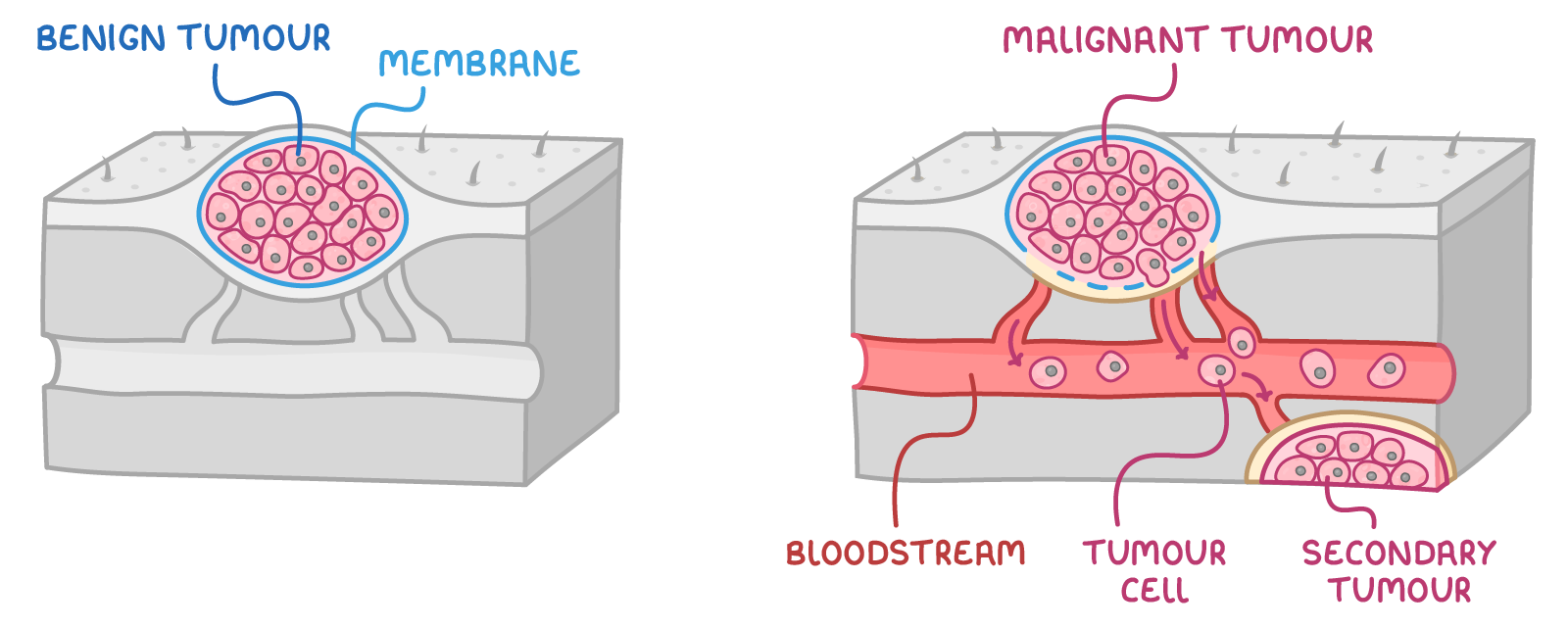
- A growth of abnormal cells that stays contained in one area, usually held within a membrane (it is encapsulated).
- It grows until there is no more room, but does not invade or spread to other parts of the body.
- Not normally dangerous, and is not cancer.
Malignant tumours
- A malignant tumour is cancer, and its cells are not held in one place (it is not encapsulated).
- The tumour grows into and invades neighbouring healthy tissues.
- Cells can break off and be carried around the body in the bloodstream.
- Wherever these cells settle, they invade the tissue and grow into new tumours, called secondary tumours.
- Because malignant tumours spread and damage tissue throughout the body, they can be fatal.
Cancer risk factors
- Anyone can develop cancer. Having a risk factor doesn't mean a person will definitely get cancer - it only raises the chance.
- Risk factors fall into two types: lifestyle factors and inherited faulty genes.
Lifestyle risk factors
- Smoking - Strongly linked to lung cancer, and also to mouth, stomach, and cervical cancer
- Obesity - Linked to cancers such as bowel, liver, and kidney cancer
- UV (ultraviolet) radiation - Too much exposure, from the Sun or sunbeds, damages skin cells and increases the chance of skin cancer
- Viral infection - Infection with certain viruses raises cancer risk. Infection with the human papilloma virus (HPV) is linked to cervical cancer, which the HPV vaccine helps protect against
- Carcinogens - Substances or types of radiation that cause cancer, such as ionising radiation
Inherited risk factors
- Not all risk factors are lifestyle choices - some people inherit faulty genes that make them more susceptible to particular cancers.
- For example, mutations in the BRCA genes are linked to an increased chance of developing breast and ovarian cancer.
TermDefinition
CancerA disease caused by changes in cells that lead to abnormal and uncontrolled growth and division.
TumourA mass of abnormal cells produced when cells divide uncontrollably.
Benign tumourA growth of abnormal cells that is contained in one area and does not invade other parts of the body.
Malignant tumourA growth of abnormal cells that invades neighbouring tissues and can spread around the body in the blood.
Secondary tumourA new tumour formed when cells break off a malignant tumour and settle in a different tissue.
CarcinogenA substance or type of radiation that can cause cancer.
Key points to remember
How were these notes?