5.6 - Puberty & the Menstrual Cycle
Puberty and reproductive hormones
- Puberty is the stage during which adolescents become sexually mature and develop secondary sexual characteristics.
- Secondary sexual characteristics are physical changes in the body - e.g. facial hair developing in males and breasts developing in females.
- Puberty is triggered by reproductive hormones.
Testosterone - The main male hormone
- Produced by the testes.
- Stimulates sperm production.
- Causes male secondary sexual characteristics to develop:
- Facial and body hair
- A deeper voice
- Increased muscle development
- Growth of the penis and testes
Oestrogen - The main female hormone
- Produced by the ovaries.
- Causes female secondary sexual characteristics to develop:
- Breast development
- Widening of the hips
- Growth of underarm and pubic hair
- Also involved in the menstrual cycle.
The female reproductive system and the menstrual cycle
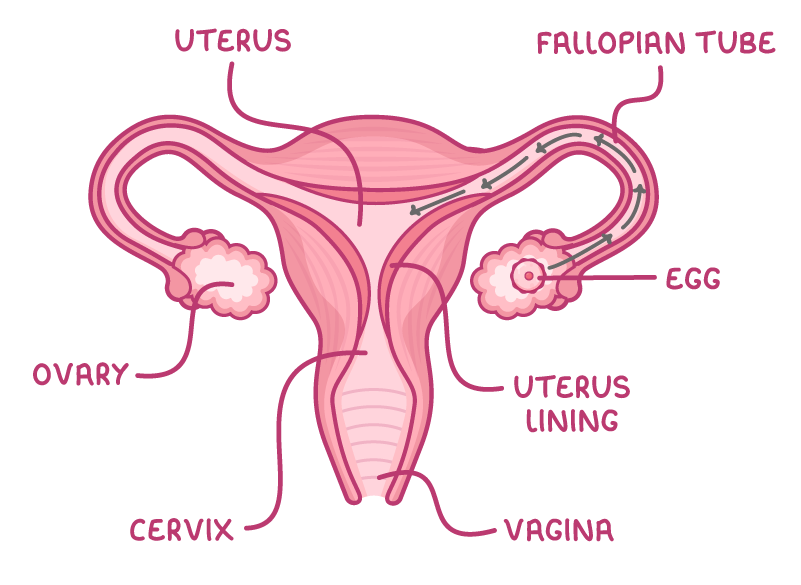
- The female reproductive system includes the ovaries, fallopian tubes, uterus, and uterus lining, as well as the cervix and the vagina.
- The menstrual cycle coordinates two main things:
- The release of an egg from an ovary.
- The preparation of the uterus lining in case that egg is fertilised.
The parts and what they do
- Ovaries - Contain egg cells. During the cycle, one egg usually matures and is released from one of the ovaries. This release is called ovulation.
- Fallopian tubes - After ovulation, the egg travels from the ovary through one of the fallopian tubes towards the uterus.
- Uterus - Also called the womb. This is where a fertilised egg can implant and develop during pregnancy.
- Uterus lining - Also called the endometrium. It changes during the cycle, building up to prepare for a fertilised egg.
What happens to the lining
- If a fertilised egg implants in the uterus lining, pregnancy can begin.
- If fertilisation does not happen, the lining breaks down and is lost from the body during menstruation.
The stages of the menstrual cycle
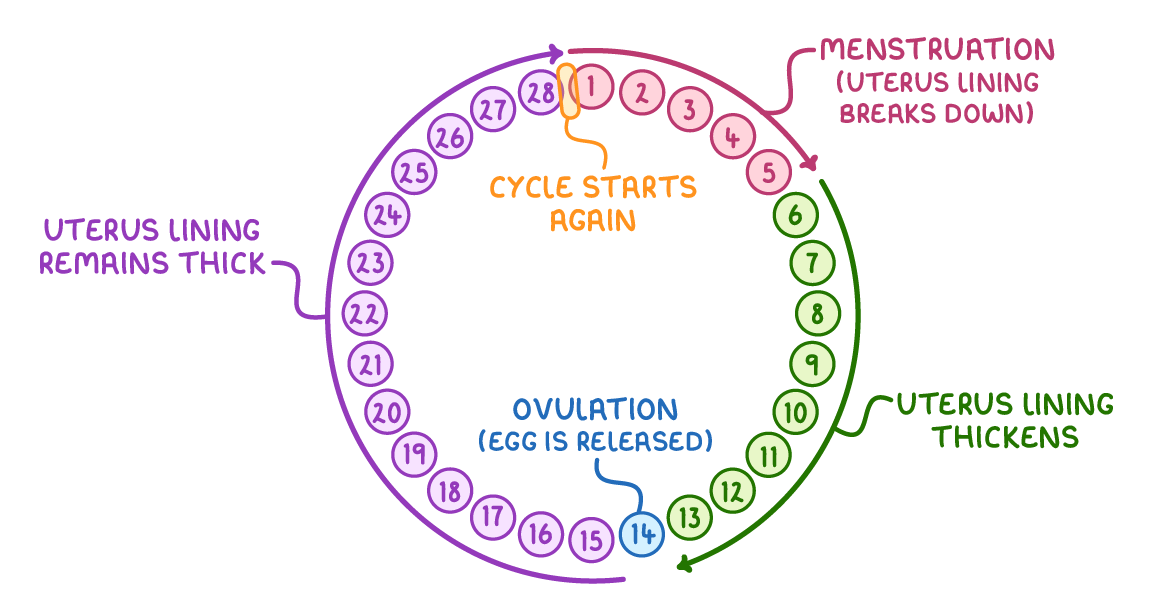
- The menstrual cycle is the monthly sequence of events in which the body releases an egg and prepares the uterus in case the egg is fertilised.
- It's usually described as taking about 28 days, though the length can vary between people.
- The cycle is counted from the first day of a period.
The four stages
- Stage 1 (about day 1-5) - menstruation - The uterus lining breaks down and is lost from the body, causing bleeding. This usually lasts around five days.
- Stage 2 (about day 5-14) - The uterus lining builds up again into a thick, spongy layer with many blood vessels, ready in case a fertilised egg implants there.
- Stage 3 (about day 14) - ovulation - An egg is released from one of the ovaries and travels along one of the fallopian tubes towards the uterus.
- Stage 4 (about day 14-28) - The uterus lining is maintained in its thickened state.
What happens at the end of the cycle
- If the egg is fertilised and implants in the uterus lining, the lining stays in place and pregnancy can begin.
- If no fertilised egg implants, the uterus lining starts to break down again, menstruation begins, and the cycle repeats.
Hormonal control of the menstrual cycle
- The menstrual cycle is controlled by four hormones: FSH, LH, oestrogen, and progesterone.
- Together they control the release of an egg from the ovary and the changes in the uterus lining during the cycle.
The four hormones and their roles
| Hormone | Where it's produced | Main role in the cycle |
|---|---|---|
| FSH (follicle stimulating hormone) | Pituitary gland | Causes an egg to mature in one of the ovaries, and stimulates the ovaries to produce oestrogen |
| Oestrogen | Ovaries | Causes the uterus lining to repair and build up after menstruation; also affects the release of FSH and LH |
| LH (luteinising hormone) | Pituitary gland | Triggers ovulation, causing the mature egg to be released at about day 14 |
| Progesterone | Ovaries / corpus luteum | Maintains the uterus lining during the second half of the cycle; also inhibits FSH and LH |
The control loop through the cycle
- At the start of the cycle, the pituitary gland releases FSH. This causes an egg to mature in a follicle in one ovary, and stimulates the ovaries to produce oestrogen.
- As oestrogen rises, the uterus lining repairs and builds up. Oestrogen also inhibits FSH, which helps stop more eggs maturing.
- When oestrogen reaches a high level, it stimulates the release of LH.
- LH rises sharply at about day 14. This LH surge triggers ovulation - the mature egg is released from the ovary.
- After ovulation, the remains of the follicle form the corpus luteum, which releases progesterone.
- Progesterone maintains the uterus lining during the second half of the cycle, keeping it ready for a fertilised egg. It also inhibits FSH and LH, preventing another egg maturing in the same cycle.
What happens at the end of the cycle
- If the egg is not fertilised - Progesterone levels fall towards the end of the cycle. The uterus lining is no longer maintained, so it breaks down and menstruation begins. The fall in progesterone also lets FSH rise again, starting the next cycle.
- If the egg is fertilised - Progesterone levels stay high instead of falling, keeping the uterus lining in place throughout pregnancy. As pregnancy continues, the placenta develops and takes over from the ovaries as the main site of progesterone and oestrogen production.
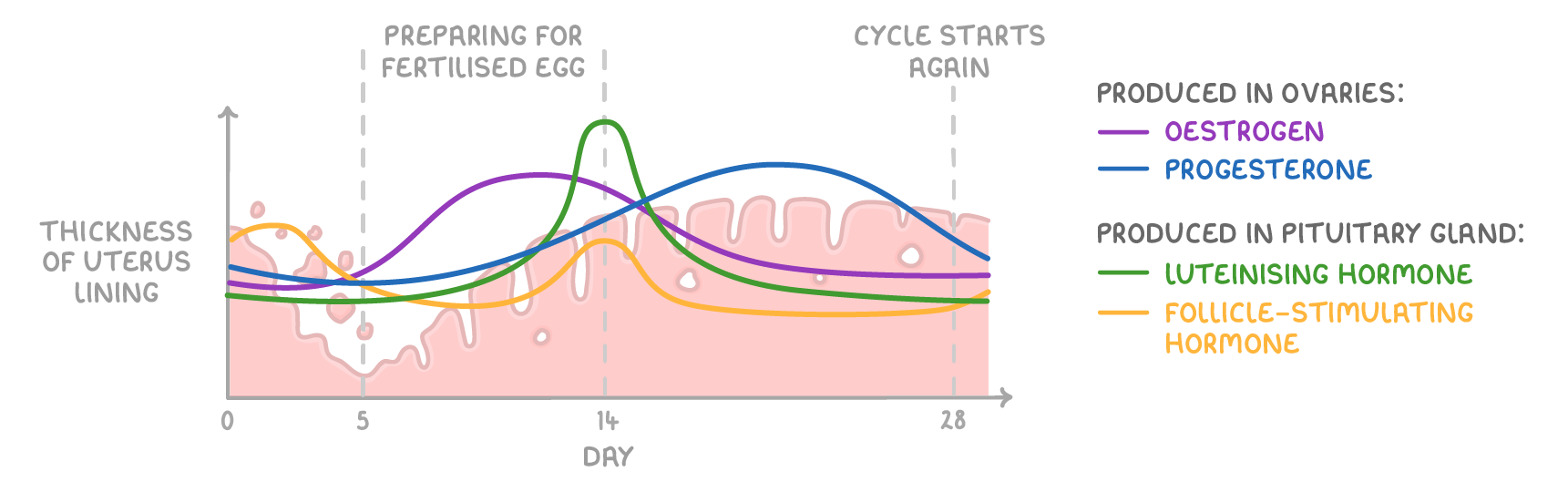
Hormone levels across the cycle, drawn over the changing thickness of the uterus lining.
TermDefinition
PubertyThe stage during which adolescents become sexually mature and develop secondary sexual characteristics.
Secondary sexual characteristicsThe physical changes that develop in the body during puberty, such as facial hair in males and breasts in females.
TestosteroneThe main male reproductive hormone, produced by the testes, which stimulates sperm production.
OestrogenA female reproductive hormone produced by the ovaries that controls the development of secondary sexual characteristics and the build-up of the uterus lining.
OvulationThe release of a mature egg from an ovary.
MenstruationThe breakdown and loss of the uterus lining from the body.
Menstrual cycleThe monthly sequence of events in which an egg is released and the uterus lining is prepared in case the egg is fertilised.
ProgesteroneA female reproductive hormone produced by the ovaries that maintains the uterus lining during the second half of the menstrual cycle.
FSHA hormone produced by the pituitary gland that causes an egg to mature in an ovary.
LHA hormone produced by the pituitary gland that triggers ovulation.
Key points to remember
How were these notes?