7.4 - Food Chains & Food Webs
Food chains
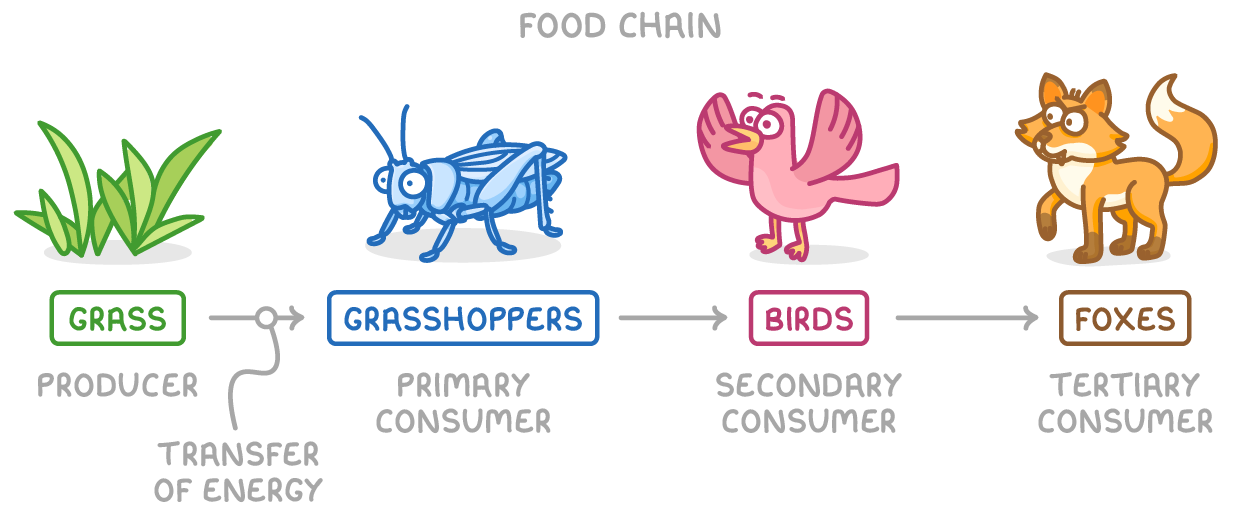
- A food chain shows the feeding relationships within a community - what eats what. It's a simplified single line of who-eats-whom.
- Every food chain begins with a producer: a photosynthetic organism such as a green plant or an alga.
- A producer uses light energy to make glucose by photosynthesis and builds this into its tissues - the material called biomass.
The order of a food chain
- The producer is eaten by a primary consumer.
- The primary consumer may be eaten by a secondary consumer.
- The secondary consumer may be eaten by a tertiary consumer.
- Some chains have more steps and some fewer.
What the arrows mean
- The arrows always point from the organism that is eaten to the organism that eats it.
- They represent the transfer of energy (and the biomass that carries it) up the chain, so an arrow points in the direction the energy flows, not the direction of feeding.
- Each organism passes on only a fraction of what it received, so the amount of energy and biomass available falls at each step.
Food webs
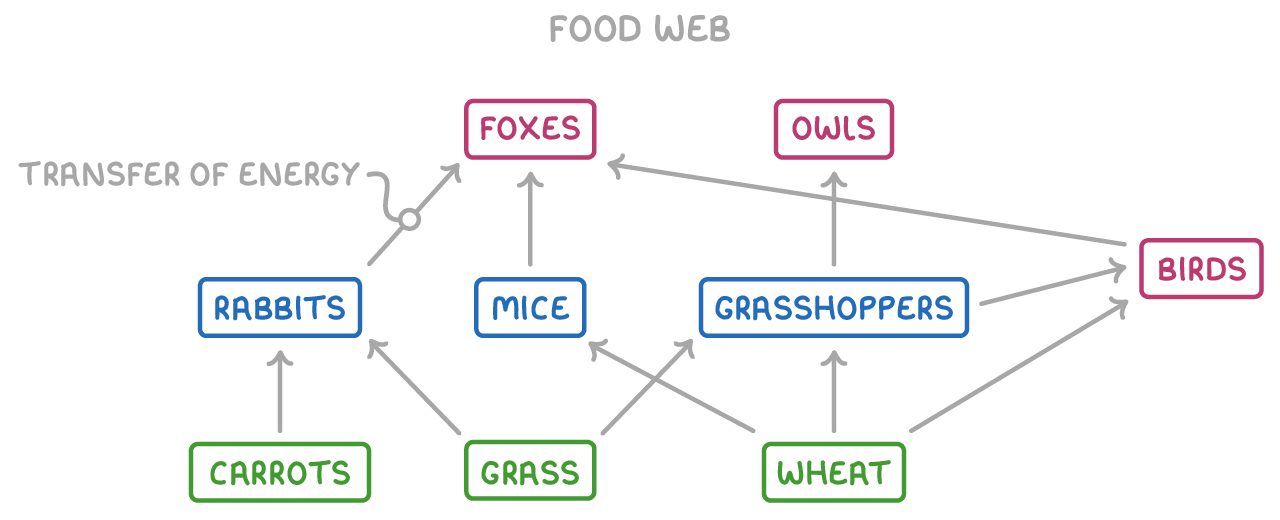
- In a real ecosystem, an organism rarely eats - or is eaten by - only one other kind of organism, so individual food chains overlap and interconnect.
- A food web is this network of many interconnected food chains, showing lots of feeding relationships in a community at once.
- Read a web the same way as a single chain: each arrow points from an organism to the one that eats it - but now with many branching links rather than one line.
Organisms in a web are interdependent
- Because the organisms are linked, a change to one population has knock-on effects on the others.
- If one organism is removed - for example a predator dies out or a prey species is lost - the populations connected to it rise or fall in response.
- Those changes then pass along the web to organisms further away.
- This is why the members of a community are described as interdependent: what happens to one can affect many.
Predator-prey cycles
- A predator is an animal that kills and eats other animals; the animals it eats are its prey.
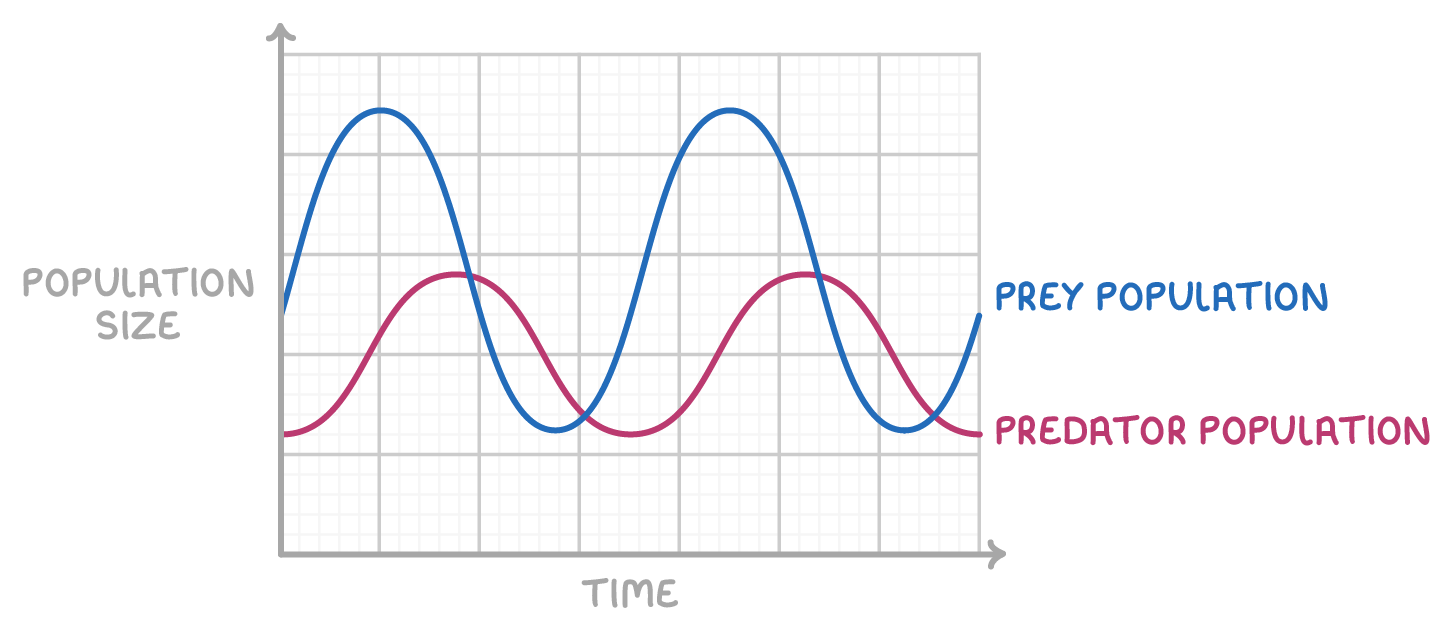
- Plot both populations against time and they rise and fall in repeating, linked cycles - a predator-prey cycle.
- This is seen in a stable community, where the populations stay roughly balanced over the long run.
Why the two cycles are out of phase
- The populations don't peak at the same moment - the predator change always lags slightly behind the prey change, so the cycles are out of phase.
- Following the cycle round:
- When predators are few, less prey is eaten, so the prey population rises.
- More prey means more food for predators, so a little later the predator population rises.
- With many predators, prey is eaten faster than it can breed, so the prey population falls.
- With less food, the predator population falls, letting the prey recover - and the cycle begins again.
Why they cycle rather than settle
- A population takes time to change size.
- Even with plenty of food, it takes several generations of breeding before predator numbers actually increase.
- So the predator response always arrives after the change in prey numbers that caused it - giving the lag and the repeating up-and-down pattern.
TermDefinition
ProducerAn organism, usually a green plant or alga, that makes its own food by photosynthesis and begins a food chain.
BiomassThe material that living organisms are made of, or the mass of this material in an organism or at a trophic level (a feeding level in a food chain).
Primary consumerAn animal in a food chain that eats producers.
Secondary consumerAn animal in a food chain that eats primary consumers.
Food webA network of interconnected food chains showing multiple feeding relationships in a community.
PredatorAn animal that kills and eats other animals.
PreyAn animal that is killed and eaten by a predator.
Key points to remember
How were these notes?