2.13 - Non-Communicable Disease
Non-communicable disease and risk factors
- A non-communicable disease is one that cannot be passed from person to person - it is not caused by a pathogen, so it is not infectious.
- These diseases generally last a long time and get worse slowly.
- Examples include:
- Cardiovascular disease
- Many cancers
- Some lung and liver diseases
- Type 2 diabetes
Risk factors
- Rather than being caught from someone else, non-communicable diseases are linked to risk factors.
- A risk factor is anything that increases the likelihood that a person will develop a particular disease during their lifetime.
- A risk factor does not guarantee the disease - someone with a risk factor is simply more likely to develop it than someone without it.
Types of risk factor
- Lifestyle - Aspects of how a person lives, such as how much exercise they do, or whether they smoke
- Substances in the environment - Such as air pollution around them
- Substances in the body - Substances found inside the body
- Inherited genes - The genes a person has inherited, which can make them more susceptible to some diseases
Many non-communicable diseases are caused by several of these risk factors interacting, rather than by any single factor on its own.
Correlation and cause
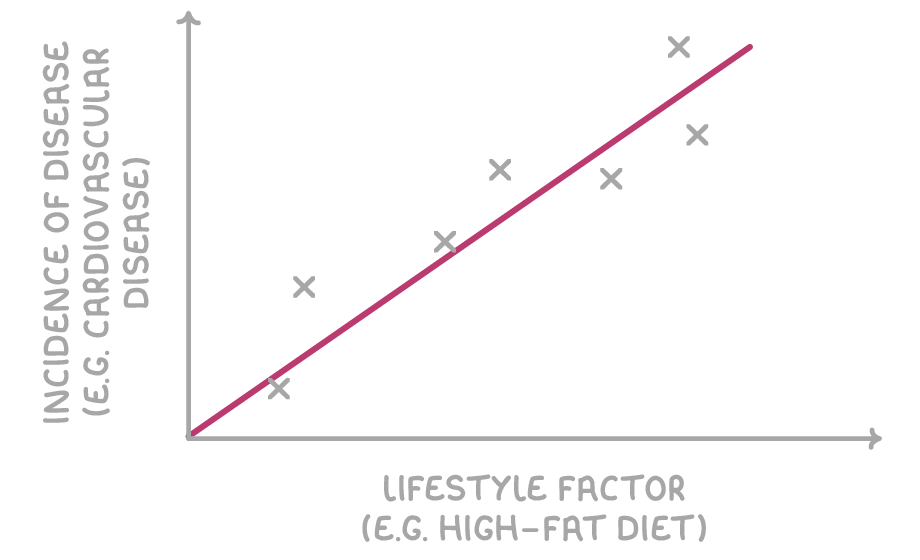
- Scientists identify risk factors by looking at data for correlations - links where two things tend to change together (e.g. more of a certain behaviour found alongside more cases of a disease).
- A correlation on its own does not prove that one thing causes the other.
- For some risk factors a causal mechanism has been proven, so the factor really does cause the disease. For others, the risk factor is only correlated with the disease and the true cause lies elsewhere.
Proving cause needs a mechanism
- To decide whether a risk factor is a cause, scientists look for a plausible mechanism explaining how it could bring the disease about - not just a statistical link.
- Example: a lack of exercise and a high-fat diet are strongly linked to cardiovascular disease, but they don't cause it directly.
- It's the high blood pressure and high level of "bad" cholesterol they lead to that actually damage the arteries.
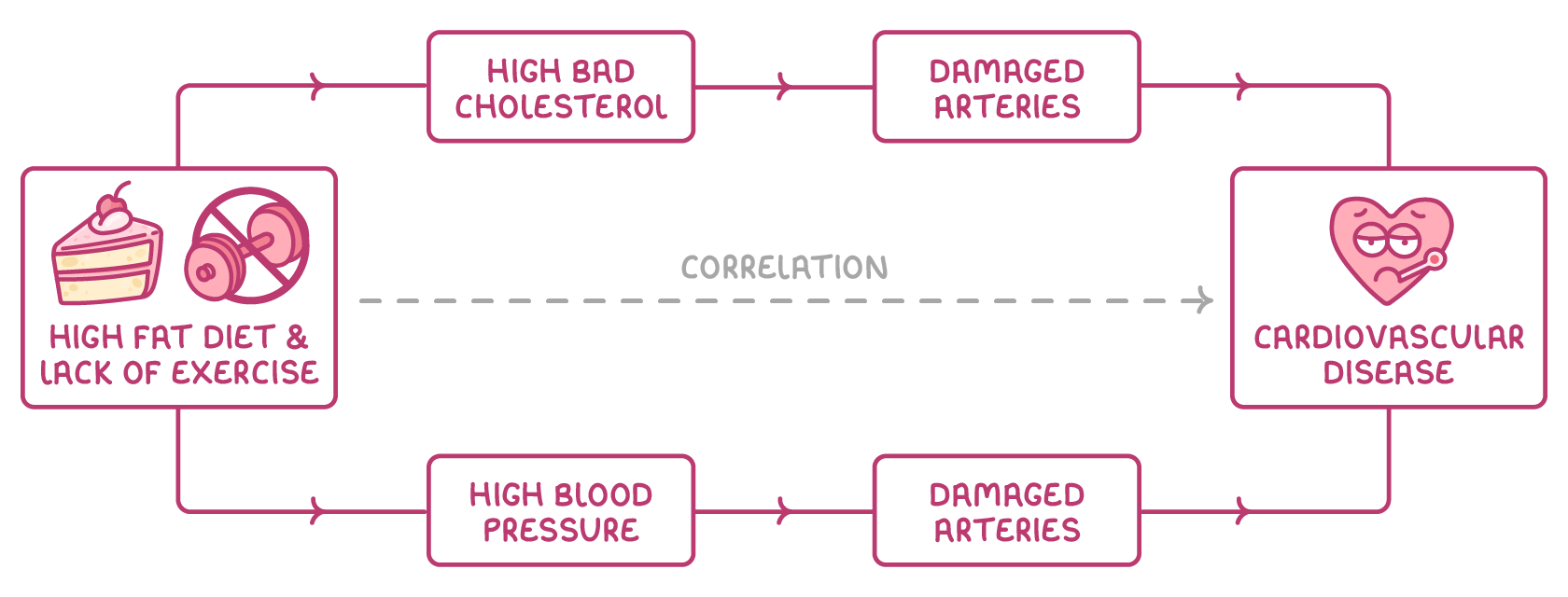
Showing data on a scatter diagram
- A scatter diagram plots two variables against each other - e.g. a measure of a lifestyle factor against the incidence of a disease - so you can see whether they are correlated and how strongly.
- Disease-incidence figures can also be translated between graphical and numerical forms - for instance reading a value off a graph, or working out a number of cases from a percentage.
The cost of non-communicable disease
Non-communicable diseases carry a heavy cost, both human and financial.
The human cost
- Tens of millions of people die from them each year.
- Those who live with them often have a lower quality of life, which also affects their families.
The financial cost
- A family's income may fall if the affected person has to stop working.
- The family may need to adapt their home.
- At a national level, researching and treating these diseases is hugely expensive.
- A smaller working population weakens a country's economy.
Incidence varies
- Incidence is the number of new cases. It varies between parts of the world, between regions of one country, and from person to person - because different groups tend to have different risk factors.
- Wealthier, developed countries - Higher incomes make it easier to buy energy-rich food and live without much physical activity, so obesity and the diseases it raises are common.
- More deprived areas within a country - People here are more likely to smoke, eat poorly and exercise less, so cardiovascular disease, obesity and Type 2 diabetes are more common.
- An individual's own choices then affect their personal risk.
Lifestyle risk factors
- A risk factor is an aspect of a person's life or environment linked to a raised chance of developing a disease.
- The main lifestyle risk factors for non-communicable diseases are diet, exercise, alcohol, and smoking - each linked to particular diseases.
- Because these factors raise the risk of overlapping diseases, a person with several of them is at much greater risk than someone with just one.
Diet
- Eating too much, especially fatty and sugary food, takes in more energy than the body uses. The excess is stored as fat.
- A poor diet is a risk factor for obesity, and through it for Type 2 diabetes and cardiovascular disease.
- A diet high in saturated fat raises the level of "bad" cholesterol in the blood. This contributes to fatty deposits forming inside arteries, raising cardiovascular risk.
- Too few nutrients causes the opposite problem - malnutrition.
Exercise
- Being active increases the energy the body uses and reduces the fat stored.
- It builds muscle, which helps raise the metabolic rate so energy from food is used up more quickly.
- Regular exercise therefore makes obesity and cardiovascular disease less likely.
- A lack of exercise has the reverse effect - it raises blood pressure, increasing cardiovascular risk.
Alcohol
- Alcohol is broken down by the liver, and some of the products are toxic. Heavy drinking over a long period can permanently damage the liver - a risk factor for liver disease.
- Alcohol is also linked to cardiovascular disease and to some cancers.
- Alcohol is a drug that slows down the nervous system. Long-term misuse can permanently damage the brain.
Smoking
- A major risk factor for cardiovascular disease. Chemicals in cigarette smoke:
- Raise the heart rate and blood pressure
- Damage the walls of the arteries, encouraging fatty deposits and blood clots to build up
- This makes a heart attack or stroke more likely
- Smoking is also a well-established risk factor for lung disease and lung cancer.
Risks during pregnancy
- Smoking and drinking alcohol during pregnancy are harmful to an unborn baby.
- Harmful substances pass from the mother's blood to the developing baby and can damage its growth and development.
Obesity
- Obesity means carrying so much body fat that it poses a risk to health.
- It develops when a person regularly takes in more energy from food than they use up.
- This is often caused by a diet high in fat and sugar combined with too little exercise.
- The excess energy is stored as fat, and over time this leads to obesity.
Obesity is itself a risk factor for other non-communicable diseases
- Type 2 diabetes - Obesity is thought to cause it. Being obese makes the body's cells less sensitive (more resistant) to insulin, so the body struggles to control the concentration of glucose in the blood.
- Cardiovascular disease - Obesity raises the risk of it.
Because these diseases are closely linked, a person who is obese often goes on to suffer from more than one of them.
TermDefinition
Non-communicable diseaseA disease that cannot be passed from one person to another.
Risk factorAnything that increases the likelihood that a person will develop a particular disease during their lifetime.
CorrelationA relationship between two variables where a change in one is linked to a change in the other.
IncidenceThe number of new cases of a disease.
ObesityCarrying so much body fat that it poses a risk to health.
Key points to remember
How were these notes?