4.4 - Response to Exercise
The body's response to exercise
- During exercise, muscles work harder, so they need more energy.
- Muscles get this energy from respiration. Some muscles contract much more frequently than usual, so they respire faster.
- This means they need a larger supply of oxygen and glucose, and produce more carbon dioxide that must be removed.
How the body meets the demand
Several changes happen at once to increase the supply of oxygen and glucose and remove waste carbon dioxide:
- Breathing rate and depth increase - More air is drawn in and out of the lungs, so more oxygen passes into the blood and more carbon dioxide is breathed out.
- Heart rate increases - The heart pumps a greater volume of blood each minute (its cardiac output rises), so oxygenated blood carrying oxygen and glucose reaches the working muscles faster and carbon dioxide is carried away more quickly.
- Blood flow is directed towards the active muscles.
- Regular exercise over time also strengthens the heart muscle itself.
Gentle versus vigorous exercise
- During gentle exercise, the increased oxygen supply is enough to keep muscles respiring aerobically.
- During very vigorous exercise, the lungs, heart, and blood cannot deliver oxygen quickly enough. The muscles begin to respire anaerobically as well, producing lactic acid.
- The glucose is only partly broken down (its oxidation is incomplete), so the lactic acid builds up in the muscles. This creates an oxygen debt - extra oxygen that the body has to take in after exercise to remove the lactic acid.
- Over a long period of hard activity, muscles become fatigued - they grow tired and stop contracting efficiently.
Oxygen debt and recovery
- During very vigorous exercise, the muscles can't get enough oxygen to meet their energy demand by aerobic respiration alone, so they also respire anaerobically.
- Anaerobic respiration only partly breaks down glucose and releases far less energy. It produces lactic acid, which builds up in the muscles and in the blood.
- When exercise stops, this build-up has to be cleared - and clearing it needs oxygen.
Oxygen debt
- The oxygen debt is the amount of extra oxygen the body needs after exercise to react with the accumulated lactic acid and remove it from the cells.
- To repay the debt after stopping:
- Breathing rate and depth of breathing stay high for a while, taking in extra oxygen. The deep breathing supplies the oxygen.
- Heart rate also stays high, keeping the blood moving so it carries the lactic acid away from the muscles.
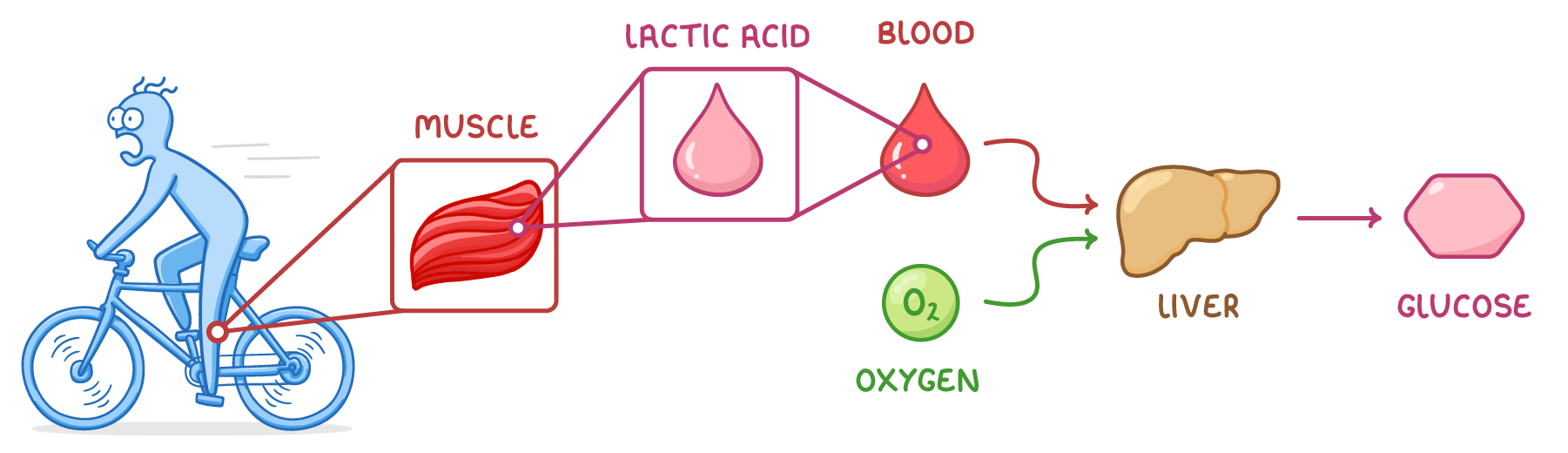
Clearing the lactic acid
- The blood transports the lactic acid to the liver.
- In the liver, the lactic acid is broken down using oxygen (aerobic respiration) and converted back into glucose.
- Pulse and breathing rate stay raised until the lactic acid and the extra carbon dioxide have been cleared, at which point they return to normal.
TermDefinition
Cardiac outputThe volume of blood pumped by one ventricle of the heart in one minute.
FatigueThe state where muscles grow tired and stop contracting efficiently.
Oxygen debtThe amount of extra oxygen the body needs after exercise to react with accumulated lactic acid and remove it from the cells.
Key points to remember
How were these notes?