2.1 - Levels of Organisation
Levels of organisation
- Cells are the basic building blocks of all living things.
- In a multicellular organism, cells aren't a loose collection - they're arranged into a hierarchy of increasingly complex levels.
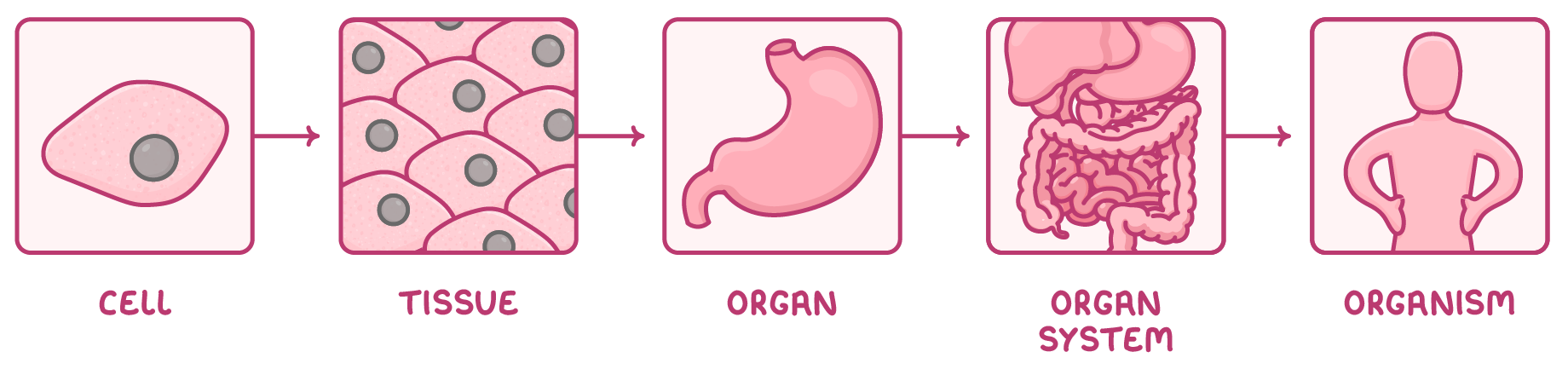
- The order, from simplest to most complex, is: cell → tissue → organ → organ system → organism.
- Below the cell sits the sub-cellular level - the sub-cellular structures inside each cell, such as the nucleus and mitochondria.
The five levels
- Cell - The basic building block of all living things.
- Tissue - A group of similar cells that work together to carry out a particular function, e.g. muscular tissue, which contracts to produce movement.
- Organ - A group of different tissues that work together to perform a function, e.g. the stomach, built from muscular, glandular, and epithelial tissue.
- Organ system - A group of organs that work together to perform a function, e.g. the digestive system, which breaks down and absorbs food.
- Organism - The organ systems together make up the whole organism.
TermDefinition
CellThe basic building block of all living things.
TissueA group of similar cells that work together to carry out a particular function.
OrganA group of different tissues that work together to perform a function.
Organ systemA group of organs that work together to perform a function.
Key points to remember
How were these notes?