2.5 - Digestive Enzymes
The three groups of digestive enzymes
- Digestive enzymes are biological catalysts - they speed up the breakdown of food without being used up themselves.
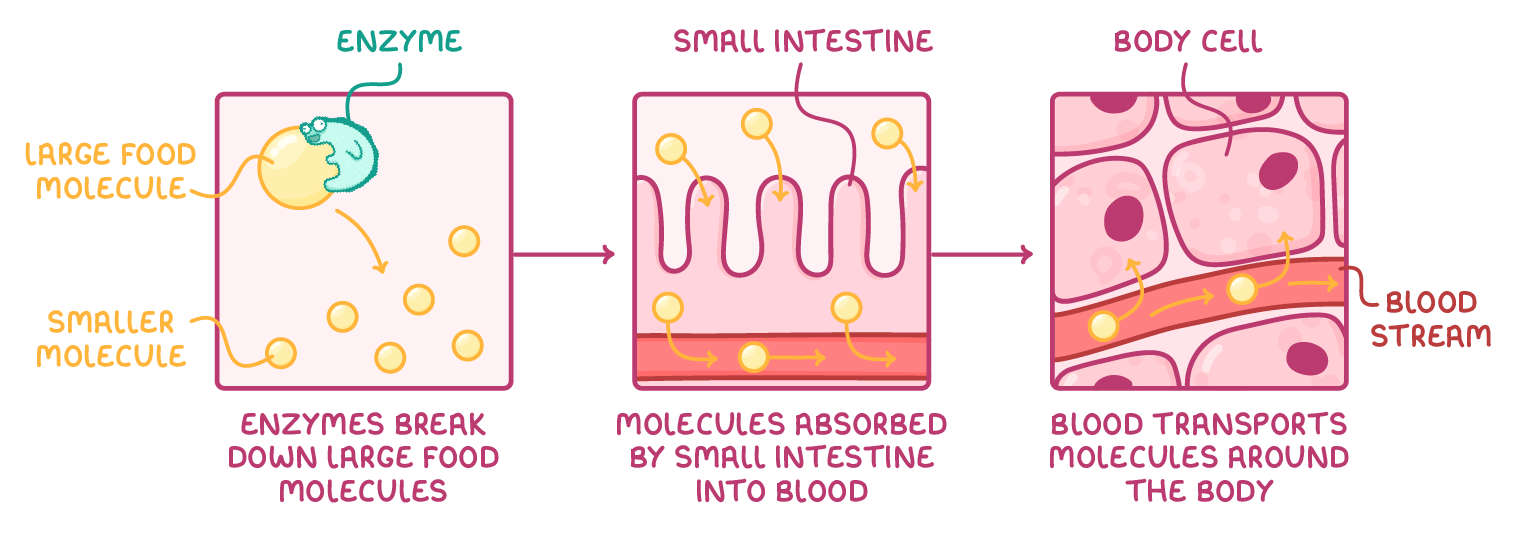
- Starch, proteins, and fats are big molecules that are too large, and mostly insoluble, so they can't pass through the wall of the digestive system into the blood.
- Digestive enzymes break these big molecules into much smaller, soluble ones, which can pass easily through the gut wall, be absorbed into the bloodstream, and be carried to the body's cells.
- Different enzymes break down different types of food, and there are three main groups.
The three enzyme groups and what they do
| Enzyme group | Breaks down | Into |
|---|---|---|
| Carbohydrases | Carbohydrates | Simple sugars |
| Proteases | Proteins | Amino acids |
| Lipases | Lipids (fats and oils) | Glycerol and fatty acids |
The carbohydrase example to know is amylase, which breaks down starch (a carbohydrate made of a long chain of glucose units) into sugars.
What the small molecules are used for
- The small molecules released by digestion are not waste.
- Once absorbed, the body uses them to build new carbohydrates, proteins, and lipids that it needs.
- Some of the glucose from digested starch is used in respiration to release energy.
Where digestive enzymes are made and act
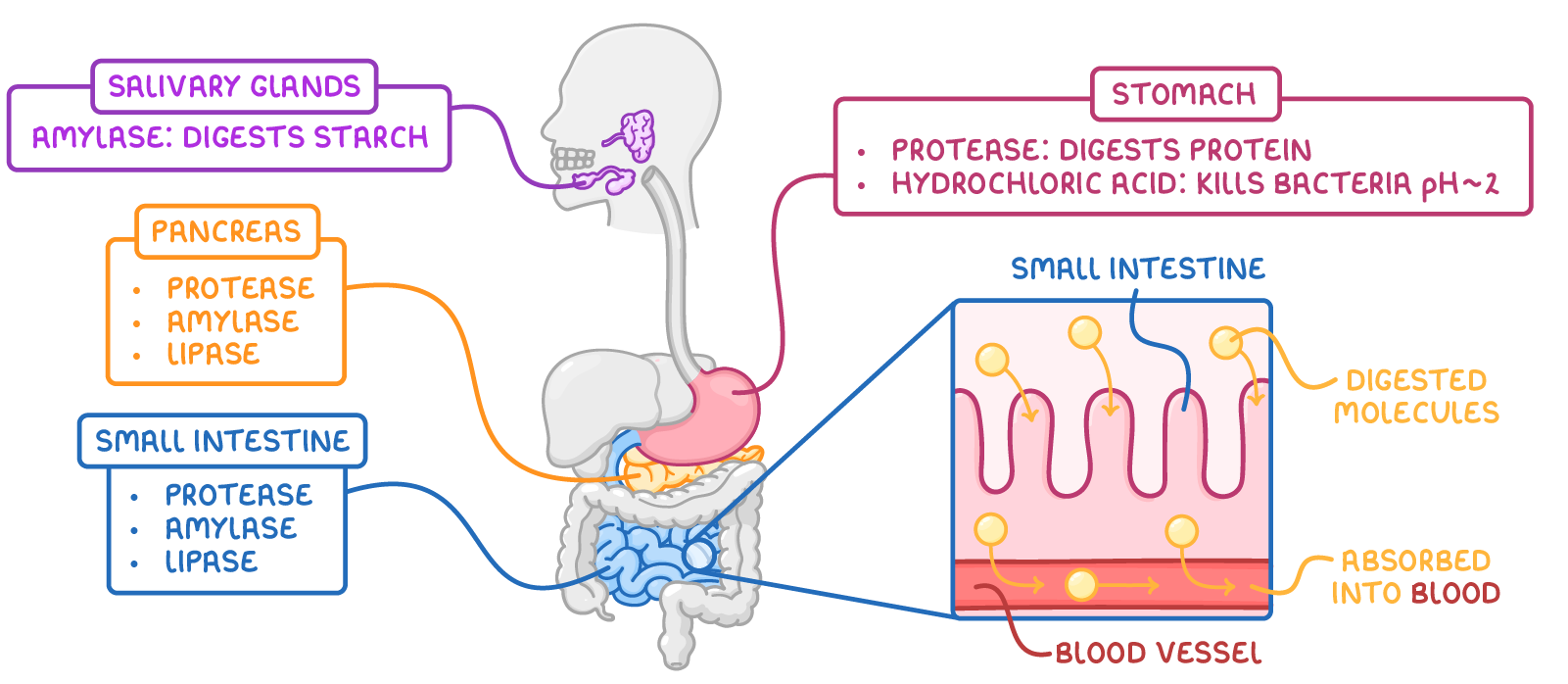
- Digestive enzymes are made by specialised cells - some in glands, some in the lining of the gut itself.
- They're released into the gut, where they mix with food and break it down.
- Each region of the digestive system makes its own enzymes.
Enzymes made in each region
- Salivary glands (mouth) - Make amylase in the saliva, which starts the digestion of starch.
- Stomach - Makes a protease to digest protein, and also produces hydrochloric acid.
- Pancreas - Makes all three kinds of enzyme - protease, amylase and lipase - and releases them into the small intestine.
- Small intestine - Makes its own protease, amylase and lipase to complete digestion.
The role of stomach acid
- The hydrochloric acid kills bacteria in the food.
- It also gives the strongly acidic conditions (about pH 2) that the stomach's protease needs to work.
Absorption in the small intestine
- Food passes from the mouth down the oesophagus to the stomach, then on to the small intestine.
- It's in the small intestine that the small, soluble products of digestion are absorbed out of the gut and into the blood.
Bile
- Bile is made in the liver and stored in the gall bladder, then released into the small intestine.
- It is not an enzyme, but it helps the digestive enzymes work. It does two jobs.
Job 1 - Neutralising stomach acid
- Food leaving the stomach is mixed with hydrochloric acid, which would make the small intestine too acidic for its enzymes to work properly.
- Bile is alkaline, so it neutralises the acid and makes the small intestine's contents alkaline - the conditions those enzymes work best in.
Job 2 - Emulsifying fats
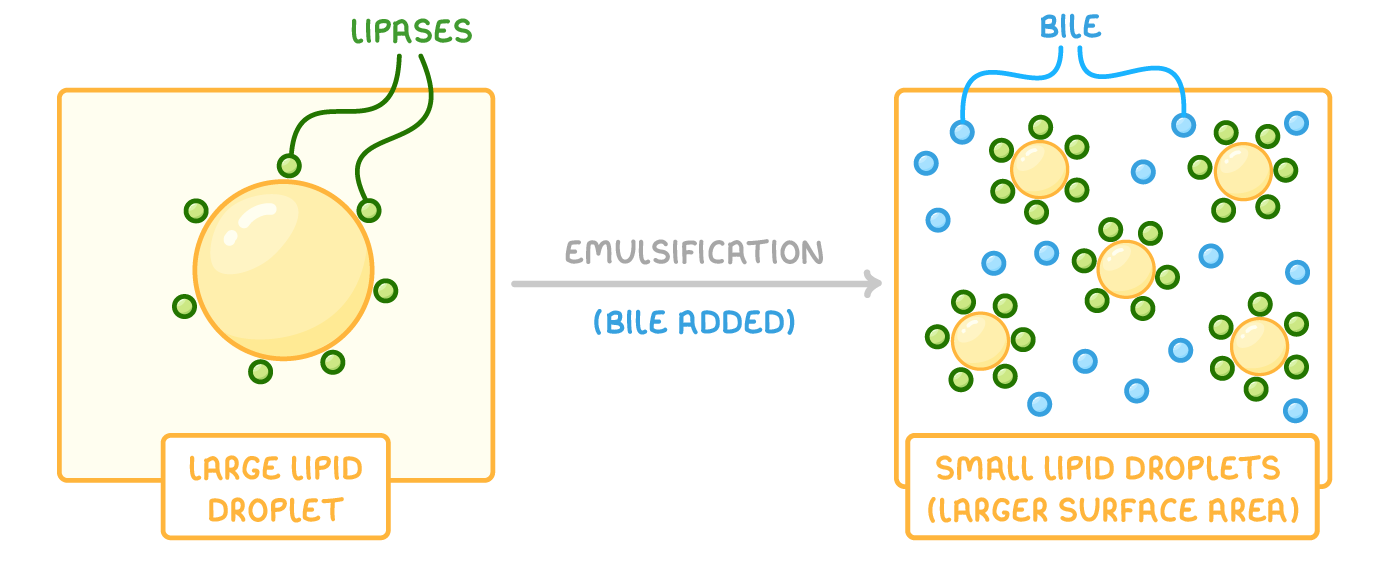
- Bile emulsifies fats (lipids): it breaks large drops of fat into many tiny droplets.
- These tiny droplets together have a much larger surface area than the few big drops did.
- This gives the enzyme lipase a far greater area of fat to act on, so the fat is digested much faster.
TermDefinition
CarbohydraseAn enzyme that breaks down carbohydrates into simple sugars.
AmylaseA carbohydrase enzyme that breaks down starch into sugars.
ProteaseAn enzyme that breaks down proteins into amino acids.
LipaseAn enzyme that breaks down lipids into glycerol and fatty acids.
BileAn alkaline substance made in the liver that neutralises stomach acid and emulsifies fats (breaks them into small droplets).
Key points to remember
How were these notes?