2.9 - Blood Vessels
The three types of blood vessel
- There are three main types of blood vessel, each with a different job.
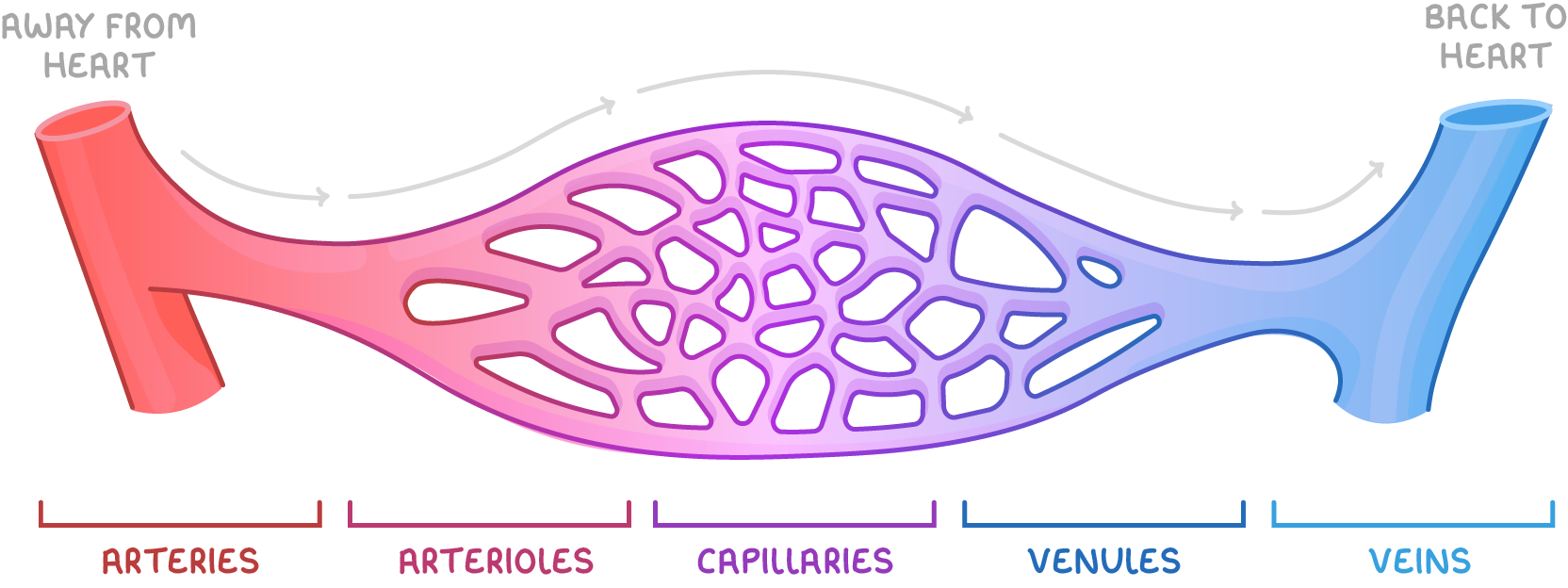
- Blood leaving the heart passes through arteries → capillaries → veins, then back to the heart.
The job of each vessel
- Arteries - Carry blood away from the heart to the rest of the body.
- Veins - Carry blood back to the heart.
- Capillaries - Tiny vessels that link arteries and veins. They carry blood close to the body's cells so materials can be exchanged between the blood and the tissues.
How the vessels connect
- Blood pumped out of the heart travels through arteries.
- Arteries branch into ever smaller vessels - the smallest are called arterioles.
- Arterioles lead into capillaries running through the tissues.
- Capillaries join up into small vessels called venules.
- Venules combine to form the veins that return blood to the heart.
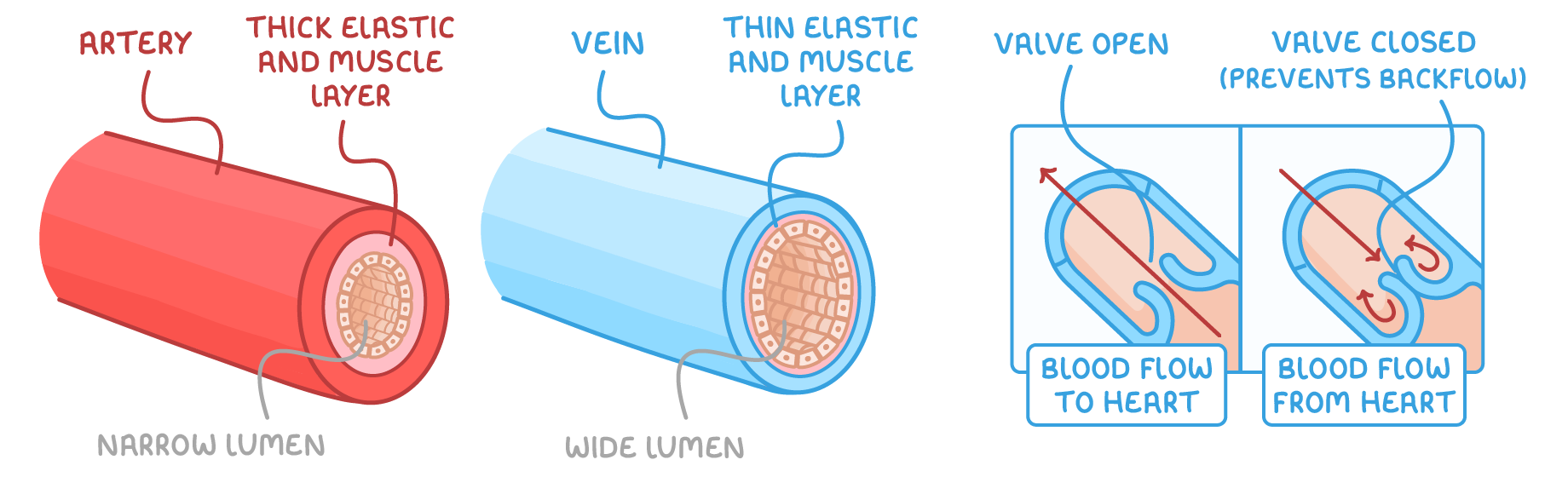
Arteries and veins - Structure related to function
- Arteries carry blood away from the heart at high pressure - the heart pumps it out in powerful surges.
- Veins carry blood back to the heart at much lower pressure - the blood has lost pressure passing through the capillaries.
- The lumen is the central channel that blood flows through.
How each vessel's structure suits its job
| Feature | Artery | Vein |
|---|---|---|
| Wall | Thick and strong, with thick layers of muscle and elastic fibres | Thinner, with less muscle and fewer elastic fibres |
| Lumen | Narrow | Wide |
| Valves | None | Valves at intervals along its length |
Why arteries are built this way
- The muscle gives the wall the strength to withstand the high pressure.
- The elastic fibres let the artery stretch as a surge of blood passes, then spring back, smoothing out the flow.
- The thick wall and narrow lumen together suit a vessel carrying blood under high pressure.
Why veins are built this way
- The wide lumen reduces resistance to flow, helping the low-pressure blood move easily.
- The pressure is too low to keep blood moving forward on its own, so veins contain valves.
- These one-way valves shut if blood starts to flow backwards, keeping it moving in the correct direction towards the heart.
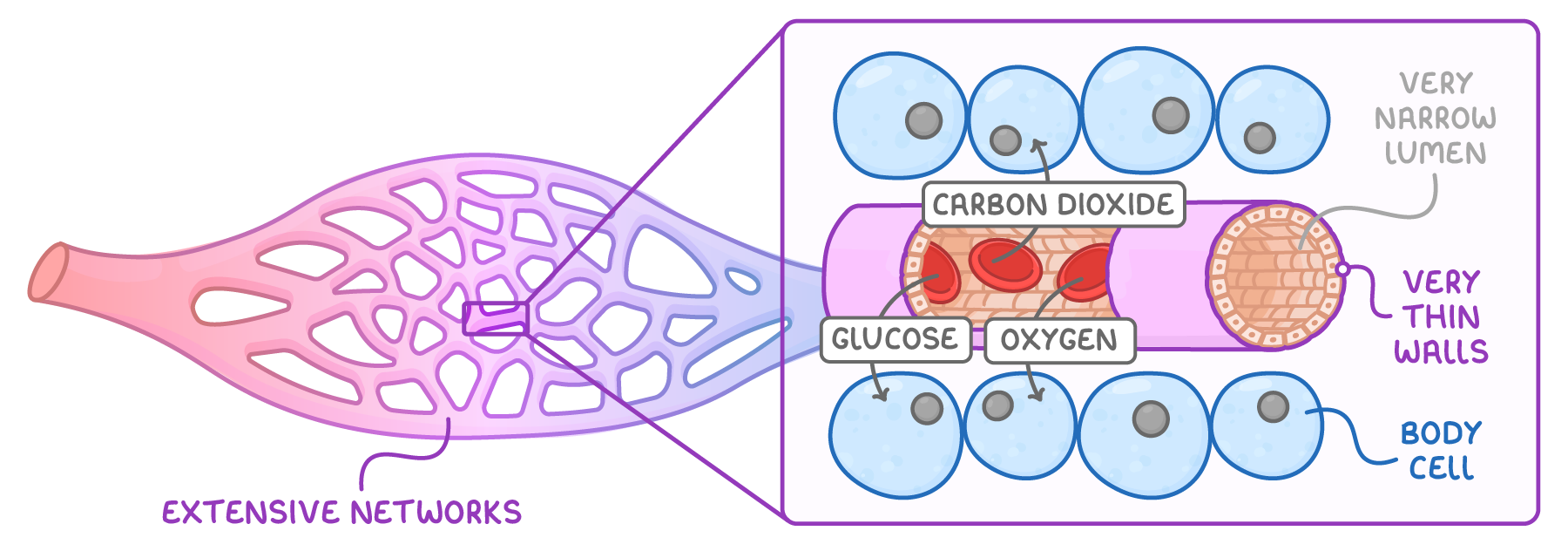
Capillaries - Structure related to function
- Capillaries are very small vessels in the organs that carry blood close to every cell, allowing substances to be exchanged between the blood and the tissues.
- Substances cells need - such as glucose and oxygen - diffuse out of the blood.
- Wastes such as carbon dioxide diffuse from the cells into the blood.
How the structure suits exchange
- Permeable wall, one cell thick - Substances have only a very short distance to diffuse across, and the thinner the wall, the faster the diffusion.
- Extensive networks - Capillaries run through the tissues in huge numbers, so together they provide a very large surface area for exchange.
A thin wall, a short diffusion path, and a large surface area together make capillaries efficient sites for exchanging materials between the blood and the body's cells.
TermDefinition
ArteryA blood vessel that carries blood away from the heart.
VeinA blood vessel that carries blood back to the heart.
CapillaryA tiny blood vessel where substances are exchanged between the blood and the body's tissues.
LumenThe central channel in a blood vessel that blood flows through.
ValveA flap of tissue in the heart or in a vein that closes to stop blood flowing backwards.
Key points to remember
How were these notes?